... with double gypsum I assume you always stagger the boards. I used existing studs; cross-laid 90x45 wooden studs, i.e., only 45 mm insulation.
No, I mean *the studs* staggered. Someone wrote earlier in the thread that you can make the outer studs 10 mm wider (a total of 55 mm for insulation) and place every other 45-stud towards room 1 and every other towards room 2. If I understood correctly.
ricnym said:
But the basic idea with soundproofing is that you should have as much mass as possible. So if you find a chipboard that weighs as much or more than a gypsum board, it should work (instead of OSB).
Plus, it should be completely airtight. So don't skimp on the sealant, for example, latex caulk which is relatively cheap.
OK, maybe gypsum+plywood is 'good enough' and go heavy with the caulk in other words!
Hello!
Here's some feedback on the discussion that will hopefully clear up any questions regarding the soundproofing of TS's partition wall.
The difference in sound reduction between 2 plasterboards vs. 1 plasterboard + 1 OSB is not that significant. The difference between a non-insulated stud cavity vs. an insulated one is, however, enormous.
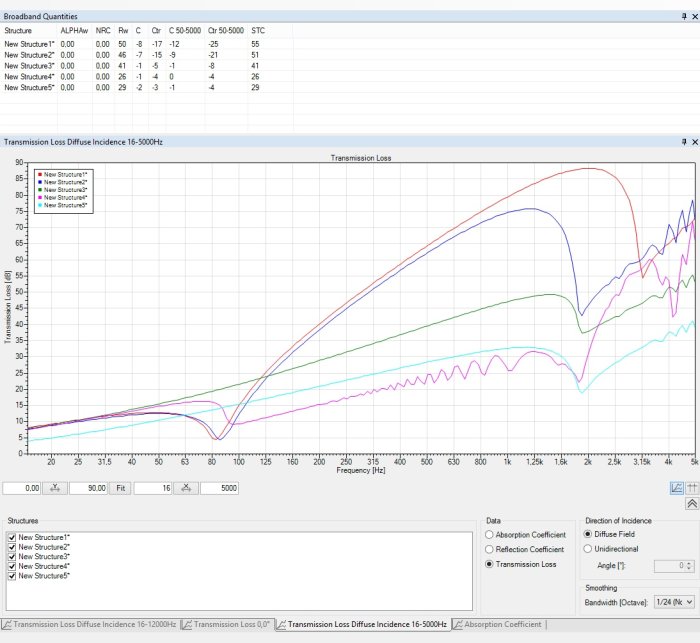
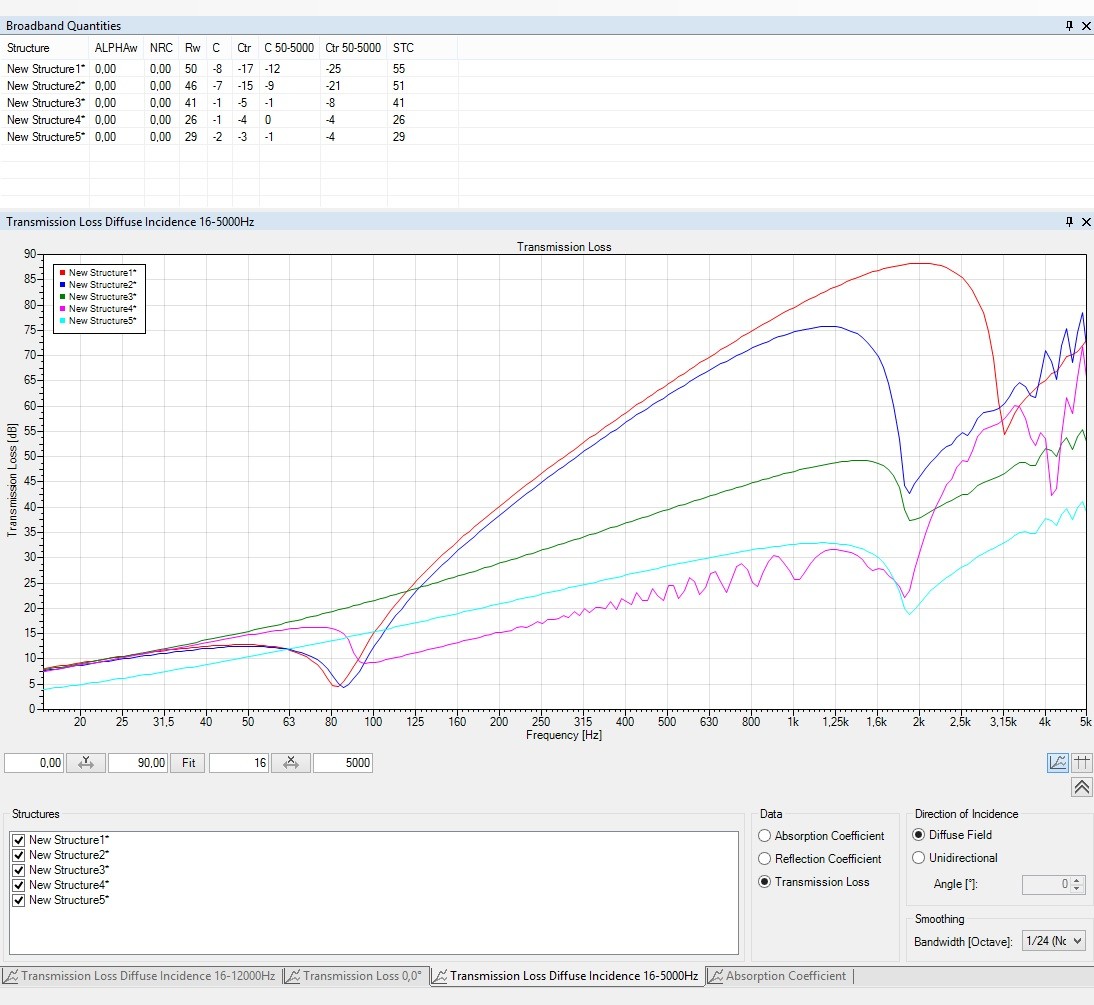
In the image below, we can see what happens with some different configurations. The calculations are based on the discussions held here in the thread, i.e., 45 mm staggered studs on a 55 mm base plate. Note that the practical sound reduction (R´w) is always lower compared to the theoretical calculations.
The blue curve shows the calculation for 2 plasterboards /45 mm mineral wool/ 2 plasterboards. The red curve shows 1 plasterboard + 1 OSB / 45 mm mineral wool/ 1 OSB + 1 plasterboard. As we can see, both constructions insulate poorly at low frequencies. The first resonance at 80 Hz is related to the air gap. Then both constructions insulate fairly similarly up to 1 kHz where the OSB variant experiences resonance earlier compared to the double plasterboard.
The green curve is calculated based solely on the mass of 4 plasterboards.
The pink curve shows what happens if we don't insulate the cavities. Quite a significant deterioration, in other words.
Some tips:
As previously mentioned, sealing is extremely important. The construction must be completely airtight. This also applies around door frames, cable penetrations, boxes, etc. If there are air vents, they need to be replaced with sound traps that match the intended wall construction.
The boards should always be laid in a staggered pattern and joined at studs.
Never use foam sealant, regular packing, or open-celled sealing strips in a soundproofing construction. Concerning insulation, mineral wool is preferable to glass wool. Flexibatt is always a good choice.
Alternatively, instead of making the outer studs thicker, you could plane off 5mm from the inner studs. That's if you're really looking to slim down the wall.
Yes, that's an interesting thought, if only I had a planer... I went to the nearest building supply store and looked for 10 mm battens but of course there weren't any. However, I saw a bunch of small boards used as separators in wood deliveries. They are about 1 m long and have a profile of 10x48 mm. I got them for free so I took a substantial bundle! Should work for adding on, just need to plane down a few mm right where the studs are placed.
Björn Melander said:
Here comes some feedback on the discussion which hopefully clears up any questions about the soundproofing of TS partition wall.
Wow, that was a detailed explanation I must say, thank you very much! Interesting that 4 layers of plasterboard (green curve) dampen better than 2+2 plasterboard with insulation in between, up to 100Hz.
What does the turquoise curve represent?
Have you mixed up the red and blue curve? Otherwise, it seems to me that red (plasterboard+osb) is better...?
It would be interesting to see a comparison between a) 55 mm baseplate + staggered studs and b) 45 mm baseplate + continuous studs.
What program are you using?
Sure, it looks good, but it seems completely impossible to get hold of. I can't find Ultra Board on any hardware store website. Moreover, they seem to only be available in 90*120 cm, so you'd have to splice both vertically and horizontally...Hmm...
What does the turquoise curve represent?
Did you mix up the red and blue curves? Otherwise, I interpret it as red (gypsum+osb) being better...?
It would be interesting to see a comparison between a) 55 mm sill + staggered studs and b) 45 mm sill + continuous studs.
Aha, good that you noticed that. The red curve should naturally be 2 layers of gypsum and the blue curve 1 gypsum + 1 OSB.
The turquoise curve only shows the properties of mass when mixing gypsum and OSB (2 gypsum+2 OSB). To be compared with the green curve which corresponds to the mass of 4 gypsum.
The staggered studs are crucial for sound reduction here. If you were to go with a shared stud, you could basically skip one side's board material with almost maintained sound reduction. That's how important the decoupling that the staggered studs provide is.
The staggered studs are crucial for sound reduction here. If you were to use common studs, you could almost skip the board material on one side with nearly the same sound reduction. That's how important the decoupling provided by the staggered studs is.
Feels like that settles it, the studs should be staggered!
Do you have any insight into sound reduction if you swap OSB for plywood? I'm still somewhat opposed to double drywall just because it's easier to screw into the wall if you have OSB or plywood behind the drywall. If the curve for drywall+plywood approaches double drywall, that would be great. Drywall+OSB is obviously significantly worse than double drywall...
You get roughly the same result if you replace OSB with regular K-plywood. If the plywood is of finer quality (higher density), the sound reduction improves.
You get approximately the same results if you replace OSB with regular K-plyfa. If the plyfa is of higher quality (higher density), the sound reduction improves.
If you are going to stagger the studs and also overlap the boards, how do you then screw on the outer board? In the joint, it will end up being screwed only into the inner board since there is no stud there.
Let's say you use plywood as layer 1, can you then screw the drywall (layer 2) just into the plywood in the joint, i.e., not into a stud?
In the middle of the drywall, there won't be any problem, as there will be a stud there, but the problem will be at the edge.
(It feels like this became a complicated question, hope you understand without me needing to draw a picture... )