You use half the stud spacing of course = twice as many studs. every other outer, every other inner.
Aha, I was thinking of being frugal and using regular stud spacing
But with twice as many studs, there will be no problem I realize now, thanks for the tip!
However, I'm wondering how you will solve the insulation when you have 55 between the panels. The staggered constructions I've seen have 90 outer studs and 70 studs. Then, they have insulated with double 45 panels overlapping. The overlapping insulation certainly contributes further to soundproofing as it eliminates all small gaps. But it will be much too tight in your case. And with single 45 panels, you get a gap. You might be able to press in single 70 panels, but then you'd have to cut them to length as well.
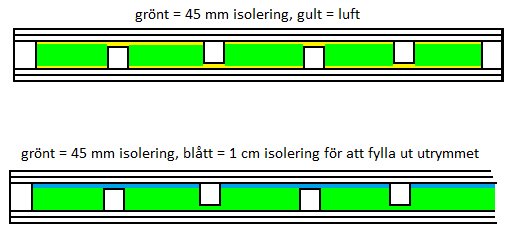
P.S. a small picture might make it clearer. Blue and green are standard 45 insulation panels.
However, I'm wondering how you will solve the insulation when you have 55 between the boards. The staggered constructions I've seen have 90 outer studs and 70 studs. Then they've insulated with double overlapping 45 boards. The fact that the insulation is overlapped certainly contributes further to soundproofing as it eliminates all small gaps. But that gets way too tight in your case. And with single 45 boards, you'll get a gap. You could possibly press in single 70 boards, but then you'd have to cut them lengthwise too.
P.S. A little picture might make it clearer. Blue and green are regular standard 45 insulation boards.
[image]
It's enough to fill the spaces between the studs with loosely packed insulation. In this case, 45 mm.
When you all just mention insulation, I want to highlight Isover Piano which is insulation specifically intended for soundproofing and is thus perfect for interior walls.
Great picture, cpalm!
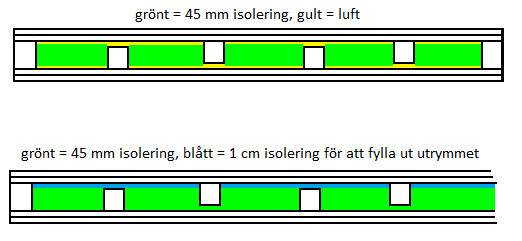
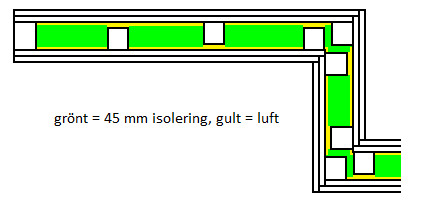
I modified it a bit so now I think it's pretty to scale how it should be for me.
I made 2 options, one according to Björn's option with 45 mm insulation and air otherwise.
The other option with 1 cm extra insulation to fill up the entire space. Maybe overkill, I don't know?
For sound insulation, mineral wool is better than glass wool. Mineral wool has, among other things, a higher volume weight versus glass wool when comparing at the same flow resistance. The flow resistance is what determines the material's sound absorption properties.
Isover, for natural reasons, is bound to glass wool products. In other contexts, glass wool might be preferable. It depends on the construction in question and the function the insulation is meant to fulfill.
Follow-up question, what happens when building sliding door frames? There will be a hole in the wall when the sliding door is closed. Can it be insulated in a smart way, or maybe it doesn't matter?
Taking the opportunity to ask a related question (hope it's not too OT).
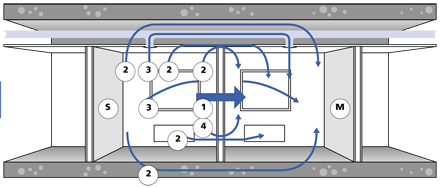
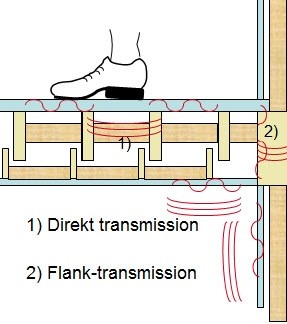
How significant are floors and ceilings and what can be done there, if sound is indeed transmitted that way? I don't mean between floors but between rooms via floors and ceilings ("under/over the wall" so to speak).
We did such a construction this past summer where we partitioned a room for the little guy who will be a teenager in a couple of years. Requirements for the construction = soundproofing (already plays PS4 in his room, has a satellite dish, etc., and already likes a bit of volume). The challenge we had was that it was in a house with many fun angles between the floor and ceiling, as well as between the long and short walls (old house). We used steel studs, extremely convenient to cut/attach, double plasterboard with OSB that we filled with insulation (45mm).
But don't forget, all the work you put into soundproofing the walls is completely wasted if you install a cheap door that does not dampen very much or if it’s not so snug around the frame. A whole wall that should be soundproofed is easy, but when it's "ruined" with a door, another challenge arises, so look carefully for a door with a frame that is soundproof, and be meticulous with the insulation around this. As previously written, be thorough everywhere in seams and openings if sound is important in the project; better to spend an extra couple of hours than to later feel, "why didn't I spend that extra time?"
Thanks for the tips Musto!
In fact, there shouldn't be any door in this wall
However, it should have two right angles (think of an 'S' with sharp edges). It will be a challenge to mount the studs in the corners so that they aren't continuous... But it should be doable! If I make a good drawing, I can upload it here.
Taking the opportunity with a related question (hope it's not too OT).
How significant are the floor and ceiling and what can be done there if sound is also transmitted that way? I don't mean between floors but between rooms via floor and ceiling ("under/over the wall," so to speak).
Sound takes all possible paths. To reduce flank transmission through walls, floors, and ceilings, you can notch the plasterboards and seal with flexible sealant so that the parts do not have direct contact. For example, if you put up a partition wall on a parquet floor, the sound will flank via the floor. Normally it might not be a major problem in homes, but it depends on what requirements you have.
If the wall is supposed to be angled (which it should be in my case) you should be able to do it like this to avoid the studs being continuous.
No no, this won't be overworked at all!
Vi vill skicka notiser för ämnen du bevakar och händelser som berör dig.