In connection with the demolition of the interior ceiling, a brownish old rockwool was found. Could this insulation contain asbestos? I have no idea how old the RockWool is, but it's certainly of the older kind.
I found this online, hence my question:
"I tested some rock/mineral wool about 18 years ago & found asbestos. Based on that finding, I then recommended testing on the next (approx.) 500 houses I found that had rock wool. None of the material tested was ACM. I know that it (rock wool) can be ACM, but I think the percentages are pretty small."
Honestly, Stina, isn't it time you seek help for your anxiety?
According to the text you quoted, asbestos has been found in 1 in 500 houses. There is nothing to suggest that your insulation would contain asbestos. The only way to know for sure is to send in a sample for analysis.
The biggest health hazard here is probably the stress you're subjecting yourself to by constantly worrying that every little stone you lift might contain asbestos. Seek help for this and spare yourself this torment.
Of course, you should still wear a mask when you remove old insulation. Mice and mold spores are not healthy things, but you don't need to worry about asbestos.
It's been "a long time" since I last asked about asbestos. However, I've asked questions about completely different things lately, so I don't see anything strange with now asking yet another question about asbestos. A question like any other.
I am very aware of all my previous questions on the subject, but for that reason alone it feels unfortunate that the focus is on commenting on my so-called anxiety. I'm looking for answers to the matter at hand. Thought maybe someone knew.
The easiest way is to call/email Rockwoll directly and attach any images, so you can find out if they used asbestos in Sweden and during which period, as well as if there are any distinct characteristics of how it looks.
Give feedback once you've received a response.
It's easy to miss all the details in moments of worry.
It is clearly stated that two products from Rockwool, where asbestos was used, are known. Both are cement products, not the wool itself.
Products
Two products manufactured by Rock Wool known to contain asbestos include One Shot and Delta Maid AF. Both of these items are insulation cement products and were likely used to help secure pipe insulation.
The person in the forum finding asbestos in 1 out of 500 houses may possibly be explained by that particular house having contamination from another asbestos source, which could then possibly have contaminated the wool in that specific house.
If there had been asbestos in old rock wool here in Sweden, it would probably be more well-known; there are few things as thoroughly investigated as asbestos. A Google search yields no Swedish results, only some automatically translated ones.
“Rock wool” is made from mineral fibers manufactured from stone and waste from mining. It consists of aluminum silicate rock (basalt), furnace slag, and limestone or dolomite.
Since mineral wool is a man-made fiber, it does not contain asbestos (which is a naturally occurring fiber)
[link]
Sure, there is a possibility that traces of asbestos can be found in the mineral wool since the ingredients partly come from leftover material from mines. But that would only be if there is unknowingly a pocket or vein with asbestos in the same mountain that the mine is extracting from, thereby getting traces of asbestos in the production. However, these should be considered as rare mistakes. Mineral wools/rock wool are not expected to contain asbestos.
If there had been asbestos in old rockwool here in Sweden, it would probably have been more well-known, there are few things as well-investigated as asbestos. A Google search gives no Swedish hits, only some automatically translated ones.
Yes, it should have been known.
The manufacturing process is also likely to have been the same in Sweden, so foreign facts very likely apply in Sweden too.
To add:
The first step in the manufacturing process of stone/mineral wool includes, among other things, heating the material to temperatures between 1300-1650°C
The first step in the process involves melting the mineral feed. The raw material (slag and rock) is loaded into a cupola in alternating layers with coke at weight ratios of about 5 to 6 parts mineral to 1 part coke. As the coke is ignited and burned, the mineral charge is heated to the molten state at a temperature of 1300 to 1650°C (2400 to 3000°F).
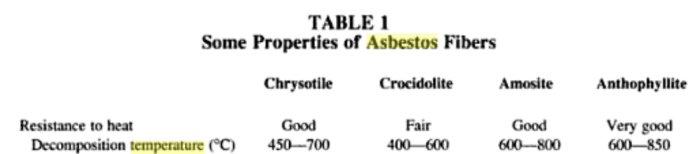
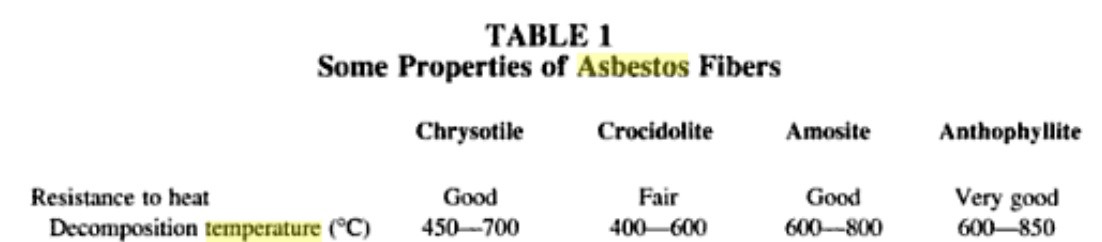
Science shows that asbestos loses its durability and begins to break down at temperatures between 400 to 800 °C
and are destroyed at temperatures above 1000 degrees Celsius.
Asbestos minerals, despite a relatively high fusion temperature, are completely decomposed at temperatures of 1000 deg C. Link
It is likely that the asbestos fibers lose their durability and transform into harmless magnesium silicate, phosphorite, etc., due to the extreme heat in the melting process during the production of mineral wool.
Click here to reply
Vi vill skicka notiser för ämnen du bevakar och händelser som berör dig.