That's what we have regulatory authorities and limit values for. All products on the market should be reasonably safe to use. Then, of course, there can still be exceptions, but nothing in life is risk-free.
Furthermore, unfortunately, our knowledge about different chemicals and their effects is quite limited. We have only conducted studies on a small fraction of all those used, although it is improving over time. So using old chemicals is the safest. That's precisely what the TS found here, i.e., that Byggmax advertises that their boards are formaldehyde-free. And formaldehyde is a tricky chemical in building materials, but it took us a few years to understand that. BUT instead, the low-cost manufacturers have used something else. (A bit like with "asbestos-free" brake pads).
In general, though, one can rely on limit values for most things, or at least a lot. Especially old ones like these.
That's what we have regulatory authorities and threshold values for. All products on the market should be reasonably safe to use. Of course, there may still be exceptions, but nothing in life is risk-free.
Yep, life is absolutely not risk-free... It has a 100% mortality rate.
But if you're doing everything to have as few chemicals as possible in the construction, isn't it smart to use råspont on the walls instead of osb? And maybe råspont on the floor? Then it's very little poison...
And why not use regular untreated wood on the facade? And paint with falurödfärg?
Yep, life is definitely not risk-free... There's a 100% mortality rate.
But if you're doing everything to have as few chemicals as possible in the construction, isn't it smart to use raw planks on the walls instead of OSB? And maybe raw planks on the floor? Then there's very little poison...
And why not use regular untreated wood on the facade? And paint with Falu red paint?
Yes, but then you get other problems. For example, cost... And warped floors over time.
And "as few chemicals as possible" is not necessarily the best strategy either. Preservatives, etc., prevent many natural processes that create even worse toxins if left unchecked (mold is, for example, a major culprit here).
And it's interesting to read the safety data sheet for Falu red paint, versus, for example, one of Flügger's wall paints. According to the data sheet, Falu red is more dangerous... It contains, for instance, lead. A metal we are much more restrictive with today than before. On the other hand, Flügger's data sheet has more "data missing". So it's actually difficult to assess the risks based on the available data. It's not obvious that Falu red paint is better. (I personally choose against Falu red because I don't want it on my clothes...) And of course, it's far from certain that the difference is big enough to make any difference. It probably isn't. But that's a guess.
So as usual, no matter how you approach it, you still have the same problem. As mentioned, life is 100% deadly.
But if you do everything to have as few chemicals as possible in the construction, isn't it smart to use raw plank on the walls instead of OSB? And maybe raw plank on the floor? Then there's very little poison...
And why not use regular untreated wood on the facade? And paint with falurödfärg?
Raw plank contains terpenes which are toxic and allergenic. Admittedly, it's almost completely harmless as a building material based on experience, but it shows that you can't just look at the content to determine what is dangerous.
In the kitchen I'm renovating now, we've chosen an oiled plank floor, lime-plastered walls, linseed oil emulsion paint, the kitchen cabinets have frames and doors made of pine/glulam, and I chose flax insulation when I installed studs on the walls to bring in electricity. However, I put OSB and drywall on these walls. I wish I had used plywood at least...
It's a bit nice trying to use materials that are pleasant to work with, seem good for nature and health, and have a long lifespan and a cyclical mindset... I've done what I can anyway, even though there might be something toxic in what I've chosen...
In the kitchen I'm renovating now, we've chosen hard waxed plank flooring, lime plastered walls, linseed oil emulsion paint, the kitchen cabinets have frameworks and doors in pine/laminated wood, I chose linen insulation when I framed the walls to install electricity. However, I put OSB and gypsum on these walls. I wish I had used plywood at least...
It's a bit nice to try working with materials that are pleasant to work with, seem good for nature and health, and have a long lifespan and circular economy... I've done what I can anyway, even if there might still be something toxic in what I've chosen...
Yes, linen in furniture, etc. tends to mold, for instance... So it's not necessarily a step forward. But with proper anti-mold treatment, it's probably OK!
And linseed oil paint releases formaldehyde when it dries!
But, the levels are low, below the limit values, and temporary, so that's probably not a risk either. But, on the other hand, one might be able to say the same about many modern paints too.
And plywood is a better material than OSB (to hang cabinets on, etc.), but if it's that much better that it makes any difference generally, and from a health perspective, I'll leave unsaid. It's probably more important who made the board and from what.
Yes, it has been discussed earlier that the treatment that isolina does is not entirely certain to be completely harmless...
As mentioned, one has to do the best one can as a layman. Unfortunately, it seems the competence among "ordinary" builders regarding this is lacking. I feel a bit like a troublemaker who wants to use more traditional methods and materials... But if it's worked for 100 years, it will probably work for a while longer, I think...
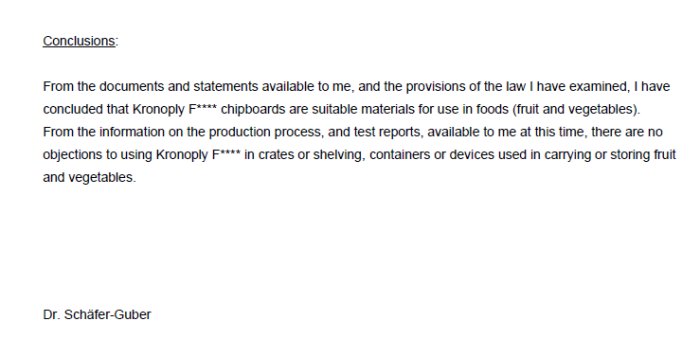
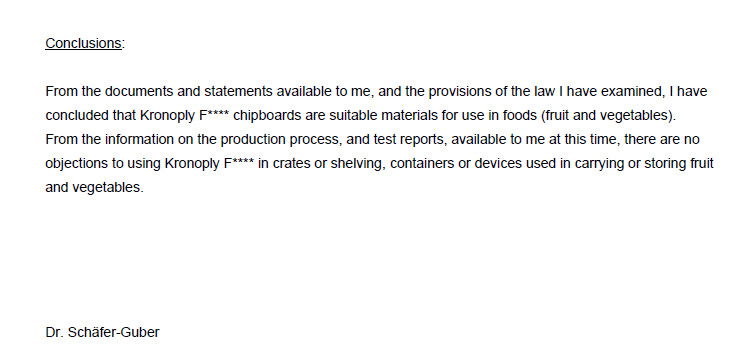
Just received a response and PDMI from SWISS KRONO (Kronoply) which produces the formaldehyde-free OSB that Byggmax sells for 105 SEK/sheet. What can be said about this?
Dear Mr. Kiander,
PMDI is a Polyurethane-based glue. You could also find this material as foam in the mattress of your bed or your sofa, in the armature of your car.... But such products are 100% made of that, and in our boards, it is only 2.5%! After bonding, this glue is emission-free and neutral to the environment. Because of that, the OSB can also be used for food packaging (find a certificate attached).
I hope this would answer your question. If you need more information please do not hesitate to contact us.
Mit freundlichen Grüßen / Best regards
Stefan Gottfried
SWISS KRONO GmbH
But if it has worked for 100 years, it will probably work for a while longer, I think...
Yes, that is one way to look at it. But it is complicated by the fact that the surroundings have changed. We build houses with different requirements for draft protection, in different places, and compose and use it in different ways than traditionally. (Torpargrunder worked excellently, for example, on cottages, where there was an ineffective open fireplace that heated the foundation. In modern houses, it became a problem). So using old methods in new(er) houses can lead to more problems than it solves.
So even that is a rule of thumb with some big and important exceptions.
In summary: Old or modern, you take risks with everything you do. If you just try to avoid the known risks, you have probably done the best you can. It's probably not meaningful to try to do much more.
Got an answer from PDMI from SWISS KRONO (Kronoply) who produces the formaldehyde-free OSB that Byggmax sells for 105 SEK/board. What should we say about this?
Well, that polyurethane is a fairly well-known substance by now. BUT it's probably not the PU itself that is the issue, if there even is one, but the additives (if there are any). So what are they? And what do we think/know about them? We've been using PU adhesive as such for quite a while in Europe and we haven't seen any decisive risks.
BUT personally, I don't think it's that dangerous. Or rather, that it would be more dangerous than anything else. However, that's my unsubstantiated opinion.
Yes, that's one way to look at it. But it's complicated by the fact that the environment has changed. We build houses with different requirements for draft-free design, in different locations, and we compose and use them in different ways than traditionally. (Crawl space foundations, for example, worked excellently in cottages, where an inefficient open fireplace heated the foundation. In modern houses, it became a problem). So using old methods in new(er) houses can lead to more problems than it solves.
So that's also a rule of thumb with some big and important exceptions.
In summary: Old or modern, you take risks with everything you do. If you just try to avoid the known risks, you've probably done as well as you can. It's probably not meaningful to try to do much more.
My house is 100 years old, so hence I believe in continuing the established path... I would have thought differently regarding methods and materials if it was a new house... however, I would still prefer to use "giftfritt" if I could...
Rough boards contain terpenes that are toxic and allergenic. Admittedly, largely harmless as a building material based on experience, but it shows that you can't just look at the contents to determine what is dangerous.
I foolishly thought that rough boards were just ordinary planed wood with tongue and groove... I didn't know that a lot of chemicals were pressed into it.....
Vi vill skicka notiser för ämnen du bevakar och händelser som berör dig.


 And warped floors over time.