
71,377 views ·
259 replies
71k views
259 replies
Newly laid floor flexes on 3 floors and in all rooms
It says all painting SHOULD be done before laying the floor, not shall.X Jeppan said:What it really says is that it is important that indoor humidity does not exceed 60%. If you have been airing out during this summer and especially for long periods, you have definitely made the indoor climate far over 60% rh, which you then trapped when windows and doors were closed. Is it also an older house with natural ventilation? Then the indoor environment is likely to have been suboptimal for the floorboards for long periods; it's hard to ignore.
It also explicitly states that all painting should be done before laying the floor.
It's silly, as someone mentioned in a comment above, to criticize those who are trying to find explanations for why this happened. There is clearly a possible explanation here. It shouldn't have to be this way; perhaps another floor would have withstood this. But now the situation has indeed arisen, and the reasonable explanation seems to be long periods with too high humidity in the house. Who the responsibility then falls on? That's something worth considering.
All plastering and all painting of ceilings, moldings, frames, etc., are done before laying the floor; all walls that needed painting received their first coat before the floor was laid.
Wallpapering and the final coat of paint on walls that should be painted are done after the floor is laid, to be able to release wallpaper on the baseboard and to paint all frames and baseboards.
Who has said that RH was over 60% or under 30%? What has been said is that during the time the floor was laid, RH was not over 55%, as the carpenter had control over it during the time the floor was laid, and that's the only time it can be managed.
How do you handle re-wallpapering and painting?
Do you remove the existing floor, wallpaper, and paint and then lay the floor again?
Or do you cover the floor, plaster, wallpaper, and paint?
How do you manage in all existing houses when RH rises during the summer? Do all the floors warp there, and do gaps appear?
The only thing you can control is RH during the time the floor is laid, then it is what it is; having a bigger difference in RH indoors compared to outdoors during summer is almost impossible unless you do something to drive up the indoor humidity.
And then you contradict yourself by saying one shouldn't air out, and then it says "air out" in the text you linked to. It makes one wonder if you work for the floor supplier? Belt, braces, life vest, and parachute to avoid taking any responsibility at all?
Last edited:
You are over-interpreting what I am saying.P Peter Petterson said:It states that all painting SHOULD be done before laying the floor, not shall.
All plastering as well as all painting of ceilings, moldings, frames, etc., is done before laying the floor, all walls that were to be painted received their first coat before the floor was laid.
Wallpapering and the final coat of paint on walls that should be painted were done after the floor was laid, this is in order to be able to release wallpaper on the skirting and to be able to paint all frames and skirting boards.
How do you go about repainting and wallpapering?
Do you remove the existing floor, wallpaper, and paint, and then lay the floor again?
Or do you cover the floor, plaster, wallpaper, and paint?
How do you do it in all existing houses when RH rises during the summer, do all floors warp and gaps appear there too?
The only thing you can control is RH during the time the floor is laid, afterward, it is what it is, having a greater difference in RH indoors compared to outdoors in the summertime is almost impossible unless you do something to increase the indoor humidity.
Then that you contradict yourself about not airing out and then it states "air out, please" in the text you link to makes one wonder if you work for the floor supplier?
My belief is that it all comes down to humidity, and obviously, conditions can arise where it tips over and becomes too much for the floor. This summer has been more humid than usual, it's been very clear here.
The note about painting is probably because the paint releases moisture when it dries. It can likely become a contributing factor if you paint large parts of the house at once. It can obviously be a contributing factor to these issues arising, even though likely in 99% of cases, it doesn't lead to any problems.
Regarding airing: here, I am not sure. But I imagine that the house would have fared better by not leaving doors and windows wide open, for example, when it rains and there is 100% humidity outside. Just like Kährs writes that excessive airing when the humidity is low can result in too low humidity indoors. When no one lives in the house, there probably isn't any circulation of air, for instance, during evenings and vacation time. I don't think the problem would have arisen if you had mechanical ventilation.
Clearly, it's difficult to analyze, and as mentioned, many factors have likely played into the final result here.

I think it's quite impossible to maintain any direct difference in humidity indoors compared to outdoors. With normal ventilation, the air inside is replaced several times a day, and then the humidity inside should basically become the same as it is outside.X Jeppan said:
I can have a very large difference indoors compared to outdoors, but I only have natural ventilation except for fans in the kitchen and bathroom that run as needed. Normally, you measure relative humidity, and then the temperature affects it quite a bit even if the amount of water in the air doesn't differ dramatically. I have meters in different places, and right now it's 82% outside in an open shed under a roof (13.7C) and 40% indoors where I am sitting (27C, attic room with computers that heat it up). If I check the coldest and dampest room on the ground floor, it's simultaneously 60% (20C). No heating or AC is on.Alfredo said:
Edit: Thinking about it, it's been much more extreme at certain times this summer, which has been very wet. I remember it being 95% outside despite a fairly high temperature, felt like a steam bath going outside. This was after 2 weeks of more or less continuous rain (and proximity to water). Simultaneously, I was around 30% in the warmest room on the second floor despite windows being ajar (I think it was around 30C, never usually goes higher).
The conclusion you can draw is that it's very difficult to say for sure how it is for someone else. You have to measure.
Edit: The logs I find don't show such large differences, but I don't have any data before mid-June unfortunately:

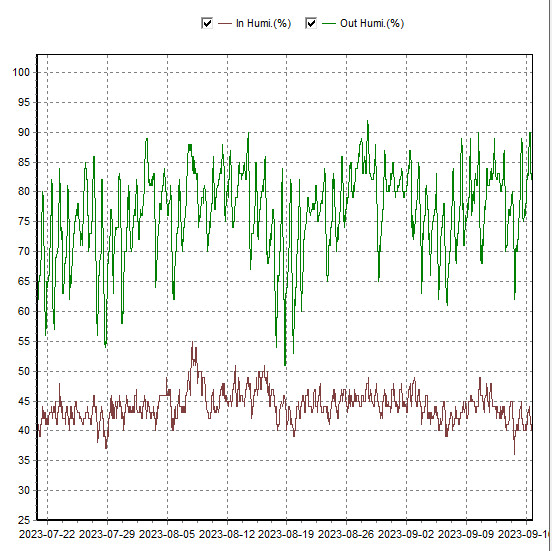
Last edited:
Yes, I was thinking about airing earlier in the summer when the indoor and outdoor temperatures were more similar. Then I don't know if that has been clearly stated in the thread or if it's just something I've assumed... 😳MultiMan said:
Then I guess natural ventilation often, especially in summer, provides significantly poorer air exchange than what Boverket considers right.
was out looking at the newly laid floor in the Attefall house today as well.
Same situation there, short seams that have separated and the floor has lifted so that it gives way.
No underfloor heating in the Attefall house, but there is an air heat pump that has been set at 18c and has run when needed.
So I no longer believe it has to do with the underfloor heating pipes.
Will buy some feeler gauges and measure how much the seams have slid apart.
Same situation there, short seams that have separated and the floor has lifted so that it gives way.
No underfloor heating in the Attefall house, but there is an air heat pump that has been set at 18c and has run when needed.
So I no longer believe it has to do with the underfloor heating pipes.
Will buy some feeler gauges and measure how much the seams have slid apart.
Self-builder
· Stockholm
· 10 435 posts
When was the floor supposed to be inspected?
Hi,R Robert-san01 said:
Inspection is booked for Thursday, Sep 28, pretty much exactly a week from now. I've put a halt on any further renovations in the house until this is done.
However, I'm really eager to finish everything and move into the house I've been renovating for 6 months and invested an enormous amount of money in.
But, we'll just have to hold on and wait for the inspection and then take it from there.
Attaching a short video of the springiness in one of the spots in the house.


Oh, that floor is going to move a lot. No wonder it bounces. It won’t even need to creep towards the walls to start bulging.
I would (unfortunately) argue that it's the wrong floor to lay over such large areas. I would have left 15-20mm around and placed a cross-laying board (threshold) in the doorways to prevent it from lifting. As a carpenter, I would have said no to laying the floor like in the pictures.
That said, maybe there are flooring specialists who have secret tricks. I mostly dealt with custom-built wardrobes and kitchens. But I've laid a floor or two.
I would (unfortunately) argue that it's the wrong floor to lay over such large areas. I would have left 15-20mm around and placed a cross-laying board (threshold) in the doorways to prevent it from lifting. As a carpenter, I would have said no to laying the floor like in the pictures.
That said, maybe there are flooring specialists who have secret tricks. I mostly dealt with custom-built wardrobes and kitchens. But I've laid a floor or two.
I think it's the humidity causing issues. I've had a piece of plywood lying outside and it's painted with facade paint on one side. It bends according to the weather changes. The underfloor heating also poses a risk factor as it lowers the relative humidity on the underside of the floor. Maybe it will stabilize over time.
I think so too, and with a completely sealed base, you can't correct it with ventilation gaps or holes.H HasseU said:I think it's the humidity that's causing issues. I've had a piece of plywood lying outside and it's painted with facade paint on one side. It bends with the weather changes. The underfloor heating also poses a risk factor as it lowers the relative humidity on the underside of the floor. Maybe it will stabilize over time.
But it might get better over time, perhaps. I hope so because you can see that a significant amount of work has gone into it.
The living room is in one sweep and doesn't connect with the kitchen or hall. There is a transition joint in the portal from the living room to the hall.Pär Sköld said:
Wow, that floor is going to move a lot. No wonder it flexes. It won't even require it to creep towards the walls for it to buckle.
I would (unfortunately) claim that it is the wrong floor to lay on such large areas. 15-20mm all around and a cross-laying board (threshold) in the doors would be necessary to prevent it from rising. As a carpenter, I would have said no to laying the floor as in the pictures.
That being said, there might be flooring experts with secret tricks. I mostly worked with custom-made wardrobes and kitchens. But I've laid one or two floors.
But it might still be too large an area to lay in one sweep. It flexes just as badly in the living room and hall as it does in the kitchen, unfortunately.
Yes, maybe it gets better over time. But the underfloor heating, damn, how much is it really working; it's been June, July, August, and it hasn't needed to work much. But I could, of course, be wrong, it has happened beforeH HasseU said:I think it's the humidity causing issues. I've had a piece of plywood lying outside, painted with facade paint on one side. It bends according to the weather changes. The underfloor heating is also a risk factor as it lowers the relative humidity on the underside of the floor. Maybe it stabilizes over time.

The floor is probably only treated on the surface, I assume. Regardless of the underfloor heating, it may be that it's still the most humid on the surface just below the finish and that's why it rises. The cracks you have also show that the floor has weathered. Over time, it should even out. But the problem is you don't have time to wait.P Peter Petterson said:
But the floor is buckling in all sorts of rooms, even in an attefallare? You can't claim that this is a floor that can't be laid in a standard room, can you?Wow, that floor is going to move a lot. No wonder it flexes. It doesn't even need to expand towards the walls for it to buckle.
I would (unfortunately) argue that it's the wrong floor to lay on such large areas. 15-20mm around and a crosswise board (threshold) in the doorways I would have laid to prevent it from rising. As a carpenter, I would have said no to laying the floor as shown in the pictures.
That being said, maybe there are floor specialists with secret tricks. I mostly dealt with custom-built wardrobes and kitchens. But I've laid a floor or two.