
71,377 views ·
259 replies
71k views
259 replies
Newly laid floor flexes on 3 floors and in all rooms


Do you know if they routed the joints?
Yes, that's how it is. I got an oak floor that had a completely different color; it was supposed to be light brown to medium brown, with a slightly brushed surface. The floor that arrived was more in white with a lilac tone. The brushing was, in comparison, fine file to coarse rasp. Kährs' response was that this can happen. You have to accept shade variations but not different colors, and the brushing was completely different. Toothpick cleaning. Never again Kährs after that response. There's no point in them having samples in the store when the delivery is completely different.D Danne213 said:
Sometimes small differences can occur in the joints between the chipboard. There, some glue residues can gather, preventing the boards from settling completely. I don't think you have that problem. It looked seriously well-laid.P Peter Petterson said:
My guess is that the floor joists are not completely even, or the pipe isn't sitting correctly in the groove. When I laid my hallway, I had to adjust the pipe as it expanded when it got warm, and I had creaking sounds in different places. I had to go over with a router to make the grooves a bit larger in the bends so the pipe would lay properly in the groove.
Yes, definitely it needs to be straightened, but the question is why it's so crooked to begin with?P Peter Petterson said:Yes, there's no doubt the old floor structure is bad. Probably why it was straightened and new joists were installed?
I've been measuring the humidity since the problem was discovered, and in the last few weeks, it's been at 55% max and as low as 35% at minimum.
Sure, there are much more expensive floors but also much cheaper ones. When it's 250 m2 of flooring that needs to be purchased, there's a huge difference in the final sum if you buy flooring for 400 SEK/m2 or 1200 SEK/m2, such a big difference that you could lay the floor again and still afford to hire craftsmen to install it again and have money left for a nice vacation.
In the worst case, you've just added more dead weight to the structure. Do the new 120 joists have supports or are they just screwed into the existing ones? Is there any KA or K involved in the construction, or have your own solutions been used?
I know I asked you earlier in the thread about how long a stretch was in a room. Is there a load-bearing wall under that structure? I remember you wrote 4 meters of span?
Then you're right that the per m2 price of flooring has gone up insanely in recent years. "Back in the day," 400/m2 was considered expensive. Now it's seen as budget type 🤔
The new joists have been screwed into the existing ones and glued. The carpenter has had free rein to do whatever needed to be done to level the floors. The carpenter has been on an hourly rate and there's been no stress or time pressure. I've told everyone involved more than once that I'd rather have it done well than quickly.D Danne213 said:Yes, absolutely it needs to be adjusted, but the question is why it is so crooked from the start?
In the worst case, you've only added more dead weight to the joists. Have the new 120 joists been supported or are they only screwed into the existing ones? Is there any Construction Manager or Engineer involved in the construction, or are your own solutions being used?
I know I asked you earlier in the thread about the span of a distance in a room, is there a load-bearing wall under that floor? I recall you wrote about a 4-meter span?
And you're right that the price per square meter for flooring has gone up like crazy in recent years. "In the past," 400/m2 seemed expensive. Now it's considered budget type 🤔
I've paid and looked happy, so to speak, and no engineer has been involved or requested.
How the load-bearing walls are placed, etc., is not something I've engaged with or thought about 🤷♀️.
But since 2.5 million has been spent on interior renovations, I expect top-notch results, like a Rolex, and that the outcome matches the money invested in the family's home for the next 20 years.
Renovations started on 3rd of April, so there's been plenty of time to do everything by the book, one would think 🙂
Tricky, an inspector normally inspects based on what's on paper. Like what a contract says. If it specifically states, for example, that cc30 should be used in a wall/floor construction, then they should adhere to that, etc.
You often come in last as an inspector and normally have documentation/contracts that prove it has been done correctly. During an inspection, you can then determine that it is not functioning satisfactorily.
Now you can determine that there is a fault, and demolition/disassembly can begin.
When you open the floor, you see that it is cc60, whose fault is it then?
Well, it should be the carpenter's fault since it clearly states in the designer's plan that it should be cc30 and not cc60.
In your case, I don't think it's that simple.
An inspector can't arbitrarily write up remarks without having sufficient support to back up. IF it is a serious inspector.
You often come in last as an inspector and normally have documentation/contracts that prove it has been done correctly. During an inspection, you can then determine that it is not functioning satisfactorily.
Now you can determine that there is a fault, and demolition/disassembly can begin.
When you open the floor, you see that it is cc60, whose fault is it then?
Well, it should be the carpenter's fault since it clearly states in the designer's plan that it should be cc30 and not cc60.
In your case, I don't think it's that simple.
An inspector can't arbitrarily write up remarks without having sufficient support to back up. IF it is a serious inspector.
The inspector should be able to see if the job is professionally executed, if the floor is the culprit or not, and find the cause of why we're having problems.D Danne213 said:Tricky, an inspection man typically inspects based on what is documented on paper. Like what a contract states. If it specifically states, and I'm giving an example here, that cc30 should be used in a wall/floor construction, then he should adhere to that, and so on.
You often come in last as an inspector, and usually have documentation/agreements that confirm it's done correctly. During an inspection, you can then ascertain that it is not functioning satisfactorily.
Now you can determine that there's a fault, and demolition/disassembly can begin.
When you open the floor, you see that it is cc60, whose fault is it then?
Well, it should be the carpenter's fault since it's clearly stated in the designer's drawing that it should be cc30 and not cc60.
In your case, I don't think it's that straightforward.
An inspector also cannot arbitrarily list remarks without sufficient basis to support them, IF it's a serious inspector.
The inspector is not there to wipe tears away. He will probably methodically go through all points like whether the chosen construction technique is right, whether all instructions are followed, if the floor is what's deformed, or if the substrate doesn't meet tolerances, etc.
I don't see the problem for a serious inspector to check if all aspects are performed correctly and whether there's a fault in the substructure or the floor itself.
The contracts/orders you're talking about certainly apply when companies are procuring services from other companies.
When it comes to private individuals buying services from professionals, it's entirely different laws/rules here; it's the consumer sales law that applies.
I've delivered the material the carpenter requested and wanted to have to do his job. It's not me who determined what or how things should be done.
I've ordered floor leveling, installation of new floor boards, and installation of underfloor heating pipes and final flooring.
Finished and expected results are not creaking floors, short joints separating, and a lot of squeaking, etc.
Last edited:
No, a serious inspector needs a basis. Otherwise, he guesses just as well as the rest of us in this forum.P Peter Petterson said:The inspector should be able to see if the job is performed according to standards, whether the floor is the culprit or not, and find the reason why we have problems.
The inspector is not there to wipe tears. He will likely methodically go through all points, such as whether the chosen construction method is correct, whether all instructions are followed, if the floor is what has deformed or if it's the foundation that doesn't follow tolerances, etc.
I don't see the problem for a serious inspector to check if all steps are performed correctly and if there's a deficiency in the groundwork or the floor itself.
The contract orders you're talking about likely apply if it's companies outsourcing services to other companies.
When it comes to private individuals purchasing services from professionals, there are entirely different laws/regulations here; it's the consumer sales law that applies.
I have delivered the material the builder requested and wanted to have to do his job. It's not me who decided what or how things should be done.
I have ordered leveling of the floor, installation of new floor chipboard, and installation of floor heating pipes and the final floor.
The finished and expected result is not a sagging floor, short seams that separate, and lots of creaking, etc.
That's why you get a lot of silly questions like the span between outer walls on this joist. But also if there's something underneath here that supports it
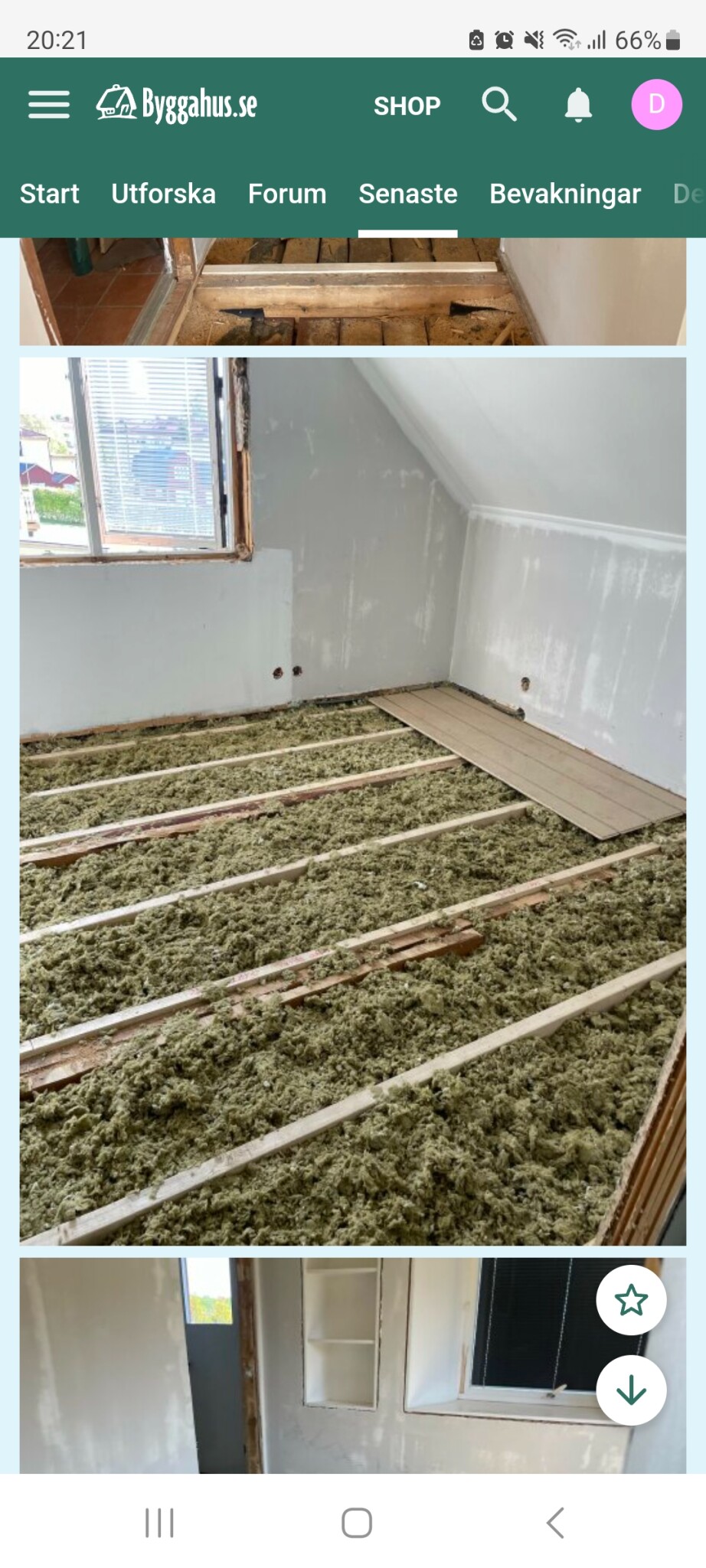

Or why like half of the 120 rule is sticking up above the old joist?
You'll have to wipe tears later.
Isn't this for the carpenter to answer? The carpenter is of course asked by the appraiser to be present at the inspection.D Danne213 said:No, a serious appraiser needs documentation. Otherwise, he guesses just as well as the rest of us in this forum.
That's why you get a bunch of stupid questions like the span between exterior walls on this floor. But also if there is something underneath here that's supporting [image]
[image]
Or why like half the 120 rule is sticking up above the old floor?
You can wipe your tears later.
Or do you mean that it is up to me as a layperson/purchaser, a private individual, to keep track of how this work should be performed professionally and correctly 😂.
You aren't that familiar with the Consumer Purchase Act and what's expected when you hire professionals to do jobs they are supposed to be trained to perform, are you?
Note that the Consumer Purchase Act is not a recommendation but a law that cannot be negotiated away.
https://www.hallakonsument.se/varor-och-tjanster-process/hantverkaren-har-gjort-fel/
Yes, of course, that's probably something everyone involved wants and wishes for.D Danne213 said:
I've talked to the appointed inspector and provided pictures as documentation of what has been done and how.
The inspector is one of 12 approved floor inspectors the flooring industry has on its website, and they of all people should know how a floor should look and be with the conditions that were present and the methods used!