
42,471 views ·
28 replies
42k views
28 replies
new method replacing the snail dynamite..?

Actually, there is no major difference between civilian chemistry and the crown's dough. The difference usually lies in the fact that you never pay for the dough, so there is no skimping there.
P.S. cutting down trees and uprooting stumps goes fast with sufficient amounts of pentyl.
P.S. cutting down trees and uprooting stumps goes fast with sufficient amounts of pentyl.
Can you buy pentyl-based explosives commercially? My instructors claimed it wasn't possible, but they might have been joking. Our explosives cost something like 40 SEK/kg when I took the explosives course. Of course, we didn't pay ourselves, but since there was a limited budget, the amount of explosives was also limited.mats_o said:
As for stumps, we tried the difference between dynamite and explosives on stumps. The dynamite sent the stump on a little flight. The explosive didn't let the stump stand, but it swept away all the soil underneath it. It was just a matter of cutting off the remaining roots and dragging away the stump.
The one we used did not have military markings but civilian ones in Swedish, so it must have been intended for the civilian market. Maybe more for demolition firms and the like that need a lot of power in a small area. If you're just going to blow up rock or something, you just load more in a larger hole normally.

As I understood it when being trained in demolition in military service, the difference between C4 and what is used for blasting rock is that the military one burns faster and is suited for "cutting" things, while for blasting rock you want something that moves large masses rather than just blowing small fragments off a smaller surface.
Regarding flying objects, we cleared tank obstacles with an arbitrary amount of C4. An old armor plate from a tank (150 kg) moved about 100 meters ;D massive blast!
Regarding flying objects, we cleared tank obstacles with an arbitrary amount of C4. An old armor plate from a tank (150 kg) moved about 100 meters ;D massive blast!
Correct. The detonation velocity of detonerbart gods and similar agents is significantly higher than that of, for example, dynamite and liquid nitrate-based explosives. You also get more effect per unit volume with detonerbart gods, but you have to pay for it with the price tag.
Free blasting is fun. I "happen" to know that taking a half-ton block and turning it into gravel is easy, as long as you have enough detonerbart gods and detonators, it went from 0-100 in that gravel type.....
Free blasting is fun. I "happen" to know that taking a half-ton block and turning it into gravel is easy, as long as you have enough detonerbart gods and detonators, it went from 0-100 in that gravel type.....
Hey!
I'm bringing up this thread again as it's become increasingly relevant to me. It seems like many of you are knowledgeable about blasting, so now it's time for you to give me some tips, thanks I'm including a picture so you can better understand my plans. The problem is mainly the retaining wall or the two future pool walls; I prefer they don't crack. I think it's about 10 m3 that needs to be removed. So what do you think, Boulder Buster/rock splitter, safes, or expanding agents like snigeldynamit? Or a blasting professional who charges X-kr per m3?
Best regards, Z
I'm bringing up this thread again as it's become increasingly relevant to me. It seems like many of you are knowledgeable about blasting, so now it's time for you to give me some tips, thanks
I'm including a picture so you can better understand my plans. The problem is mainly the retaining wall or the two future pool walls; I prefer they don't crack. I think it's about 10 m3 that needs to be removed. So what do you think, Boulder Buster/rock splitter, safes, or expanding agents like snigeldynamit? Or a blasting professional who charges X-kr per m3?Best regards, Z
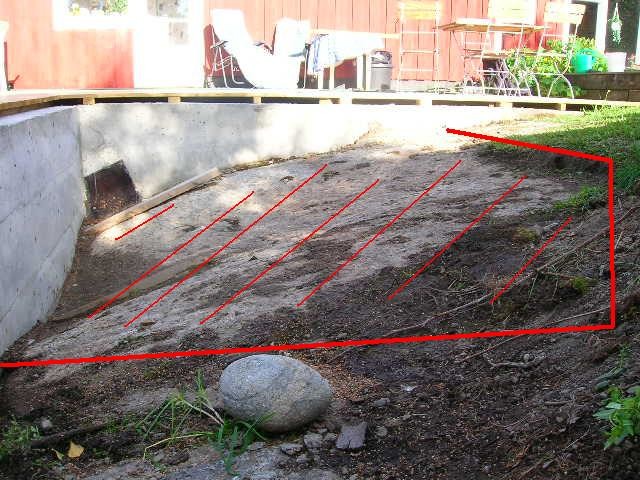

Oh!
To begin with, you can forget the wall. There's no way you can save it.
If it's bedrock and you need to blast down 1m or more into the ground, you can forget stone splitters too. In your case, more effective equipment is required. It takes great forces to blast rock that's anchored downward.
Additionally, the house seems too close for it not to sustain damage. If I were you, I would opt for an above-ground pool or place the pool where there's not much rock to remove.
Sorry, but it's going to be difficult to achieve without spending a lot of money.
/CC
To begin with, you can forget the wall. There's no way you can save it.
If it's bedrock and you need to blast down 1m or more into the ground, you can forget stone splitters too. In your case, more effective equipment is required. It takes great forces to blast rock that's anchored downward.
Additionally, the house seems too close for it not to sustain damage. If I were you, I would opt for an above-ground pool or place the pool where there's not much rock to remove.
Sorry, but it's going to be difficult to achieve without spending a lot of money.
/CC
Darn, almost suspected that What do you think about working upwards with snigeldynamit? It's probably not what you mean by "more effective stuff." Takes longer, but I have patience and am a tough bastard The goal is to start casting in the spring.
What do you think about working upwards with snigeldynamit? It's probably not what you mean by "more effective stuff." Takes longer, but I have patience and am a tough bastard The goal is to start casting in the spring.If you have a lot of patience, you should try using a rock splitter and see how much patience you really have. Rent the equipment along with a Cobra for a weekend, and you'll notice after a while whether it will work or not, and you can estimate how expensive it will be. Much depends on how hard the rock is. I have very hard rock on my property, but it's layered like shale and cracks easily. Your rock might behave in a completely different way, who knows.
A rock splitter is at least 10 times more effective than snigeldynamit, and the rock moves, which is absolutely necessary in your case. Snigeldynamit only makes the rock crack at best Imagine how hard it is to pick up rock that has only cracked a few decimeters. You can't get any grip with the pick, and you have nothing to brace against. I would skip the test with snigeldynamit if I were you.
When you test with a rock splitter, prepare well with the right equipment:
1. Water hose with pistol nozzle
2. Sturdy tarp against rock chips (you rent a rubber mat at the same time as the rock splitter, but it doesn't protect windows and the rest of the house from chips.
3. Whistle to warn neighbors before each shot
4. Hearing protection
5. Work shoes with steel toe
6. Wedges
7. Large and small sledgehammer
8. Wheelbarrow
9. Shovel
10. Extra gasoline and oil for the Cobra (you use at least 10 liters over a weekend)
11. Two sturdy picks. Buy a new one with a sharp edge.
12. Workmate (the mat is heavy, and you should be two to share the drilling and picking)
Good Luck!
/CC
A rock splitter is at least 10 times more effective than snigeldynamit, and the rock moves, which is absolutely necessary in your case. Snigeldynamit only makes the rock crack at best
Imagine how hard it is to pick up rock that has only cracked a few decimeters. You can't get any grip with the pick, and you have nothing to brace against. I would skip the test with snigeldynamit if I were you.When you test with a rock splitter, prepare well with the right equipment:
1. Water hose with pistol nozzle
2. Sturdy tarp against rock chips (you rent a rubber mat at the same time as the rock splitter, but it doesn't protect windows and the rest of the house from chips.
3. Whistle to warn neighbors before each shot
4. Hearing protection
5. Work shoes with steel toe
6. Wedges
7. Large and small sledgehammer
8. Wheelbarrow
9. Shovel
10. Extra gasoline and oil for the Cobra (you use at least 10 liters over a weekend)
11. Two sturdy picks. Buy a new one with a sharp edge.
12. Workmate (the mat is heavy, and you should be two to share the drilling and picking)
Good Luck!
/CC
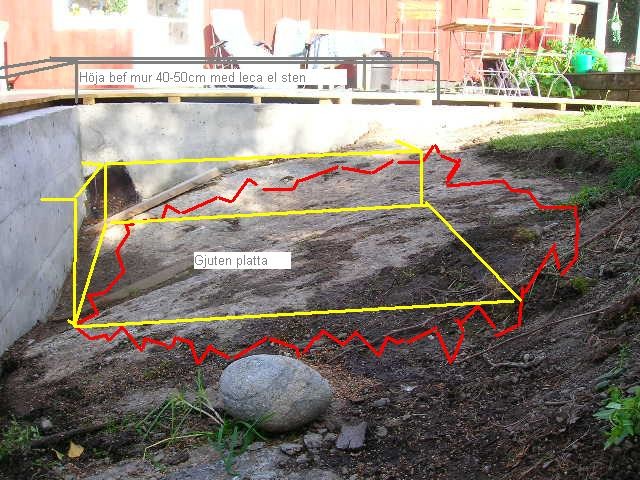
Okay, but it seems like rock splitters are a bit too powerful. Do you think it's possible to avoid damaging the wall? It doesn't need to be blasted right next to the wall, but about 20-30cm away since I plan to cast a support ledge/wall on the inside of the existing wall, about 50cm high and 10cm wide. The important thing is to get the depth in the middle and not along the wall/pool wall. So maybe rock splitters will still work?
I have beams for the deck in the retaining wall, and it's also meant to become a pool wall, so cracks are not good I should have blasted before the retaining wall and deck were built if I could be a bit wise after the event, but back then I didn't have any pool plans.
Great with all the tips, thanks!
I have beams for the deck in the retaining wall, and it's also meant to become a pool wall, so cracks are not good
I should have blasted before the retaining wall and deck were built if I could be a bit wise after the event, but back then I didn't have any pool plans.Great with all the tips, thanks!

Reviving an old threadFein said:Unfortunately, I must inform all law-abiding citizens that you need a blasting license to use the stone breaker. I don't think you need it to buy or store, transport, etc., but if something goes wrong when you detonate, it's probably not great. I believe it's because if you "boost" with like three charges in one hole, you get the same effect as dynamite.
According to what I can ascertain, no blasting license is required for either the Stone Breaker or SAFEX. The only requirement is that you are 18 years old and have understood the manufacturer's safety instructions. However, the National Road Administration Production considers the safety instructions for the Stone Breaker to be inadequate and requires "a greater degree of caution regarding charging and safety distance."
From the SAFEX website
From the National Road Administration Production about the Stone Breaker.What are the requirements for SAFEX users?
The supplier of SAFEX primarily targets knowledgeable and active professionals in the mountain, construction, demolition, and civil engineering industries, preferably to those with experience in cracking, demolition, and blasting. SAFEX may only be used for its intended purpose, i.e., cracking rocks, concrete, and larger stones. The minimum age is 18 years. Users must have understood and follow the supplier's more extensive user manual with safety instructions. Personal consumption stock must be stored in a locked metal cabinet.
The Stone Breaker is portable equipment primarily used in boulder/stone blasting (cracking) and in the cracking of concrete.
The Stone Breaker can be purchased from the age of 18 and does not require a blasting license. For best results, the volume should be 1-2 m³ and at least 1 m high with 2 exposed surfaces.
When using this method, the user manual must be followed diligently! The manufacturer's safety instructions are not entirely satisfactory and require a greater degree of caution regarding charging and safety distance.
Now, I don't know anything about blasting, but I personally would never dare to blast so close to houses and homes. What does a professional charge to do the job? I thought it might be worth it compared to the risk of getting secondary damages to the house, which may not even be covered by insurance?
Click here to reply