
8,358 views ·
5 replies
8k views
5 replies
Most accurate method for marking out and cross-measuring foundation for greenhouse?
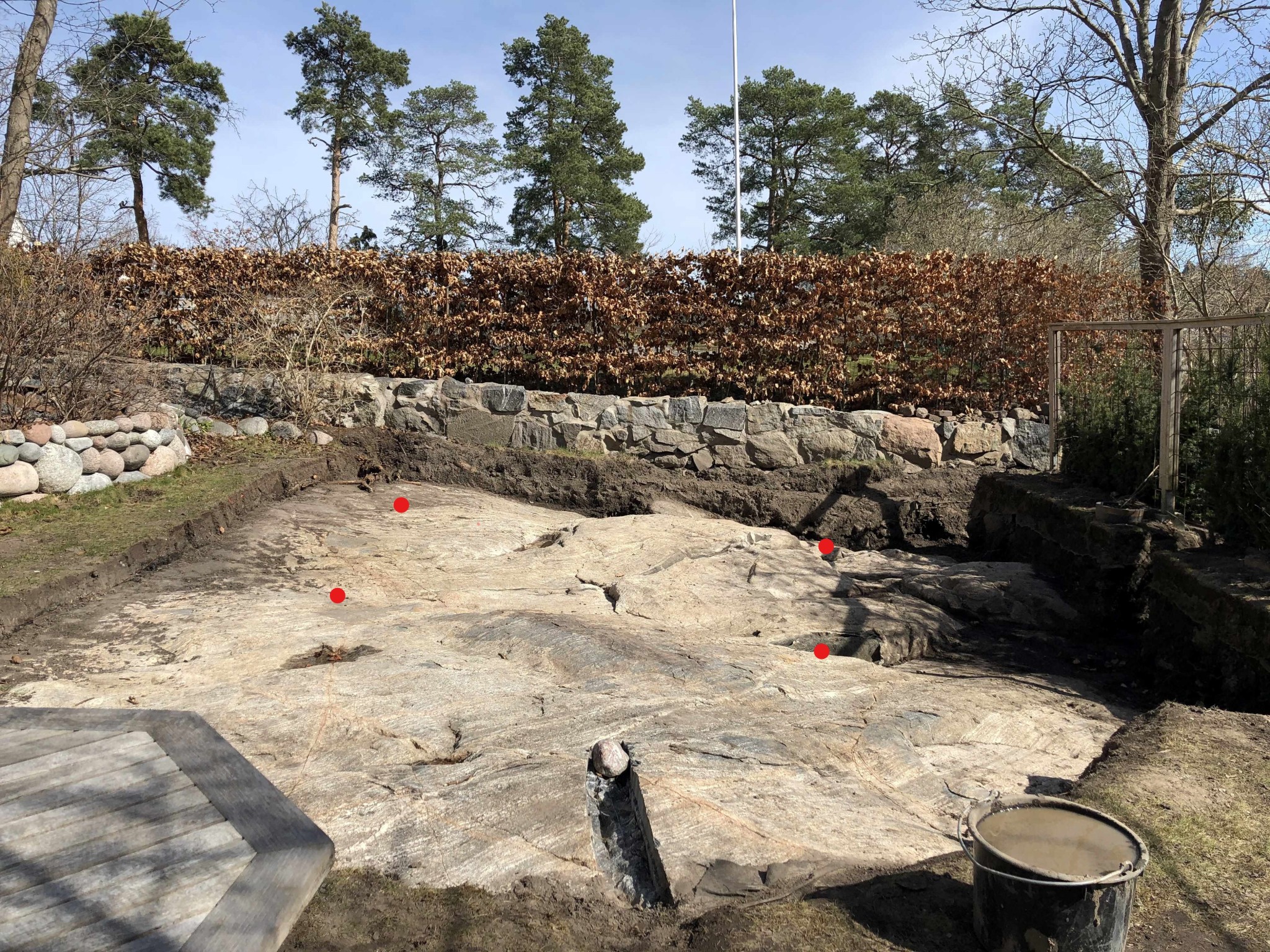
We will set up a greenhouse on a foundation of a concrete ledge which we will then build up with Leca blocks. The concrete ledge will be placed on a bedrock that is uneven and sloped (see photo). But how do you make sure, especially the Leca blocks, are exactly according to the dimensions required by the greenhouse manufacturer, including 90-degree angles and exact cross measurements when the bedrock is sloped and uneven?
I imagine making the concrete ledge somewhat larger and wider than the Leca blocks to then be able to adjust the placement of the Leca blocks as precisely as possible? The ledge will be in "steps" with Leca block heights as the lowest part of the ledge is about three Leca blocks lower than the highest ledge.
But what method and measuring tools should be used in this special case so that when it's time to build up the Leca block foundation, you get as precise a rectangle as possible with the dimensions prescribed by the greenhouse manufacturer?
I imagine making the concrete ledge somewhat larger and wider than the Leca blocks to then be able to adjust the placement of the Leca blocks as precisely as possible? The ledge will be in "steps" with Leca block heights as the lowest part of the ledge is about three Leca blocks lower than the highest ledge.
But what method and measuring tools should be used in this special case so that when it's time to build up the Leca block foundation, you get as precise a rectangle as possible with the dimensions prescribed by the greenhouse manufacturer?
Here's how I would do it with the materials I have available:
- Construct a right triangle where the legs have the same measurements as the long side and short side of the bracket you want to cast. (Or x centimeters longer if you want the markings further out.)
- Place the triangle's 90-degree corner on the highest point. Position a laser level at a suitable height in the middle of the triangle.
- Two people lift each tip of the triangle until you can see the laser level's line inside the triangle, and the triangle should, of course, be level. With the help of a plumb bob at each tip, you can now mark two more corners.
- Now rotate the triangle 180 degrees and let one tip rest on the higher of the newly marked corners.
- The other tip should be plumbed in on the other newly marked corner.
- Use the same method with the laser level to position the triangle correctly and plumb mark the last corner.
- Construct a right triangle where the legs have the same measurements as the long side and short side of the bracket you want to cast. (Or x centimeters longer if you want the markings further out.)
- Place the triangle's 90-degree corner on the highest point. Position a laser level at a suitable height in the middle of the triangle.
- Two people lift each tip of the triangle until you can see the laser level's line inside the triangle, and the triangle should, of course, be level. With the help of a plumb bob at each tip, you can now mark two more corners.
- Now rotate the triangle 180 degrees and let one tip rest on the higher of the newly marked corners.
- The other tip should be plumbed in on the other newly marked corner.
- Use the same method with the laser level to position the triangle correctly and plumb mark the last corner.
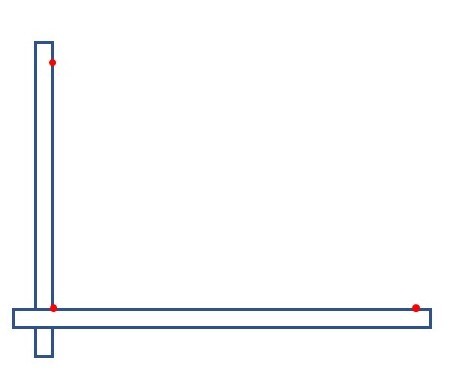
Exactly like that, but with a plank for the hypotenuse as well. Then you'll have a sturdy triangle. Also, the timber doesn't need to be completely straight as long as you can precisely measure and mark your three red points on the triangle.
I envision three planks standing on their edge. Mark the three red dots on the inside so it will be easy to level it with the laser level.
I envision three planks standing on their edge. Mark the three red dots on the inside so it will be easy to level it with the laser level.
OK, thanks @ToRy! Sounds perfect! And since the greenhouse is just over 3 meters wide and 4 meters long, you can quite easily get an exact 90-degree angle by also setting measurement points at exactly 3 meters and 4 meters with the hypotenuse at 5 meters. I will try this in combination with my green Bosch cross laser to see if the laser lines are visible during the day. Otherwise, I'll have to wait until it gets a bit darker.T ToRy said:Exactly, but with a board for the hypotenuse too. Then you get a sturdy triangle. The wood doesn't have to be completely straight either as long as you can accurately measure and mark your three red points on the triangle.
I picture three boards standing on edge. Mark the three red dots on the inside, and it will be easy to level with the laser level.

Click here to reply