
Member
· Stockholms län
· 65 posts
Hello again!
I'm back with questions regarding our renovation. Once you've received such good answers as you usually do here, I suppose you're hooked Now to my question:
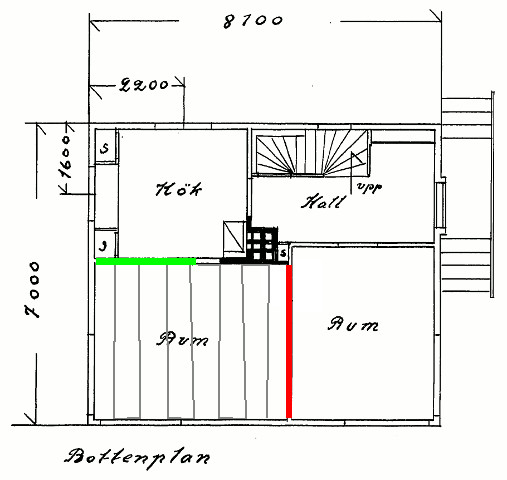
We are in the process of opening up our living room from having had a dining room (marked "Rum" on the drawing) and a living room (also marked "Rum" on the drawing) to a slightly larger living room instead. Between these rooms, there used to be a wall with sliding doors in it. The house is from 1938 and this wall/sliding door solution also seems to be from that time. We have already (with the help of a construction company) opened up a part of the wall I have marked in green on the drawing and they were quite sure that wall was load-bearing. Therefore, we now have a thick laminated beam and posts on the sides to take care of that load-bearing function.
We were therefore quite sure that the wall I have marked in red (which has sliding doors in it) was not load-bearing since it runs parallel to the floor joists (which are drawn in ugly dark gray lines on the drawing) and is perpendicular to the previous wall. After removing the drywall (which probably came from a renovation in the 70s) and the paper-like board that initially concealed the wall, we can now confirm that this too consists of fairly thick wooden planks (about 4.5 cm thick) across the entire wall (thus not like studs with cc60 but tongue-and-groove planks across the entire width of the wall).
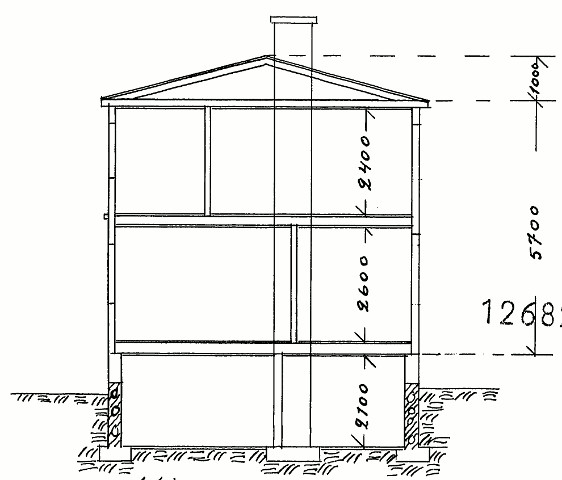
So, my question now is: could it be that this wall is also load-bearing? Isn't it extremely unlikely that they would make a load-bearing wall parallel to the joists? On the drawing, all the walls on this floor (the middle floor with a basement below and another floor with rooms above) seem to be narrower, even the one we previously replaced with a laminated beam....
So: what do you think?
Best regards, Magnus
I'm back with questions regarding our renovation. Once you've received such good answers as you usually do here, I suppose you're hooked
Now to my question:We are in the process of opening up our living room from having had a dining room (marked "Rum" on the drawing) and a living room (also marked "Rum" on the drawing) to a slightly larger living room instead. Between these rooms, there used to be a wall with sliding doors in it. The house is from 1938 and this wall/sliding door solution also seems to be from that time. We have already (with the help of a construction company) opened up a part of the wall I have marked in green on the drawing and they were quite sure that wall was load-bearing. Therefore, we now have a thick laminated beam and posts on the sides to take care of that load-bearing function.
We were therefore quite sure that the wall I have marked in red (which has sliding doors in it) was not load-bearing since it runs parallel to the floor joists (which are drawn in ugly dark gray lines on the drawing) and is perpendicular to the previous wall. After removing the drywall (which probably came from a renovation in the 70s) and the paper-like board that initially concealed the wall, we can now confirm that this too consists of fairly thick wooden planks (about 4.5 cm thick) across the entire wall (thus not like studs with cc60 but tongue-and-groove planks across the entire width of the wall).
So, my question now is: could it be that this wall is also load-bearing? Isn't it extremely unlikely that they would make a load-bearing wall parallel to the joists? On the drawing, all the walls on this floor (the middle floor with a basement below and another floor with rooms above) seem to be narrower, even the one we previously replaced with a laminated beam....
So: what do you think?
Best regards, Magnus
Member
· Stockholms län
· 65 posts
Hello Huggan!
I think it's a browser thing. I also can't see the text properly in ie8 or ie9, but when I use Firefox or Chrome, I can see the entire text (and the second picture as well!). However, you can copy the text to Notepad and the whole thing will appear. I'll try attaching the second picture again to see if it helps...
I think it's a browser thing. I also can't see the text properly in ie8 or ie9, but when I use Firefox or Chrome, I can see the entire text (and the second picture as well!). However, you can copy the text to Notepad and the whole thing will appear. I'll try attaching the second picture again to see if it helps...
Agree with your assessment, it doesn't seem likely to be load-bearing. A board wall is not unusual, though the dimension is remarkable.
As the owner of another old house, I have stopped being surprised by what you find when you tear down.
As the owner of another old house, I have stopped being surprised by what you find when you tear down.
Without more facts in the case, it seems unlikely, as mentioned, that it would be a load-bearing wall parallel to the joist... a theory might be that they wanted a stiff and thick wall so that it wouldn't be shaky with the sliding doors, assuming these are quite heavy if they are original? This is probably the most likely.
In my sister's house, the brother-in-law swears with every alteration...every wall is a board wall, 55mm...built from their own forest back in the day...they wanted solid walls even back then
In my sister's house, the brother-in-law swears with every alteration...every wall is a board wall, 55mm...built from their own forest back in the day...they wanted solid walls even back then
In the apartment building I lived in a few years ago, all the walls were made of tongue-and-groove 45mm planks. On each side of that were rough-sawn 22mm and a sheet of masonite to have something smooth to paint/wallpaper on. So even non-load-bearing walls. It was probably just the way they built at the time when wood was cheap
At least you don't have any problems attaching things to the walls.
At least you don't have any problems attaching things to the walls.
Can't quite figure out how everything fits together. But isn't the red wall 90° to the floor/ceiling joists for the floor above? If so, they might rest on this wall and then it is probably load-bearing.
Now, maybe many houses built with standing plank are load-bearing ten times over, but it's hard to estimate. But if it looks like this above doors (instead of just nailing), they probably intended for the wall to bear some sort of load.

Now, maybe many houses built with standing plank are load-bearing ten times over, but it's hard to estimate. But if it looks like this above doors (instead of just nailing), they probably intended for the wall to bear some sort of load.
Member
· Stockholms län
· 65 posts
Hello again, and thanks for all the answers so far!
So, to answer your additional thoughts:
@Huggan: The tongue and groove boards are attached differently. On one side of the sliding doors, they are just nailed to the floor (not the joists) and the tongue and groove in the ceiling. The other side, however, is attached above the ceiling tongue and below the floor tongue (can't quite see how right now).
@Forbo: Yes, we are also beginning to suspect that it was mainly because it was an easy and (at that time?) cheap way to get a rigid wall, as the sliding doors from that time are quite heavy.
@baljbalj: No, the red wall is parallel to the floor/ceiling joists for the floor above. All joists (above and below) are parallel to the red wall. (as the gray drawn lines on the drawing try to indicate) However, it looks exactly like in your picture, on both sides of the sliding doors (even on the side that is just simply nailed into the ceiling and floor tongue).
So: what conclusion can be drawn from this? Is it, as we suspect, just that wood was a relatively cheap and easy way to set up a reasonably stable wall?
So, to answer your additional thoughts:
@Huggan: The tongue and groove boards are attached differently. On one side of the sliding doors, they are just nailed to the floor (not the joists) and the tongue and groove in the ceiling. The other side, however, is attached above the ceiling tongue and below the floor tongue (can't quite see how right now).
@Forbo: Yes, we are also beginning to suspect that it was mainly because it was an easy and (at that time?) cheap way to get a rigid wall, as the sliding doors from that time are quite heavy.
@baljbalj: No, the red wall is parallel to the floor/ceiling joists for the floor above. All joists (above and below) are parallel to the red wall. (as the gray drawn lines on the drawing try to indicate) However, it looks exactly like in your picture, on both sides of the sliding doors (even on the side that is just simply nailed into the ceiling and floor tongue).
So: what conclusion can be drawn from this? Is it, as we suspect, just that wood was a relatively cheap and easy way to set up a reasonably stable wall?
Hmm...if you turn it around...what could the "red wall" possibly support? It can basically only carry load from a beam...so it would be if there was a wood stove or a bathtub or something similar over just that beam. Alternatively, it could function as lateral wind bracing, but that seems far-fetched.
Aha. Well, then who knows. Same situation here by the way, not even daring to widen doors. It might support something, but the question is if that wall needs to be load-bearing. Can’t you leave standing planks out on the edges and put some kind of steel/glulam beam on them just in case? That way, you might sleep a little better at least.
You might get different answers depending on which carpenter you talk to. Like a structural engineer would be something, but there's a high risk that such a person would go overboard and just verbally state that it should be okay but write the opposite.
You might get different answers depending on which carpenter you talk to. Like a structural engineer would be something, but there's a high risk that such a person would go overboard and just verbally state that it should be okay but write the opposite.
Click here to reply