See my earlier post, deflection 26mm on a 245. How can you get it to 5mm for a 170??
In Träguiden, it is calculated with about 350 kg load per square meter, not just deadweight as we want for this load case.
edit: yes, it should also withstand snow, so the deadweight is not the only consideration. But the deflection requirement from Träguiden together with their load might not be relevant in all cases.
For pools, acid-resistant steel is usually used. Do you know if Stena Stål has such sheet metal in 3mm and approximately what it costs? Can they also deliver customized lengths?
And I see now that stainless sheet metal wasn't as exorbitantly priced as stainless beams (per kg). I don't know if they deliver anything other than "standard sizes." But there are of course more suppliers.
It might be a good idea to mount the beam so that it can be heat-straightened later without the wood burning.
It's much more convenient to bring someone with an induction heater to adjust any sagging than to have to remove the entire beam.
It sounds completely foreign to me to cut material into an arc shape for that beam. As soon as you touch that beam with a welding rod, it's more than crooked, at least in my experience. Any village smith with a heater can bend an appropriate beam.
I welded a 2.3-meter long U beam with approximate dimensions of 60x180mm, 8mm material. Welded 6x25mm flat iron to the flanges along the entire length of the beam. With a 2.3-meter span, the beam had bent around 20-30mm!
But no problem to heat-straighten it again for me, who is still an amateur in this context.
As I've said, I don't have that experience, but I'm humble in recognizing that it might be problematic, especially with stainless steel.
I work in a different world where it wouldn’t be a big problem, but I don't have full insight into what it takes for it to work well there either.
I also tested a bit in the TräGuiden program, and with a bearer beam of 8.4 m, glulam 115x630 mm is suggested, and even then the deflection requirement is not met... It gives a bit of a feel for the problem
I tested a bit in the TräGuiden program myself, and with a supporting beam of 8.4 m, laminated timber 115x630 mm is suggested, and even then the requirement for deflection isn't met... It gives a bit of perspective on the problem
Hmm... But as someone suggested, putting a 3 mm plate, stainless or rust-protected, 45*170 and screwing it into the wooden beams should suffice, right? 4-meter lengths?
I have built enough to understand the concept..........Also worked with heavy forging. We still have a given scenario with a built wooden structure that can be slightly reinforced to achieve the desired result. If you want a flexurally rigid structure in beams, then it's a completely different thing. Then you also have to take the self-weight of the beam into account plus everything else. Of course, that would be a substantial construction but completely unnecessary.
Do you think it would work with 3 mm sheet metal that is rust-proofed? 45*170 and screwed into the wooden beams in 4M lengths?
Unfortunately, I can't calculate how much a 3mm sheet would stiffen such a rule. However, what I do know is that the sheet must be as high as the beam it is meant to reinforce in order to be effective.
I also think you are overlooking factors that are quite obvious to consider in a calculation.
-snow
-people walking on it
-self-weight, including that your insulation will be waterlogged
Hmm… But as someone suggested, putting a 3 mm sheet, stainless or rust-protected, 45*170 and screwing it onto the wooden beams should suffice? 4 meters lengths?
Now it was the load-bearing beam I was looking at, the one to be reinforced with a steel beam.
On the floor joists (which run the other way) I get similar results to @Erik Lindroos with a 5 mm deflection with 1500 kg distributed.
The calculations are linear, so if you increase with snow, wet insulation, or whatever you want up to, for example, 4500 kg, the floor joists' deflection becomes 15 mm.
Then you have to consider that the lowest hanging point's deflection is a combination of the floor joists' and the load-bearing beam's deformation, which is relevant when you need to close and get over the edge.
Unfortunately, I can't calculate how much a 3mm sheet would stiffen up such a beam. What I do know, however, is that the sheet must be as high as the beam it is supposed to stiffen to be of any use.
Then I think you are ignoring factors that are completely obvious to consider in a calculation.
-snow
-people walking on it
-dead weight including that your insulation will be waterlogged
maybe I missed something…….
As winter coverage, self-supporting sheet metal is used in entire lengths. You can walk on them, and they should handle 140 kg of snow/sqm, I believe.
After reading everyone's reasoning and calculations, it feels logical and good to me to go with a T-beam and rework the floor joists to 170*45 and strengthen it with a steel sheet 45*170. I have a 2mm acid-resistant sheet on a bar and you can't just bend that.
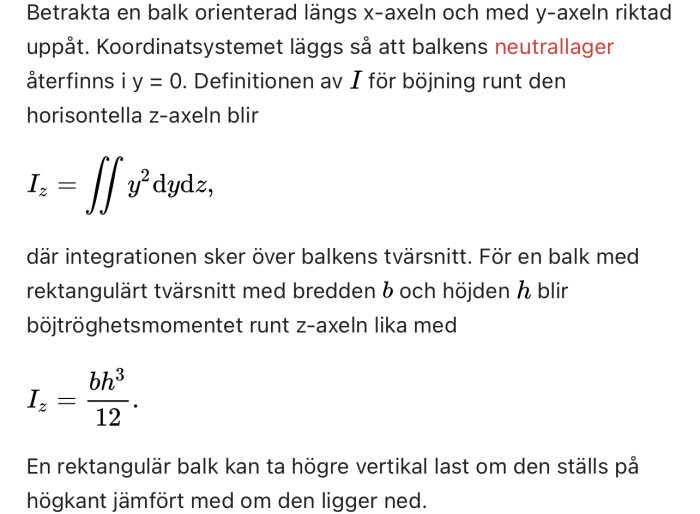
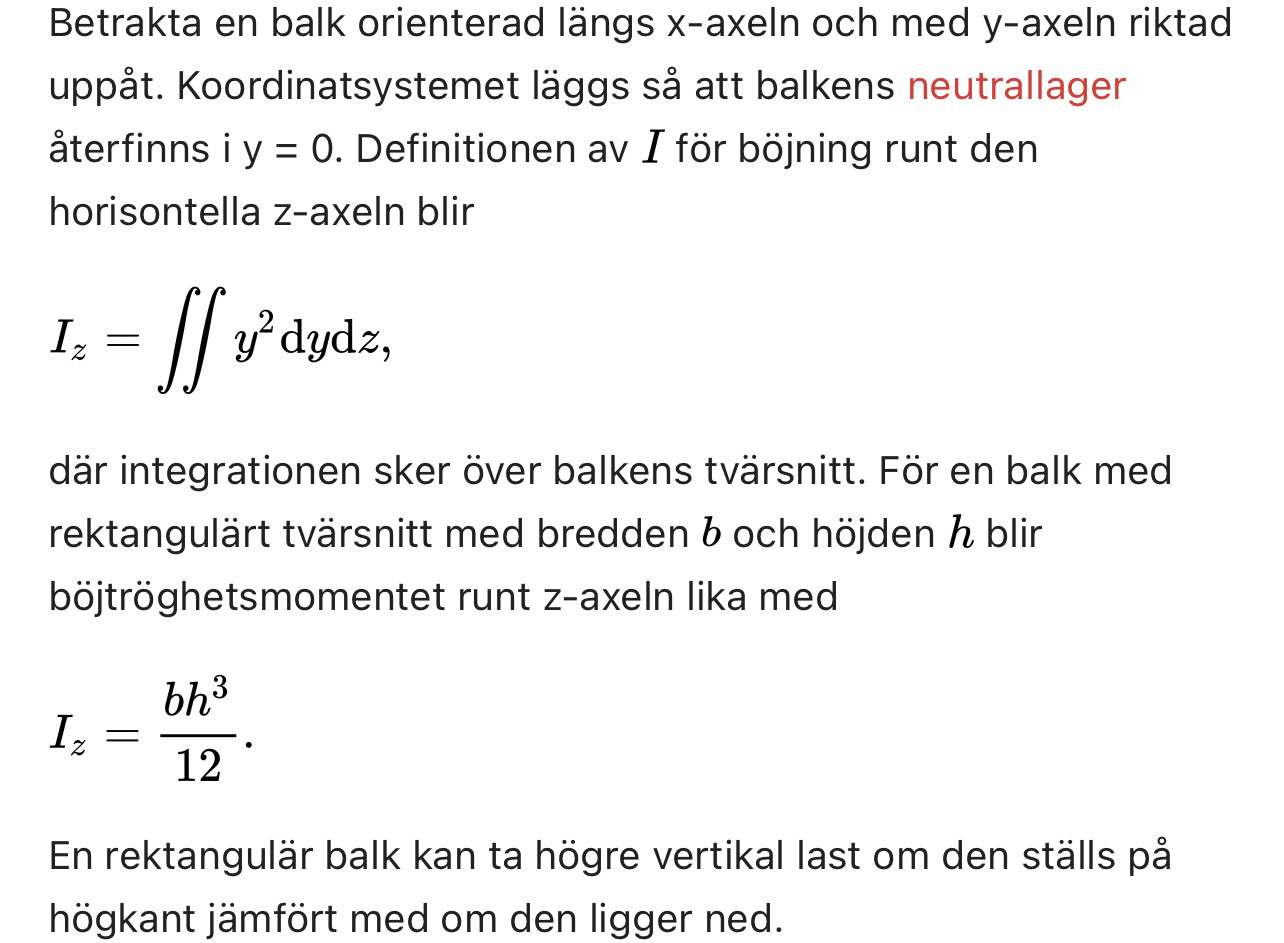
It's just a matter of calculating it, it's no problem regardless of the cross-section, the difference is that you can't scroll to find the values for the moment of inertia in any table. For a sheet, it's very simple.
One could "reverse-engineer" the beam profile used by Aquisdeck(?) if you're interested in that.
Now it was the support beam I was looking at, the one that will be reinforced with a steel beam.
On the floor joists (which run in the opposite direction), like @Erik Lindroos, I calculate a 5 mm deflection with 1500 kg distributed.
The calculations are linear so if you add snow, wet insulation, or whatever to, for example, 4500 kg, the floor joists' deflection will be 15 mm.
Then you have to consider that the lowest hanging point's deflection is a combination of the floor joists' and the support beam's deformation, which is relevant when you're going to close and get over the edge.
I could easily create this construction without a lot of "fancy" calculations, simply because I have so much experience with this type of constructions...
But trying to give someone a solution via the internet that achieves the desired result, when the current attempt results in what is visible in this thread, seems quite difficult to me...
@Huggedugge1, I don't have the energy to read more in this thread... But when you've come up with the solution you envision and have suitable manufacturing documentation, feel free to reach out to me so I can take a look at it...
Then I'll give you my honest opinion on how difficult it actually is to manufacture it in such a way that you get a construction that is both durable and fulfills the desired function...
Because as someone who has experience with "both sides," meaning both as a designer and as the one who manufactures what someone else has drawn, I know how little they usually understand about how things actually behave in reality...
It's great to have people who, at a glance, can see exactly how the optimal construction looks to solve a problem. Congratulations to them. But the rest of us have to tackle the problems systematically and evaluate how different variations work. It's not very fancy to calculate the deflection of a beam, quite basic theory that Galilei invented and has been used successfully since then.
Now I was looking at the support beam, the one that will be reinforced with a steel beam.
On the floor joists (which run in the other direction) I, like @Erik Lindroos, find a 5 mm deflection with 1500 kg spread out.
The calculations are linear, so if you increase with snow, wet insulation, or whatever you want to, for example, 4500 kg, the floor joists' deflection becomes 15 mm.
Then you have to consider that the lowest hanging point's deflection is a combination of the floor joists and the support beam's deformation, which is relevant when you are closing and trying to get over the edge.
Awesome, then it works, but why is there such a difference between your calculation and the teäguide?
Vi vill skicka notiser för ämnen du bevakar och händelser som berör dig.

Huggedugge1 said:

Bernieberg said:


Violina said:
To be honest...