A few urgent questions now. If I construct wood formwork, reinforce, and cast an uninsulated slab, can I then build walls of 19cm Leca instead of wood or metal?
The posts that support the load-bearing beams inside the building. Is it smart to cast in fittings for these directly in the slab from the beginning, or how are the posts best/most easily anchored otherwise?
I will also install a larger metal gate with a frame in galvanized steel, should I cast in some supports for the frame for this?
If the edge reinforcement of the sole and ground preparation are made sufficiently coarse/strong, there should be no problem with using stone instead of wood.
Either you cast in post brackets directly, or you drill and peg them afterwards.
I assume the actual frame should be screwed into the walls and ceiling? Possibly then a threshold strip/iron that is cast into the slab?
The reinforcement is resting on plastic spacers directly on the macadam. Are spacers even needed, or can the reinforcement lay flush against the macadam where the concrete flows between the stones anyway?
I feel the reinforcement mesh lifts slightly in some places, should one be worried that the reinforcement mesh will "float" up?
Is it okay to tie some joints together with zip ties?
I have suggested before and I do so again that you should hire an experienced builder for your quite large construction project, which will require some expertise and experience, it pays off. Your questions indicate a little too much ignorance and make me, without wanting to be patronizing, worried that it will go wrong and that you will end up in a situation that becomes unnecessarily complicated and costly. There is nothing wrong in seeking knowledge from professionals, I do it often even though I have been in the industry for more than 40 years and it has made me quite knowledgeable and surprisingly informed but not about everything. Concrete is a fantastic material but also difficult to work with and often offers little scope to correct mistakes and misconceptions. Go to YouTube and study some videos there about foundation casting. There you will get good tips on how to proceed and what you should have done before, during, and after. Briefly about your questions: Spacers are used to position the rebar at the correct level in the concrete, roughly in the middle. They should not rest against the substrate. Joints should be tied or fastened with cable ties so they do not move when the concrete is poured. I have been involved in placing rebar when the concrete is in place, but it requires a smaller area and a good hand. Finally, I assume you have already reinforced but, the future is uncertain and with it ideas about what constructions should be used for. If you or someone else would like to use the building for something other than a cold garage, problems arise because the slab is uninsulated. Therefore, I suggest using ground insulation under the concrete slab, for several reasons, but it is not entirely necessary, regards
10 cm insulation vs none at all - yes, it would have made a big difference.
It's the first few cm of insulation that make the biggest difference.
0 - 10 cm = huge difference.
20 - 30 cm = minimal difference.
Okay. I have been sleepless last night and wondering how on earth to attach a door frame to lightweight concrete if I choose to build everything with lightweight concrete?
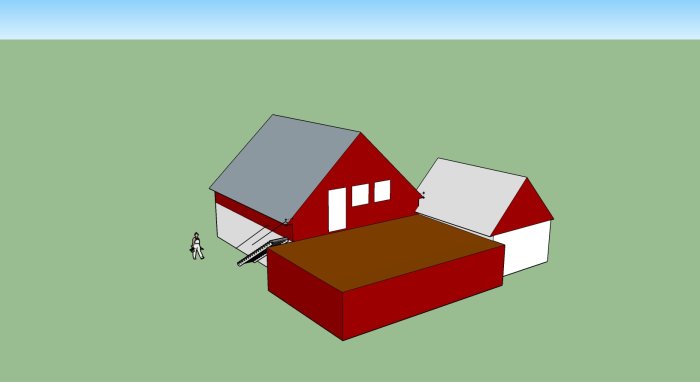
How does the panel vote: build walls with leca and paint white or contrast with adjacent buildings using red siding boards?
Unfortunately, the new building's height does not align with the height of the adjacent wall to the building on the right side...
The construction will be as described below in shape + fence with pressure-treated horizontal 45x45 slats.
It's probably six of one, half a dozen of the other with stone vs. wood.
I might have thought that a simple utility building would be made simple and cheap => wood.
On the other hand, you seem to have masonry utility buildings, so it might not be that simple.
If the wall itself (Leca) is sufficiently stable and durable, then it's just a matter of using large/coarse and long screws, right?
150 - 200 mm long, and perhaps M12 - M18?
A gate brake might not be a bad idea either.
Not the appearance as such, but whether it will look good together with your existing buildings.
Vi vill skicka notiser för ämnen du bevakar och händelser som berör dig.