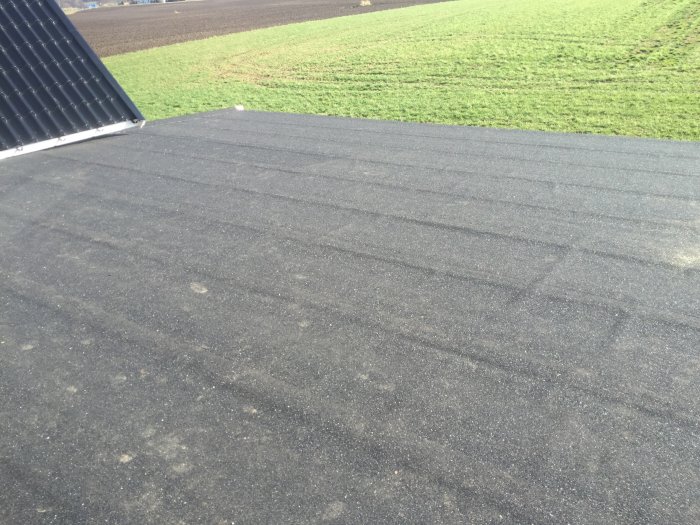
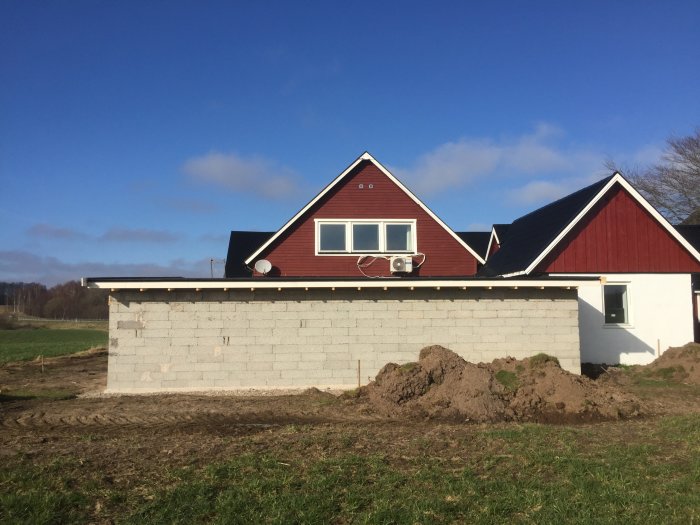
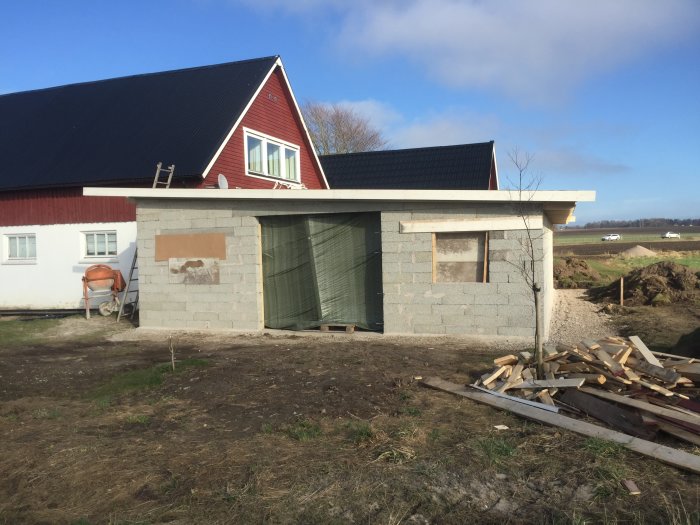
1 degree makes approximately a 15-centimeter height difference over 9 meters, so you plane or saw a 9-meter plank from 0 to 15 cm and nail them onto the roof beams before laying down the tongue and groove boards. There is no reason to skimp on structural requirements, as it will have consequences in the long run since you’ll have greater stress on the material in the form of lower strength and risk of leakage.
Personally, I would choose a larger roof pitch, 5-6 degrees, and sleep soundly at night. Regards
I was thinking if you had already done the roof rafters, then it might be easiest to stack above them, if you haven't done it then you're building with a slope from the start. Since you're going to have 9-meter lengths on them, you might want to consider the alternative of making roof trusses instead, more stable and easier for me since the ceiling becomes straight. 9 meters makes half a meter in height over that distance with a 3-degree slope.
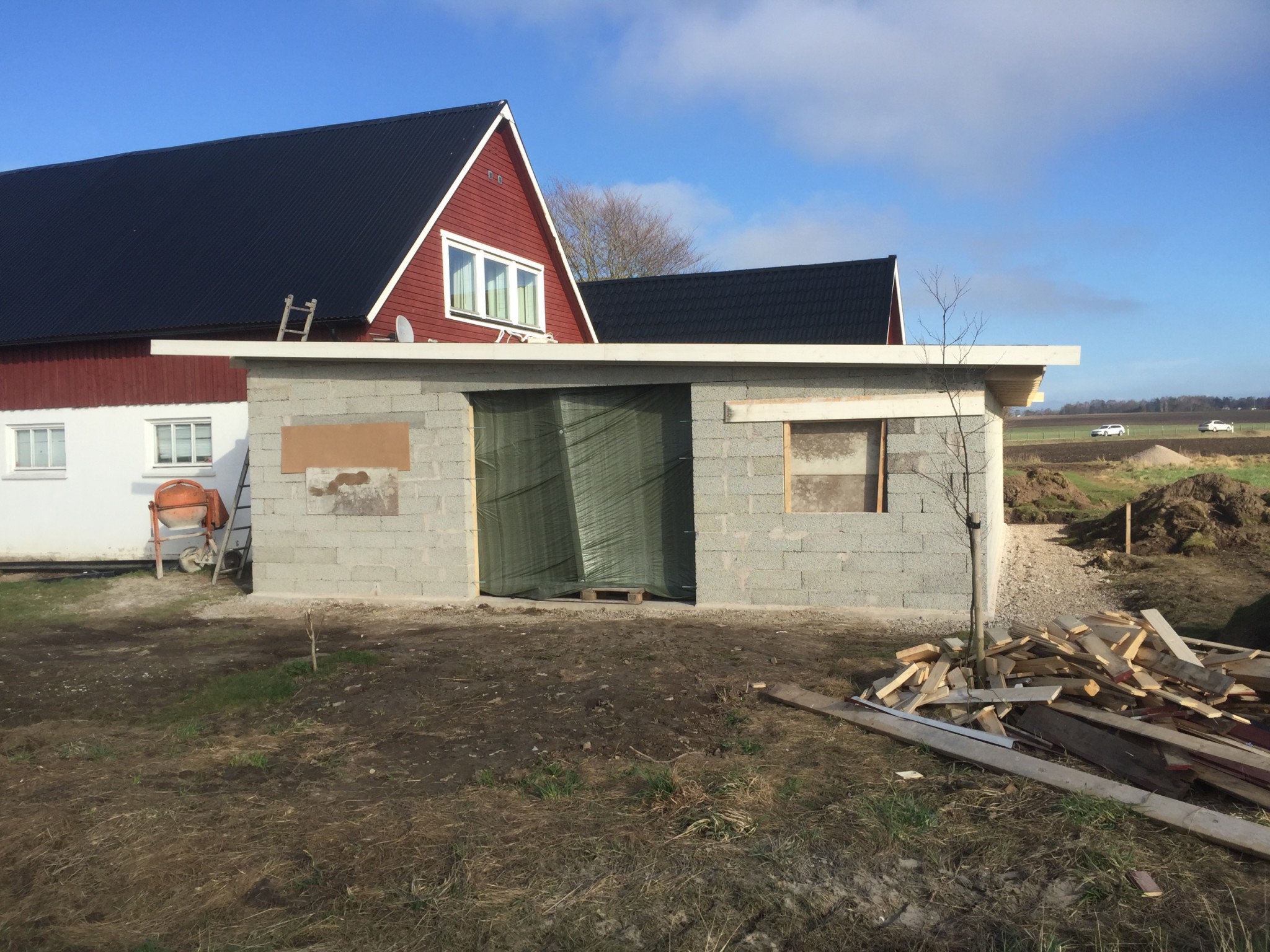
Ok no, I haven't done it yet. No need for a straight ceiling, rather it's better for storage if it is higher at one end.
A pressure-treated frame and decking will be placed above the raw boards, which need to be shimmed 0-50cm over an 8.4m stretch. How would you handle this shimming?
Build up with 45x195 into thick beams that are then approximately 45-500mm? And screw together with short decking boards as nail plates?
Or would you construct something with a system of posts/blocks under a 45x195 beam to save on beam material?
Off the top of my head, I can't think of anything that justifies one over the other, so it's probably six of one, half a dozen of the other. It's likely a bit easier to work with straight studs and support legs/blocks. You might want to consider how it will look at the gable where you have about 50 cm from the roof to the deck. For example, if you can see into/under the deck, and if/how you should possibly cover it or not.
Spontaneously, I'm considering horizontal printed 28x45 as a fence on the terrace; would it look good to let these continue down and cover the gap between the roof and decking?
Wouldn't leaving the gap completely open without covering look strange..?
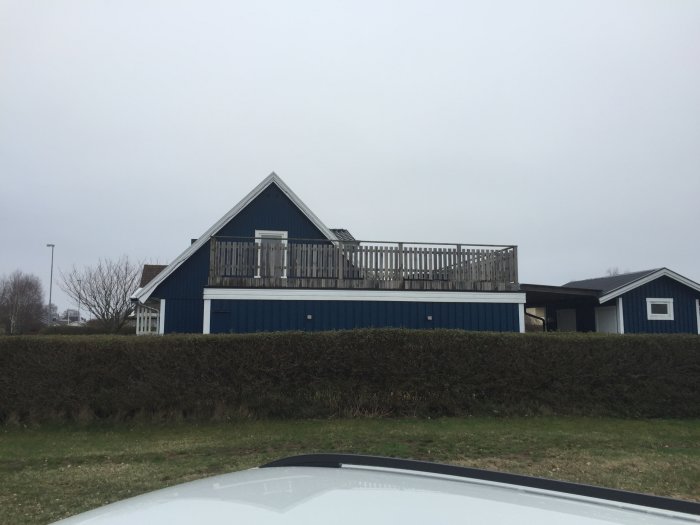
Posting some new pictures. The last picture is of a different house.
How would you handle the appearance of the deck "skirt" and railing?
Do you envision a "wedge-shaped" covering of the framing for the decking completely? I have hardly seen such a solution... Everyone seems to build a high skirt evenly?
Considering building the deck about 20cm onto the roof on all sides to give a sleeker impression. Where the roof is the lowest, I will install a gutter, so I need to leave a board's space for water to drain out.
The slope from the highest to the lowest point of the roof is about 50cm.
Thinking about covering this with horizontal or vertical deck boards screwed flush with the wedge-shaped beams.
Then there's the question of vertical 20x95 for the railing or horizontal 28x45 slats?
Nice work.
What do you mean by "kjol," do you mean the weather protection along the edge?
You're asking us if it looks nice, what do you think yourself? If you've done this well so far, decide for yourself on the rest; it will look nice if you think so.
Remember that when you make the fence, it should not be possible to climb up on it, nor should there be gaps that heads or fingers can get stuck in.
There are specific standards for that.
Having an intake on the fence makes it easier to maintain it better, and, which we don't wish for, if an accident occurs and the premises need to be evacuated, it is easier if there is a platform to stand on outside the fence.
Get a sheet to protect the roofing felt where the other roof slopes down; a lot of water, ice, and snow will erode that spot violently.
Yes, sort of covering the wedge-shaped joists of the deck. Possibly let these joists remain visible along the sides but not "from the front." There, I can nail on pressure-treated joists that create a covering.
Otherwise, it seems that the most common approach is to let the fence be flush with the roof edge and build everything in with a type of fascia that in my case has to be almost 50cm.
I think I would rather set the fence and the entire deck 20cm in from the roof edge all the way around. And initially let the wedge-shaped pressure-treated deck joists be visible. If it looks odd, I can cover them with, for example, horizontal or vertical decking.