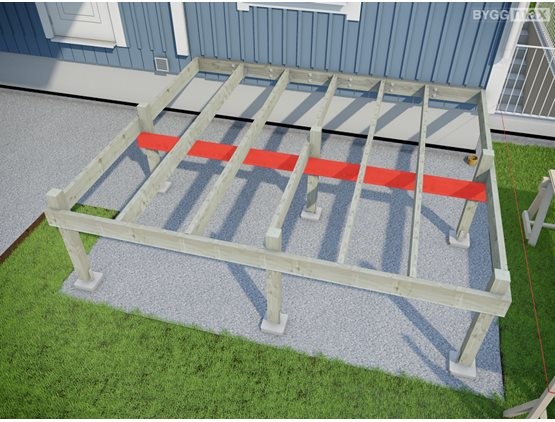
So, joist hangers in the end wall, studs approximately 3 meters to the bearing beam where they are attached with joist hangers, on the other side joist hangers where 3-meter studs are attached to continue to the wall?
Yes, but it's not the short wall. Now they're leaning towards making the entire hangar even larger, 9x9 meters, but not having a wooden deck across the whole area.
Still thinking about a slope from the gable out towards the field.
Considering first a beam in the gable, possibly posts for safety. A 3m beam, then a bearer with joist hangers on both sides, then another 3m beam, then another bearer with joist hangers on both sides, then another 3m beam, then the beam rests on the new outer wall without joist hangers...
https://www.byggahus.se/forum/byggmaterial-byggteknik/216499-fasta-altantak-i-isolerskivor.html
A supporting beam must be supported by posts if the joists the beam is supposed to support are more than two meters. In your case, it is six meters across and the beam should be nine meters. I would have posts on the beam with a three-meter distance, let the six-meter joists rest on the beam, and not attach with joist hangers considering the size of the floor and potential future loads.
I am considering the suggestion below since there is a low roof pitch, so metal feels better than a tar paper construction?
The question is what center-to-center distance I should have between the joists? You can add blocking as support for the metal, would cc 60 be sufficient then? (It fits well with the pressure-treated beam on top if it’s about cc 60? I’ll have to align with the peaks of the metal profile...
pelpet said:
I would probably choose regular wood screws but pre-drill with a metal drill through the top beam and metal. But self-drilling might work well too. The screws should press the wooden deck against the metal and hold the metal down. Where the top beam is thick you could drill down with a 14 mm drill so that you have maybe 5-6 cm of wood to screw through. It's easiest to do this before you place the beam on the roof. I think the following procedure is easiest.
1) Drill through the beam that will lie on the roof completely. About 6 holes per beam.
2) Place it in position and mark on the metal where the holes should be.
3) Move the beam and drill holes in the metal.
4) Lay a thick bead of outdoor caulk under the beam and place it so it matches the holes.
5) Fasten the beam with regular wood screws, about 120mm.
The façade profile might work. The disadvantage of having wide ridges is that more water will run over the treated beams, but if you choose NTR AB it should last at least 20 years in water, so it might not be a problem.
I know, I meant to also place posts on the "support beam" that is bolted to the wall...
Using joist hangers on the two support beams in the middle is about saving ceiling height in the storage under this support beam...
It's good that you secure properly to the wall with posts under the support beam, but if you are going to do that and then have a free-hanging 9-meter support beam in the middle of the shed with 3-meter joists anchored only with joist hangers, I want you to consult an experienced carpenter in your area for advice. I am sure that carpenter, just like me, will strongly advise against it. I prefer tongue and groove and roofing felt because I consider it stable, easy to work with, and simplifies the construction of a deck, others may prefer metal for perhaps the same reason, so it's more or less six of one, half a dozen of the other. Speaking from experience, I know you never regret over-engineering building constructions, however, when roofs cave in, walls fall, or floors sag, that's when you curse and swear. And as you write, the additional cost for thicker dimensions is small considering the value. In the imagination, you can build castles in the air, but in reality, it's more practical to build stable and well-thought-out.
I envision a smaller "hangar" nowadays about 9x9m.
I'm not thinking of a support beam in the middle of the shed but rather two support beams. The free-hanging joists would then be no more than 3 meters.
Am I crazy for thinking that 3-meter 45x220 on 60 cm center-to-center with joist hangers should be stable as heck?
Now I'm not following, a 9X9 meter hangar and two support beams, which should then be 9 meters each, or are you going to place the support beams "crosswise"?
In any case, I am doubtful about attaching joists to support beams with joist hangers considering the strength.
Do you mean that the joist hanger/bracket attachment is not strong enough? Better to place the bracket on top of the beam?
I imagine your hangar as a building with dimensions of 6X9 meters, with beams running lengthwise, but you could also place them crosswise, meaning from the house and outward, which I now understand you are not planning to do. If you nail/screw brackets into the beam instead of placing them on top, you lose a significant amount of load-bearing capacity, in my opinion. I've never seen it and would never do it myself. A joint is a joint and should not support large loads, especially when it can be solved with a beam. You plan to have a 9x9 meter free-hanging roof, but I advise against it unless you're prepared to acquire substantial beams to build with, like steel or glulam. So, I suggest you shrink the dimensions a bit and consider a partition wall or posts that don't take up much space, which you could use to hang things from.
Wait here now, I'm thinking of a 9x9 meter area with support beams/partition walls every third meter; these support beams rest on posts approximately 2.5m apart or on a partition wall.
Hi, I am truly torn here. What do you vote for? Sheet metal roofing according to the construction below or tongue and groove+underlay felt+top felt?
Price-wise, it seems to make no difference.
Shouldn't it be harder to get the felt waterproof than metal?
Is it a big problem that I have to screw through the felt for the joists to the deck?
pelpet said:
Here is a profile picture. Tp20 sheet metal might work if you bevel the ends of the joists so that they fit under the ridges that are 35mm wide. That way you can have the rafters under the metal. On top, you lay treated joists that you bevel so that you get the deck level even if the metal is sloping. Then decking on top (brown in the picture)
I would settle for maybe a 2-degree slope. I believe the 5.5-degree slope requirement is to prevent water from seeping between the sheets at the seams, but if you lay with two rows of overlap and a thick silicone bead in between, you should avoid that problem. Choose full lengths for the metal.
[image]
I think you should over-dimension properly since you'll have loads both from the decking and snow on the rafters. They're both a deck and a roof at the same time.
Vi vill skicka notiser för ämnen du bevakar och händelser som berör dig.