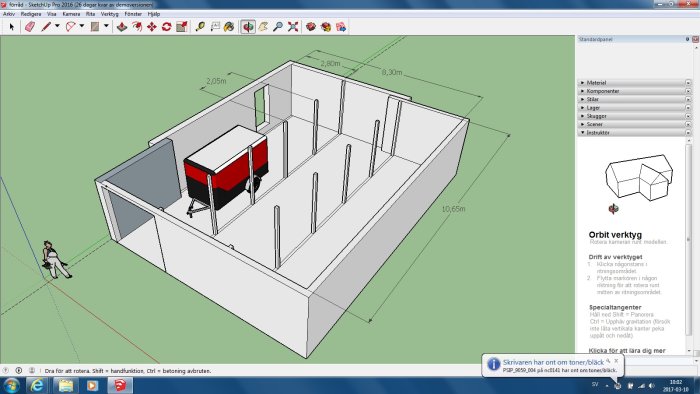
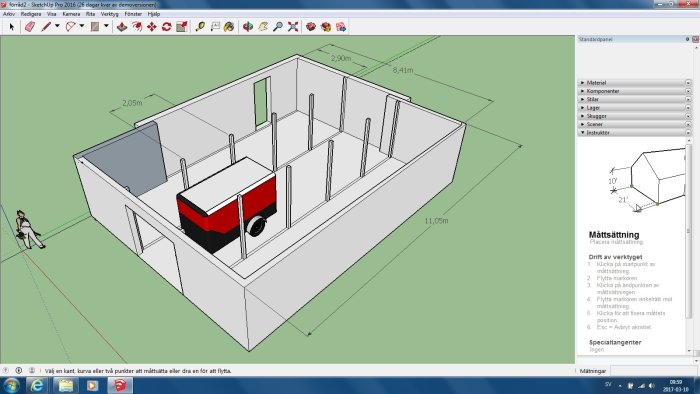
Ok. Is there any reason to build with 25cm blocks or is 20cm sufficient?
Mmm I think that white plaster looks better with the rest that is plastered, but as mentioned, the level of the wall on the new building and on the adjacent building to the right will not be the same, so maybe it would look better to change it up with faluröda cladding boards instead..?
What I'm thinking about is if a door swings open because of the wind, it can result in considerable forces twisting in the frame, especially if the door cannot open 180° without the façade/door hole or trim stopping it earlier.
I don't think that differences in the level of walls matter that much.
On many old stables and barns that are built with masonry, the eaves and gables are clad with wood paneling (overlap paneling). Often the long walls are slightly elevated to provide more volume in the hayloft, but it is only the ground floor that is built with masonry.
If it's just the eaves/beams that need to be clad, then a horizontal batten/board can be used between the roof beams.
It's probably fine to embed them as well, but then one typically wouldn't use a wall plate...
It should be possible to create a hybrid solution that you were considering as well. (I.e., 10 cm masonry and 10 cm wall plate.)
Assuming they are just laying loose, i.e. not nailed down. (But maybe this only works on older houses where the beams are significantly thicker and heavier?)
Then the flooring should be properly joined on the inside so that it forms a whole "cake", which is both stable and heavy and doesn't move easily. If trusses are attached, there will be forces in different directions, including lifting that must be managed. Possibly, one could use brackets/bands on the inside of the wall to nail/screw the beams to the wall.
I was planning on using 2 carrier beams with posts. Can I splice the 45x220 beams on the carrier beams, or is it really worth the extra cost to buy finger-jointed 45x220 in 9m lengths?
My first thought was to have two support beams with posts under each support beam consisting of 2 glued 45x220 for increased support.
Then I thought about using roof beams 3.6m long in 45x220 cc 60 overlapped with through screws?
Or is it better to splice end to end over the support beam with nail plate?
However, that means splicing on both support beams regardless.
Overlap splicing is better from a load-bearing perspective. Whether it is necessary for your loads here, I do not know, but it always feels better to put in a little extra effort.