These days I'm planning what might be the biggest project of my life, just like for many others, namely building a house, and as a civilian, there's quite a lot to get into. It's not a problem, just challenging , and now I've reached a point where I'd like a bit of help, and I'll try to explain my "dilemma" as best as I can.
A while ago, I discovered the material foam glass or cell glass, as it can also be called, and have read quite a bit about it. I've fallen in love with this material just like with wood fiber insulation, and both are quite easy to work with. In general, they can be worked with just like EPS and mineral- and glass wool. But now, this isn't exactly the dilemma, so let me explain.
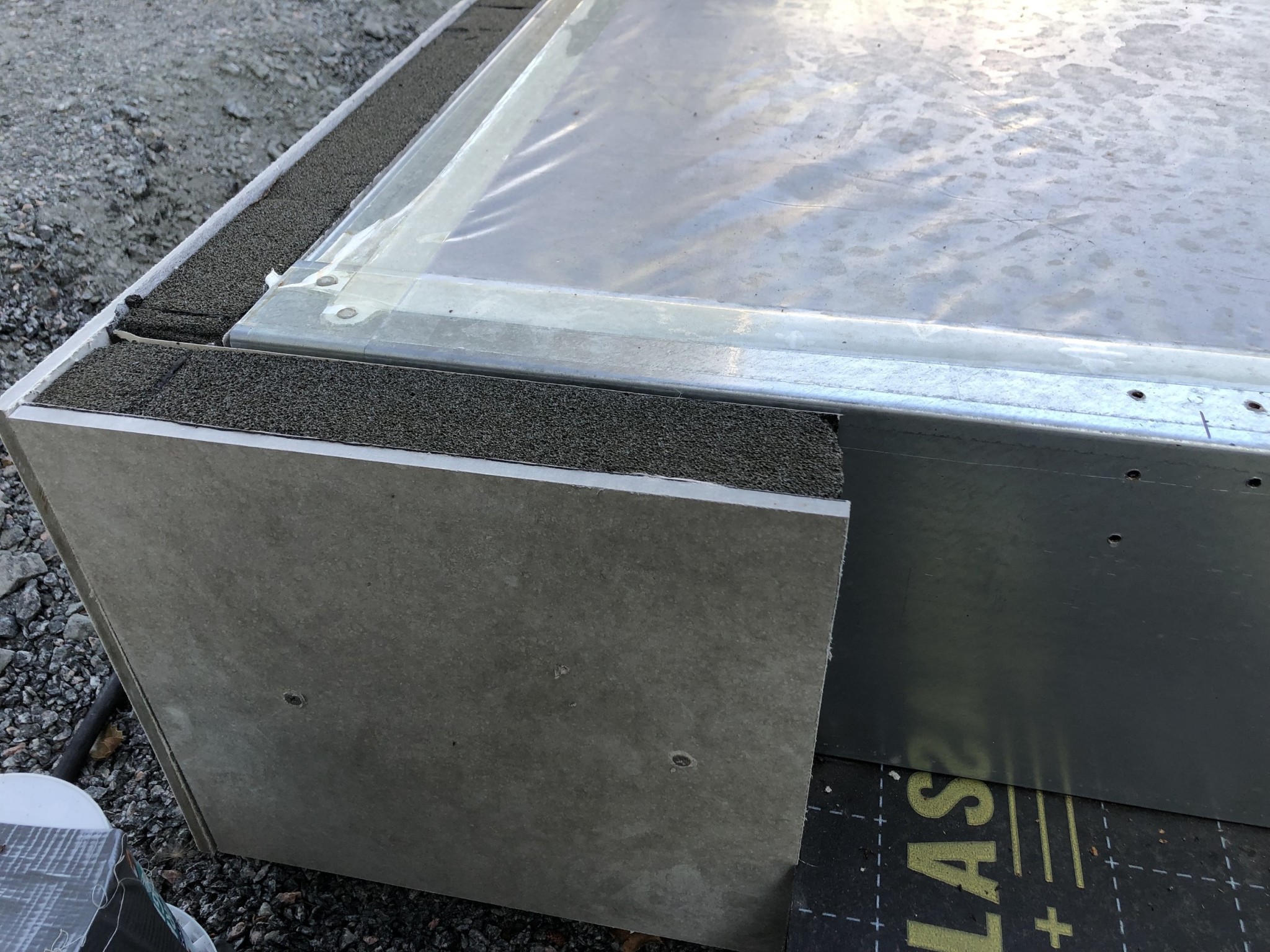
Koljern (KL Nordic AB) developed a concrete-free "slab-on-ground" solution that consists of galvanized steel lightweight beams and cell glass insulation, which is built in their factory and then transported and placed on-site. The sill is mounted in the metal stud which then houses the wall construction while the floor is laid on top of the steel beam-cell glass insulation elements. No problems are mentioned regarding potential moisture or similar issues in the floor, which I will return to.
Looking at Leif Tjälldén AB, which developed the Hybridgrunden, this is straightforward, an insulated crawl space or foundation with a joist floor on top of the foundation, and I quote:
The floor above the hybrid foundation, i.e., the space between the plastic film and the floor chipboard, should not be fully insulated but only soundproofed with 70 mm mineral wool. This is because the insulation is in the foundation, and the floor is then on the warm side. The sound insulation can either be attached at the top or bottom of the floor joists. If it's at the bottom, it can be laid on transverse joists or on the subfloor.
The text comes from information under the "installation" tab.
And now to my question.
Why does the moisture problem not exist for the Koljern foundation but it does for the Hybrid foundation? Is the Koljern foundation considered to be built on the cold side so that moisture does not accumulate as it can with the Hybrid foundation?
So, looking around a bit, it seems that the Koljern foundation, like a concrete slab, is mostly built downward so that the "wood layer" is found just above ground level, while the Hybrid foundation exists mostly above ground, and the floor joist is then exposed to greater temperature differences, hence the insulation recommendation?
In the Koljern alternative, there are no materials that are sensitive to moisture, which is often the case in "crawl spaces" where these are usually combined with organic materials. The Koljern alternative is also guaranteed to be airtight. What the Hybridgrund does is create an environment "suitable" for organic materials in the joists and ensure a hygienic indoor climate, a somewhat artificial solution to a problem that can often be avoided by not building a "crawl space."
Do you know the geotechnical conditions that prevail at the site? If not, it's good to find this out as it determines the choice of foundation.
Hi bossespecial, and thanks for the response. Briefly, I currently do not own any land, but I am only looking at the fundamentals with the intention of building myself, partly "for the sake of it" and partly to reduce the total cost.
1.) I really appreciate your perspective of "suitable" as I suspected this could be one of the main reasons. If there is a bit of air space, moisture can come and go between the insulation and the floor. Could it also be that since the plastic side is diffusion-tight downwards, it could create a layer of moisture collection and wetness?
2.) When it comes to the Koljern foundation, it should be considered that cellular glass insulation is capillary-breaking and their construction, as you point out, is completely airtight, partly because they build a climate shell around the "slab" (see image) which is additional insulation, moisture, and airtightness, something that the Hybrid foundation itself does not offer... but what if it did???
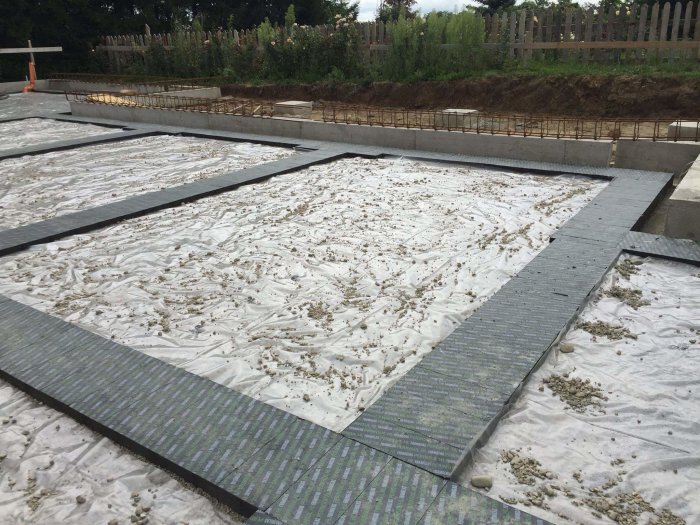
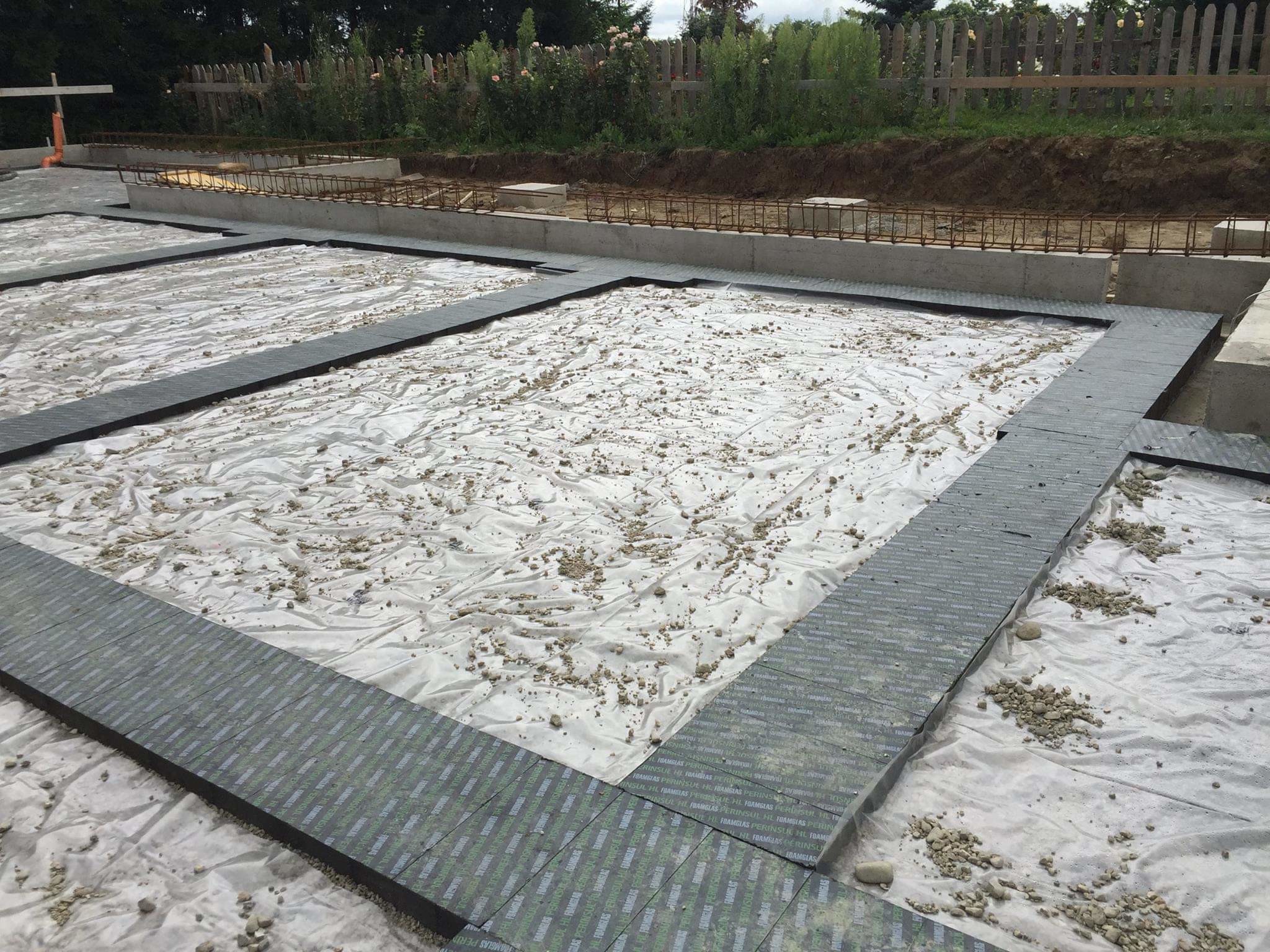
2.1) What if we start from a crawl space but instead of foam plastic, use cellular glass, build the bearer with Leca blocks resting on *Foamglas Perinsul, then create a climate shell that includes the joists similar to the Koljern method above. Shouldn't the organic wood material then be enclosed, moisture and airtight, thus avoiding moisture problems?
* Foamglas Perinsul is approved as a building element according to [Eurocode 6: Design of masonry structures - Part 1-1: General rules for reinforced and unreinforced masonry structures]. Perinsul is a combination of the words Perimeter and insulation.
While I was sleeping (as they say), I figured out how to build the foundation with as little hassle as possible while still starting from the Koljern/slab-on-ground perspective, and then I ended up with a KL timber slab on cell glass with bitumen or something similar as a connection. The linked article that you can see below goes through why such a foundation has much less climate impact and potentially can last longer than the Koljern foundation. Of course, it's the same person behind both Koljern and Trelicell, what a guy
While I was sleeping (as they say), I figured out how to build the foundation with as little hassle as possible while still starting from the Koljern / slab-on-grade perspective, and then I end up with CLT slab on foam glass with bitumen or similar as a connection. The linked article you can see below this text goes through why such a foundation has much less climate impact and potentially can last longer than the Koljern foundation. Of course, it's the same person behind both Koljern and Trelicell, what a guy
[link]
Hi. How are the foundation plans going?
I'm exploring options for building new and, like you, am looking into alternatives to the beloved concrete slab, which should also be in a similar price range or cheaper. I glanced briefly at the link and feel that Trelicell is still in the concept stage. Is it available for purchase, and have you received any price information?
Jag sonderar för att bygga nytt och är precis som du inne på alternativ till den älskade betongplattan, det bör även vara i liknande prisklass eller billigare. Kikade kort på länken och upplever att trelicell fortfarande är i konceptstadie. Finns det att köpa och h
Naturlig obegåvning said:
Hej. Hur går det med grundplanerna?
Jag sonderar för att bygga nytt och är precis som du inne på alternativ till den älskade betongplattan, det bör även vara i liknande prisklass eller billigare. Kikade kort på länken och upplever att trelicell fortfarande är i konceptstadie. Finns det att köpa och har du fått någon prisuppgift?
ar du fått någon prisuppgift?
Hej. Jag skapade en blogg i somras där jag gick igenom en del saker som vilket isoleringsmaterial för vägg och grund, vilket ledde fram till en hel del intressant fakta som jag är glad jag spenderade tid på. Medan jag jobbade på det så tog jag fram en grund som bygger på arbetet koljern gjorde när de utvecklade sin grund, men eftersom stål balkarna dom använder kostar flera gånger mer än en träbalk, så gick jag tillbaka till ett hederligt träbalks fundament ovanpå skumglaset. Detta kan du läsa om under [That which everything rests upon.] inlägget. Men nu sitter jag och funderar på om jag ändå ska gå tillbaka till Leca sula/betong och mur men behålla skumglas & fibercement skalet medan Perliten naturligt följer med (som du kan läsa om).
Att bygga med Leca och trä är betydligt billigare och enklare då jag inte behöver ta in hjälp och jag kan förhandskapa allt material innan jag lägger ut och monterar. Så i skrivande stund så har jag två alternativ att jobba med. Nu ligger mitt bygge några år bort då jag tänkte spara till allt istället för att ta lån, men inte bara det, jag ska hitta min tomt me, bara det är en resa ...
Onemind. The hybrid foundation that I read about in your link is interesting!! But perlite is not renewable. Replacing the foam glass boards with 300mm foam glass granulate and perlite with 300mm foam glass granulate provides 600mm insulation at a lower cost (alternative: flax insulation in the top floor?). Any leaks run straight through the foam glass down into the ground! Underfloor heating in the installation floor gives waste heat down into the flooring which keeps the wood dry? What do you think? I am planning to build in Västergötland myself and am considering the most suitable foundation. Regards tomas.fredholm@hotmail.com
Note that earlier in the thread I mentioned that when I eventually build, it won't be with Foam Glass Sheets, but with traditional Leca blocks, although I will adapt foam glass sheet insulation along the sides, according to the Koljern foundation.
Since Perlite is a loose mass it can be removed and "reused" elsewhere, just like foam glass. The great thing about Perlite is that it breaks capillarity after 6mm, I don't think foam glass granulate does that and there is much more void between the granules as they are so large which can lead water vapor both ways. Floor heating helps to keep some of the moisture away, but it's important to insulate under the coils to minimize leakage into the foundation. As long as moisture doesn't get in, no heating is needed down there. Since it is unventilated, there are no issues with dew point and moisture influx as a traditional ventilated crawl space has. There are indeed active systems that can drive away moisture, but it's best to cut off the supply.
The hybrid foundation is nice in that it's ready-made (Lego) while the Leca perspective is more traditional building. What is best is personal. There is always an extra cost when purchasing ready-made systems which is as it should be since someone else has spent time on development, manufacturing, etc. But this also applies to the house itself, buying pre-fabricated versus building from scratch. Time is a factor, absolutely, and if you are short on time, you simply have to buy the services.

 , and now I've reached a point where I'd like a bit of help, and I'll try to explain my "dilemma" as best as I can.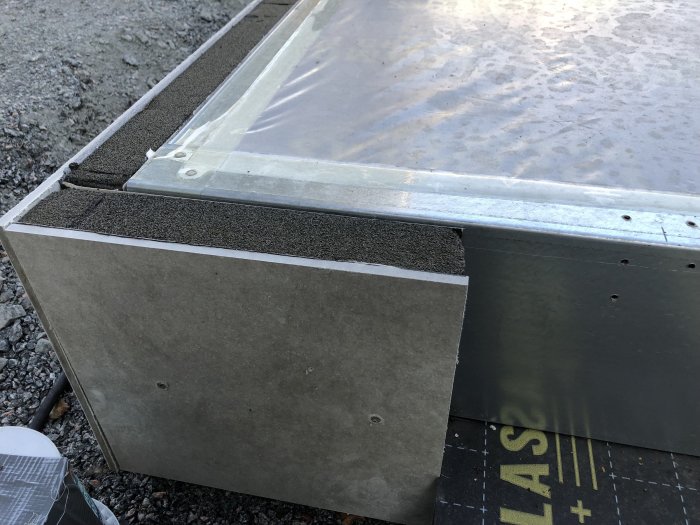
Naturlig obegåvning said:
Hej. Hur går det med grundplanerna?