
17,339 views ·
65 replies
17k views
65 replies
Isolate vibrations from neighbor
Well, there are gaps up to 0.5 cm all around the wall to the steel frame.I icho said:
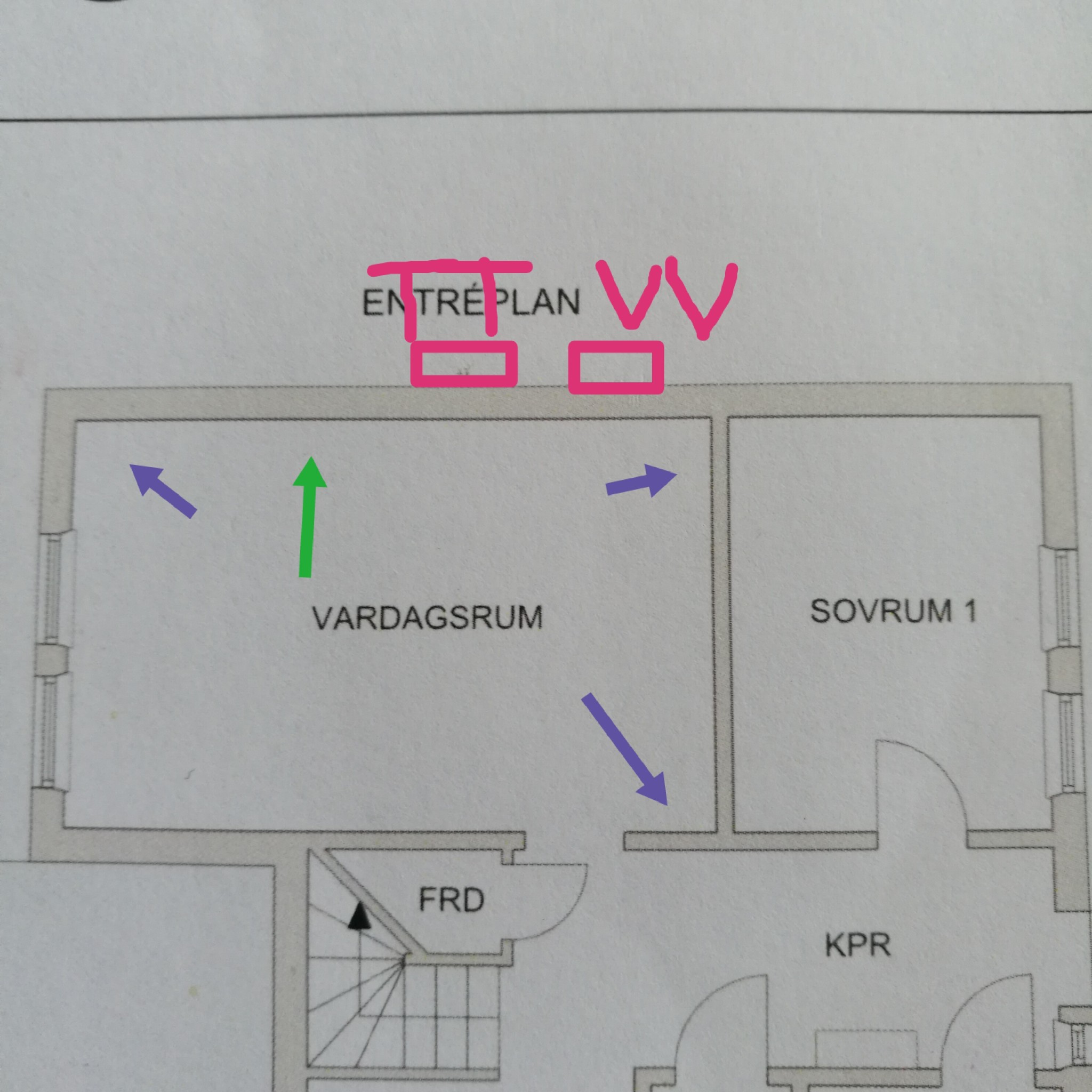
The funny thing is that in some spots you don't hear the noise while it’s amplified in, for example, the corners. Just moving a meter sideways on the couch makes the noise more noticeable. Could something like curtains help block it? I've recently moved in, so the walls are bare, and there are no curtains.
At the purple arrows, the noise is the worst. At the green arrow, you can sit without hearing it.
Yes, sorry. I should have written FTX. Yes, they are from the building year and the same with the fans that were in ours.Ulltand said:
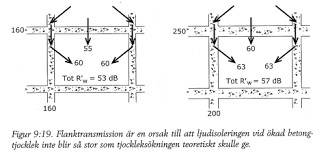
That looks like flank transmission. The sound travels through the floor and/or ceiling joists. It can indeed become stronger than directly through the wall. For low-frequency sound, mass is beneficial, so in that regard, two layers of drywall are better than one. However, it will not help against flank transmission. Additionally, if the room is fully furnished, it might be perceived as better.
Yes, you can hear vibrations in the floor too, unfortunately, there's a concrete slab under the parquet. Is there anything that can be done about this phenomenon?That looks like flanking transmission. The sound travels through the floor and/or ceiling joists. It can indeed become stronger than directly through the wall. For low-frequency sound, mass is beneficial, so in that regard, two layers of gypsum are better than one. However, that won't help against flanking transmission. If the room is fully furnished, it might feel better.

Tool enthusiast
· Stockholm
· 1 399 posts
The fact that you experience the noise more strongly in the corners is not surprising, as the sound pressure is greatest there. It can be simply explained as the sound "gathering" in the corners. If it's low frequencies, you will also experience the noise differently in strength depending on where you are in the room (lengthwise, widthwise, and even in height). The standing waves depend on the room dimensions.
Curtains do not alleviate the problem.
Regarding the wall construction, it can actually worsen the issue because there are two closed volumes one after the other (Google "triple leaf"). The resonance in the two stud cavities acts counterproductively at certain frequencies.
Ideally, the gypsum on your inner wall should be removed before a new stud frame is erected.
When it comes to noise disturbances, one first looks at the noise source and sees what can be addressed there. To map out what is airborne noise and structure-borne noise, one can, for example, try unscrewing the unit from the wall and running it to listen to what happens.
If the noise decreases to an acceptable level, it is most likely sufficient to mount the unit with a decoupled bracket with Sylomer for vibration isolation on the wall. However, it is preferable to have as large an air gap as possible between the unit and the wall.
Curtains do not alleviate the problem.
Regarding the wall construction, it can actually worsen the issue because there are two closed volumes one after the other (Google "triple leaf"). The resonance in the two stud cavities acts counterproductively at certain frequencies.
Ideally, the gypsum on your inner wall should be removed before a new stud frame is erected.
When it comes to noise disturbances, one first looks at the noise source and sees what can be addressed there. To map out what is airborne noise and structure-borne noise, one can, for example, try unscrewing the unit from the wall and running it to listen to what happens.
If the noise decreases to an acceptable level, it is most likely sufficient to mount the unit with a decoupled bracket with Sylomer for vibration isolation on the wall. However, it is preferable to have as large an air gap as possible between the unit and the wall.
If the unit cannot be placed on the floor, a bracket with rubber bushings, novibra, or for example feet of silence might be an idea. https://www.hifiexperience.se/produ...2dgNPBbgZpcwZXi0HNkJdlbMj_TO7vnhoC4v0QAvD_BwE
If it's structure-borne sound (which it seems to be), then mass is the key. A number of layers of floor gypsum (much heavier than usual) screwed up at random places have both mass and a low resonance. If you can have a couple of centimeters between these gypsum layers and the existing wall, it further reduces the risk of structure-borne sound. Using porous insulation of the thickness you mentioned does not help to insulate against low-frequency sound, it's mainly used to counteract box resonances (should not be the case here).
Best regards,
Hifinörden
If it's structure-borne sound (which it seems to be), then mass is the key. A number of layers of floor gypsum (much heavier than usual) screwed up at random places have both mass and a low resonance. If you can have a couple of centimeters between these gypsum layers and the existing wall, it further reduces the risk of structure-borne sound. Using porous insulation of the thickness you mentioned does not help to insulate against low-frequency sound, it's mainly used to counteract box resonances (should not be the case here).
Best regards,
Hifinörden
Addressing the sound source, as mentioned above, is crucial. I think the neighbor might have a responsibility for it as well. Especially if the equipment is improperly mounted or has started to vibrate because it is worn out.P danneha said:
Björn Melander describes the problem well, I think. However, I would like to add that attempting to build away low-frequency vibrations is futile. The only reasonable solution is to address them at the source. Rubber mounts between the wall and the unit located in existing holes are definitely the simplest and cheapest. After that, a floor stand which must, of course, also have good rubber dampeners. The best is, of course, to balance the fans, but I have no idea how to do it practically.
Sure, they can help a little with more layers of plasterboard, etc., but only marginally. You seem to have discovered this yourself through a practical experiment.
Sure, they can help a little with more layers of plasterboard, etc., but only marginally. You seem to have discovered this yourself through a practical experiment.
Tool enthusiast
· Stockholm
· 1 399 posts
The principle is to add as much mass as possible to both the vibrating component and the base itself. The decoupling is then done with an isolator, such as sylomer, which is dimensioned according to the weight. This is important for the isolator to work within its dynamic range and not short-circuit.
Renovate your fans with new bearings and some nerdy form of balancing. Then, when you're satisfied, knock on your neighbor's door and swap their fans with your newly renovated ones and see how it goes. Well, renovate the neighbor's before you install them in your place.
Then try to develop a new suspension system like you were planning. There can also be noise from ventilation even if the fans are in good condition. More silencers might be the solution there if the noise comes from "self-vibrating" rigid ventilation ducts.
Then try to develop a new suspension system like you were planning. There can also be noise from ventilation even if the fans are in good condition. More silencers might be the solution there if the noise comes from "self-vibrating" rigid ventilation ducts.

There should be a big difference going from wall mounting to standing on the slab.
Wall-mounted LLVP makes more noise/vibrations than one standing on legs, for example. Even when it's newly installed with accompanying rubber bushings.
I have myself screwed up a water filter on consoles on a stud/drywall. It makes a hell of a noise when the pump fills up the hydrophore.
Wall-mounted LLVP makes more noise/vibrations than one standing on legs, for example. Even when it's newly installed with accompanying rubber bushings.
I have myself screwed up a water filter on consoles on a stud/drywall. It makes a hell of a noise when the pump fills up the hydrophore.