
17,290 views ·
65 replies
17k views
65 replies
Isolate vibrations from neighbor
Moved into a new semi-detached house and unfortunately experiencing vibrations in the living room from the neighbor's heat exchanger, which is located behind the living room wall in their laundry room.
Spoke with them, and the unit is old, from '85. They have cleaned the fans but there is still a low rumbling vibration. Worse in the corners of our living room. However, nothing is heard in the room upstairs or the room next to the living room.
Will a new wall with steel studs, insulation, and double layers of drywall help eliminate the noise?
Also, what is the best way to handle the ceiling and floor? Should the existing drywall and parquet be removed? I guess it's necessary to find a joist in the ceiling to attach the steel stud?
Spoke with them, and the unit is old, from '85. They have cleaned the fans but there is still a low rumbling vibration. Worse in the corners of our living room. However, nothing is heard in the room upstairs or the room next to the living room.
Will a new wall with steel studs, insulation, and double layers of drywall help eliminate the noise?
Also, what is the best way to handle the ceiling and floor? Should the existing drywall and parquet be removed? I guess it's necessary to find a joist in the ceiling to attach the steel stud?

We have discussed this but it feels like it's getting expensive. It is probably the best solution. However, I have read about others who have installed newer units that have experienced similar problems with vibrations in the structure. Unfortunately, their unit is screwed into the wall that separates us.
Ours is clearly newer than -85, but it causes some vibrations and noise in the walls. It's currently on a floor we don't use, so it doesn't bother us much, but a company that came here and adjusted it said a new motor for a few thousand would make it quiet. Could perhaps be an intermediate solution for you. And when someone is there replacing the motor, maybe it could get rubber feet if possible.
Exactly, I have looked at new fans and ordered them for ours as I need to do something about it too. I think that if you detach their unit from the wall and place it on the floor, which is a concrete slab, the noise should decrease. However, the unit doesn't seem to be made with legs unfortunately, only hung up.
If we still choose to build insulation on our side, I wonder what would be best against vibrations in the wall.
1. Add an additional gypsum board that is heavy and rigid, perhaps floor gypsum? That would mean 3 layers of gypsum. Or maybe even 4 layers in total. Is it possible to attach?
2. Build a new interior wall 1cm from the old one with metal studs, insulation, and double layers of gypsum.
1. Add an additional gypsum board that is heavy and rigid, perhaps floor gypsum? That would mean 3 layers of gypsum. Or maybe even 4 layers in total. Is it possible to attach?
2. Build a new interior wall 1cm from the old one with metal studs, insulation, and double layers of gypsum.

It turned out to be both the dryer and the drying cabinet making noise through the wall. Therefore, I've started the construction.
I don't know if I should fasten the vertical studs when I start putting up the drywall in case there's a few mm of difference, which could mess things up at the end. Then you can adjust as you go. The studs are only 40mm wide, so there's not much to screw into. Anyone have any tips? The drywall panels might have very precise measurements, but I haven't bought them yet.
I don't know if I should fasten the vertical studs when I start putting up the drywall in case there's a few mm of difference, which could mess things up at the end. Then you can adjust as you go. The studs are only 40mm wide, so there's not much to screw into. Anyone have any tips? The drywall panels might have very precise measurements, but I haven't bought them yet.
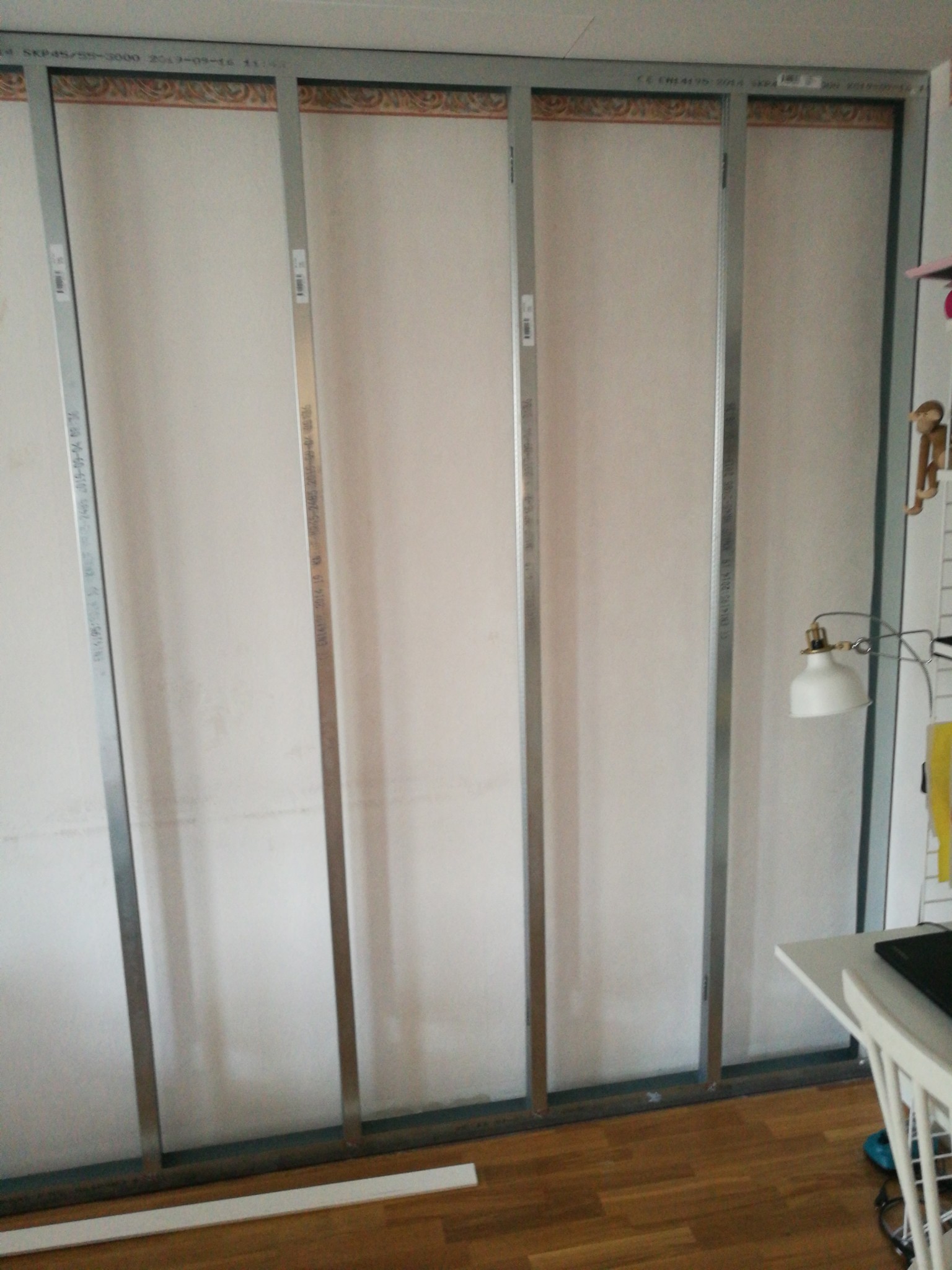

That should be fine - I myself clip the studs in place with the designated clamp at one end and let the other run freely until the drywall or ply is up. Install them with a small magnetic level for a flying start.
Remember to use the right insulation for sound - Isover Piano Ljudskiva is intended for soundproofing.
If you're going to hang things on the wall, I would use OSB or K-Plywood.
If you use double layers of drywall, remember to stagger the seams so both layers don't land on the same stud.
Make it a habit to mark the locations of the studs on the panel before installation - it makes it easier, and start against a wall for a straight beginning.
Good luck!
Remember to use the right insulation for sound - Isover Piano Ljudskiva is intended for soundproofing.
If you're going to hang things on the wall, I would use OSB or K-Plywood.
If you use double layers of drywall, remember to stagger the seams so both layers don't land on the same stud.
Make it a habit to mark the locations of the studs on the panel before installation - it makes it easier, and start against a wall for a straight beginning.
Good luck!
The insulation should eliminate the resonance... sure, the risk is, as you mentioned before, that it can travel in the structure - but as long as you keep a small air gap between the new wall and the old one, it shouldn't come from the wall in any case.
Came to think of something now that I'm going to insulate. The last two meters of the wall are outer wall. The rest faces their laundry room. Could there potentially be problems with condensation inside the wall if I have an air gap between the old drywall and the new insulation? Or should I fill with insulation against the old drywall there?