
17,305 views ·
65 replies
17k views
65 replies
Isolate vibrations from neighbor

If the house is built in modern times and has a vapor barrier, it's probably not a good idea to insulate significantly, since the vapor barrier will likely be on the cold side.
If noise isn't a problem in that part, perhaps a partition can be made and that part left uninsulated. A vent or similar into the room is probably also needed to reduce the risk of moisture/condensation.
If noise isn't a problem in that part, perhaps a partition can be made and that part left uninsulated. A vent or similar into the room is probably also needed to reduce the risk of moisture/condensation.
Thanks for the response. I called Isover technical support, and they suggested I could fully insulate since the existing insulation in the exterior wall is about 180mm and the new one would add 90. Provided that there is a vapor barrier inside the plasterboard on the old wall. If I was still worried about moisture, I could, as you wrote, avoid insulation at the exterior wall.
I might have to install a temperature sensor there to monitor during the winter. But as you mentioned, a vent might be needed in that part, although it would compromise the sound insulation somewhat.
I might have to install a temperature sensor there to monitor during the winter. But as you mentioned, a vent might be needed in that part, although it would compromise the sound insulation somewhat.
Yes, it's borderline, so a hygrometer and thermometer wouldn't be wrong. They're always good to have, so if you think everything seems okay after a winter or two, they can definitely be useful somewhere else.
I know from personal experience that mold can develop behind a couple of Billy bookshelves. It was an exposed outer corner of the wall, perhaps not perfectly insulated, along with moderate ventilation and a laundry dryer in the room sometimes. Didn't notice anything until we moved and took down the bookshelves.
I know from personal experience that mold can develop behind a couple of Billy bookshelves. It was an exposed outer corner of the wall, perhaps not perfectly insulated, along with moderate ventilation and a laundry dryer in the room sometimes. Didn't notice anything until we moved and took down the bookshelves.
Have insulated and put a layer of drywall now. However, not fully screwed and not sealed along floor walls and ceiling. The sound became a bit more muffled but unfortunately, there are still vibrations in the new wall from the heat exchanger and you can hear when they run the dryer.
The question is whether it's even worth putting on another layer of drywall? If it will help?
Feels like you would need 10 layers to get proper weight.
There is resonance in certain spots in the living room, the corners are the worst. Now I don't know if there is anything to do except go to the failing source.
The question is whether it's even worth putting on another layer of drywall? If it will help?
Feels like you would need 10 layers to get proper weight.
There is resonance in certain spots in the living room, the corners are the worst. Now I don't know if there is anything to do except go to the failing source.
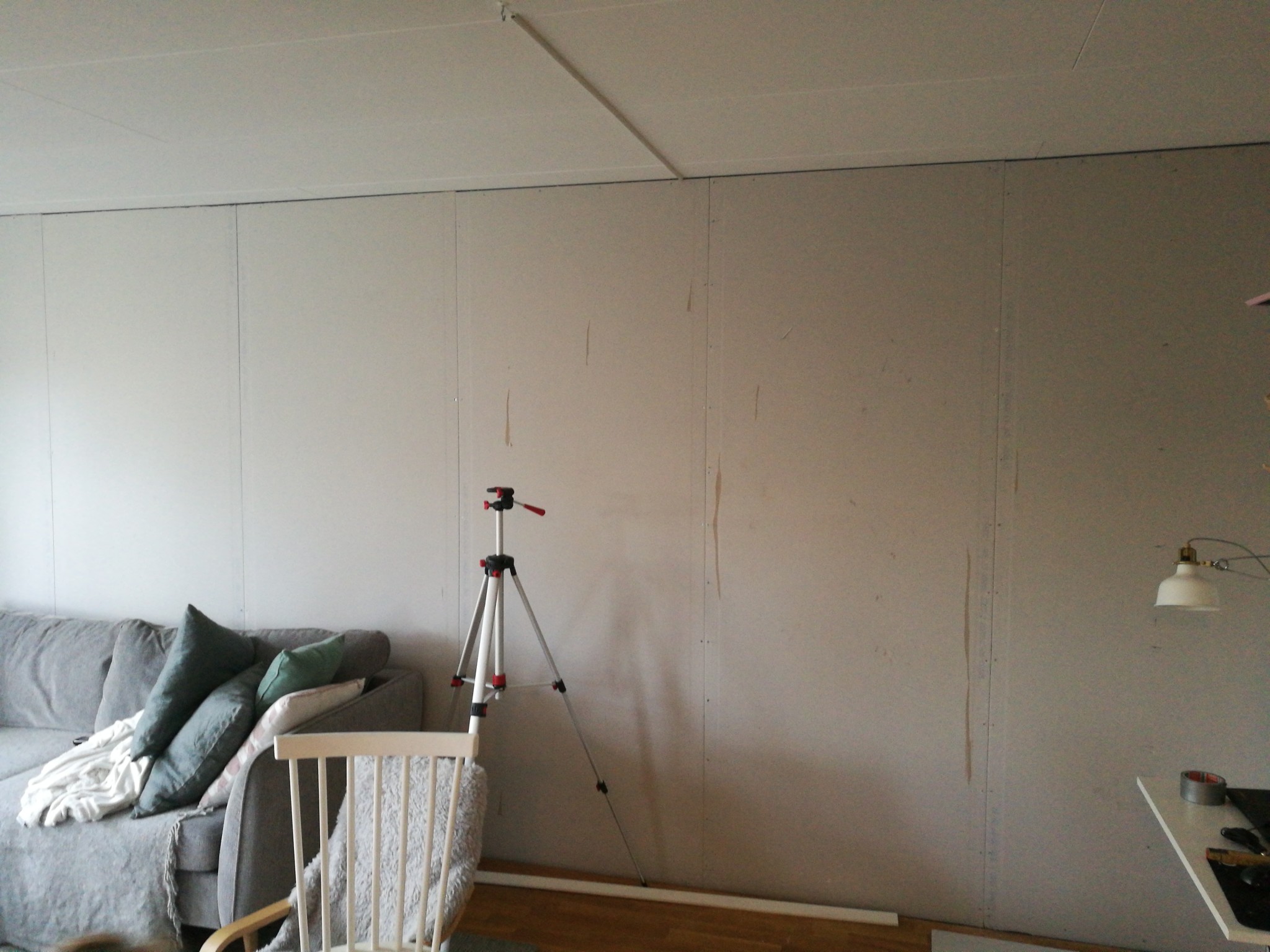
Right now it feels like the wall construction was unnecessary as it also took up 10cm of the room.
Maybe I should consider demolishing the wall and screwing/gluing more plasterboards onto the existing wall. So that there are about 4 layers there.
Maybe I should consider demolishing the wall and screwing/gluing more plasterboards onto the existing wall. So that there are about 4 layers there.
That said, I have just put up a layer of drywall that is not completely screwed in yet. The idea is to apply a soft joint and then put on another layer with staggered seams. But right now it feels like the whole new wall is vibrating about the same, so I'm not sure if it's worth the effort.

Know-It-All
· Västra Götaland
· 12 495 posts
It doesn't get worse, but it's probably a lot of structural vibrations involved, and they're hard to eliminate without addressing the source. However, a modern washing machine is barely audible through a closed silent interior door. If you ask to adjust the feet on the machine at your neighbor's place, the noise might be reduced.
Unfortunately, it's their heat exchanger that causes the most vibrations as it is mounted directly on the wall. According to the installation instructions, it should actually be standing on legs. That's probably the real issue. I just need to figure out how they have fastened it and find suitable legs.
In hindsight, I should have started there.
In hindsight, I should have started there.
A wall with a theoretical sound reduction index R’w=48dB loses 10dB in reduction at a 1m long 3mm gap. So, I would have sealed and then put up the other panel. If you can measure what frequency the noise is at, you can more easily get an answer from an acoustician here.
I think it's an imbalance in the fans attached. My exhaust fan was full of dirt, so I cleaned it, but eventually had to buy a new one as the bearings started to go bad. It got a little better but still have vibrations from it too.Ulltand said:
Then we are talking about a ventilation unit here? If it's from 85, it has exceeded its technical lifespan and it's appropriate to replace motors and fans. Otherwise, a fan can be balanced in the same way as a car wheel.P danneha said: