
Hello!
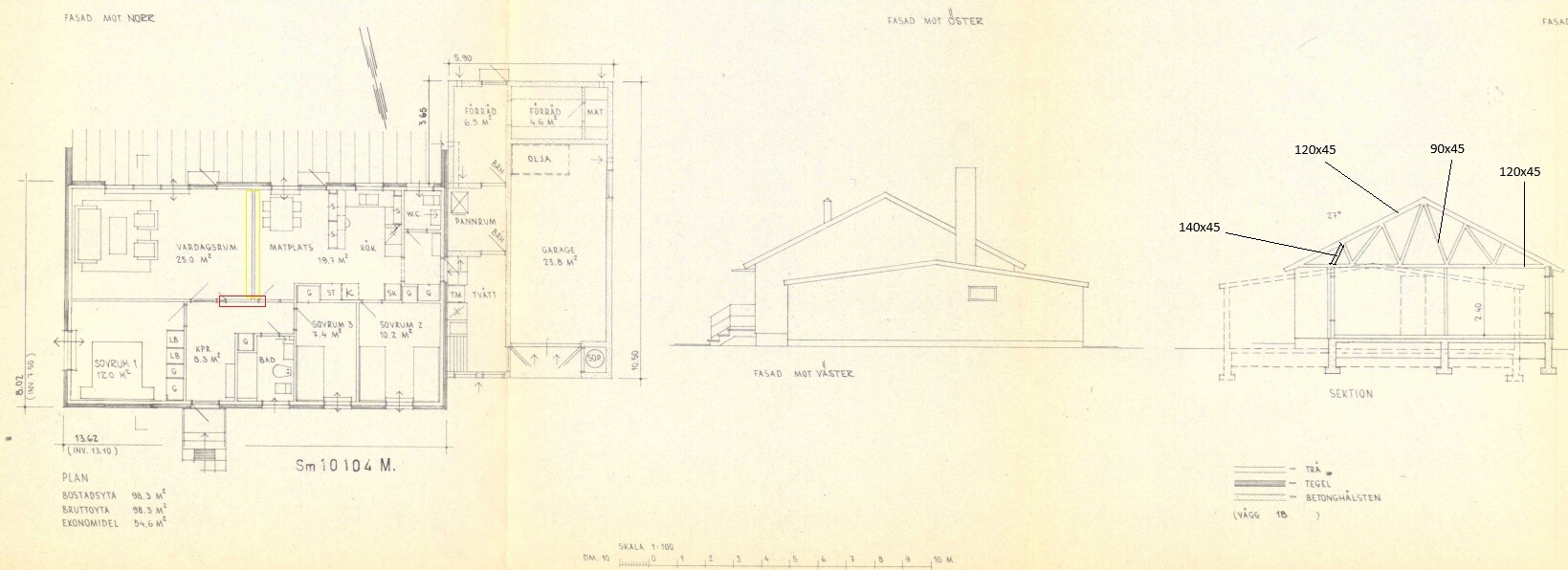
I have a question regarding the roof trusses on our Hultfred house from 1968. The house is a single-story house with a cold attic and a crawl space with Zandapannor tiles. The interior walls consist of fiber planks where all the interior walls have the same dimension, and the exterior wall planks are thicker. As I've read in many threads, truss roof trusses are often self-supporting, and I hope that is the case here as well. I don't have a drawing of the trusses or a document describing the construction, and the municipality does not have any more drawings than the one I have attached.
I have measured the attic's different parts and drawn on the picture for the trusses. The house is located in Skåne, Svalöv, where the snow zone is 1.5. The trusses are spaced at c/c 1200 and are 11 in number.
The previous owner opened up between the kitchen and living room and thus demolished a wall marked "yellow" on the drawing, leaving the red-marked part. I want to remove the doors and tear down that small piece of wall, so my question is, can these fiber planks be load-bearing? The sectional drawing is what makes me uncertain.
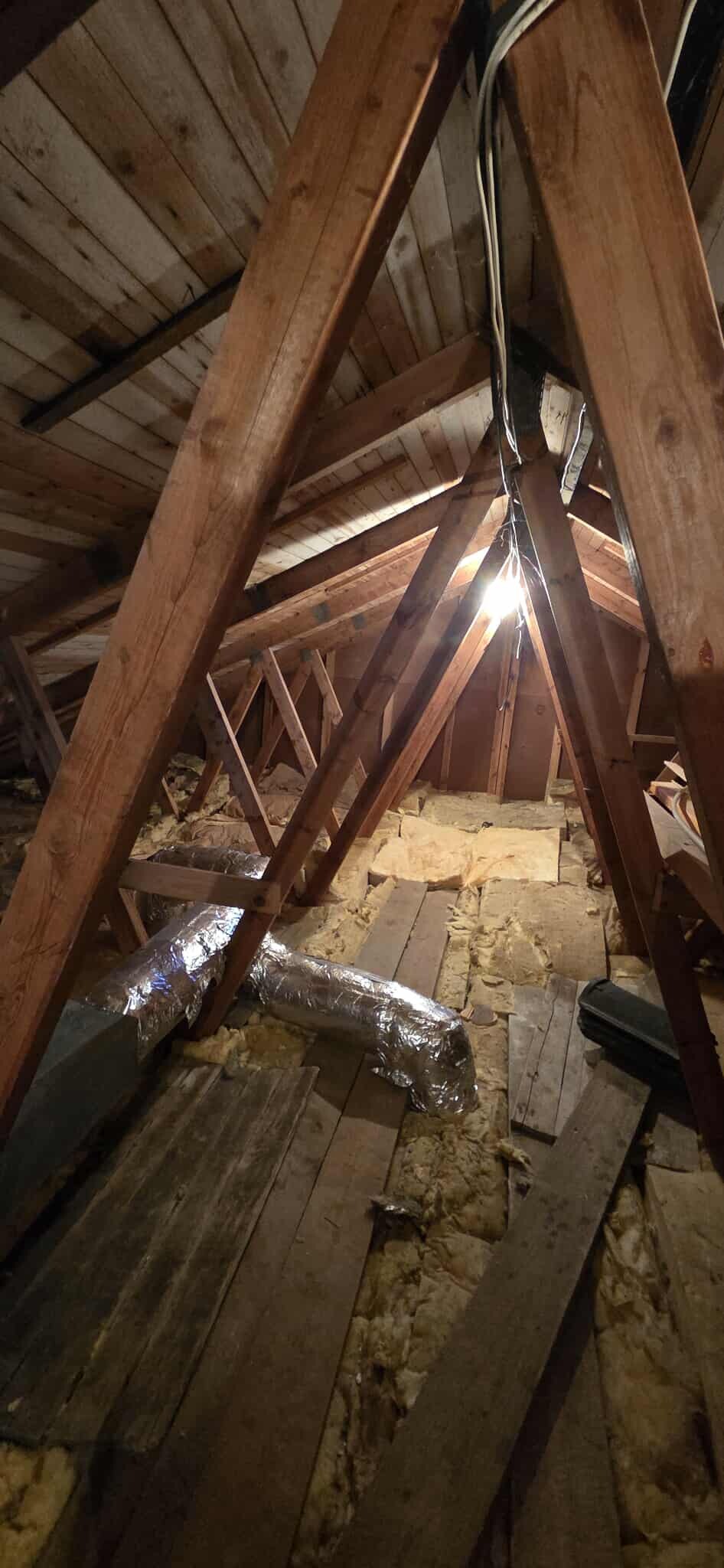
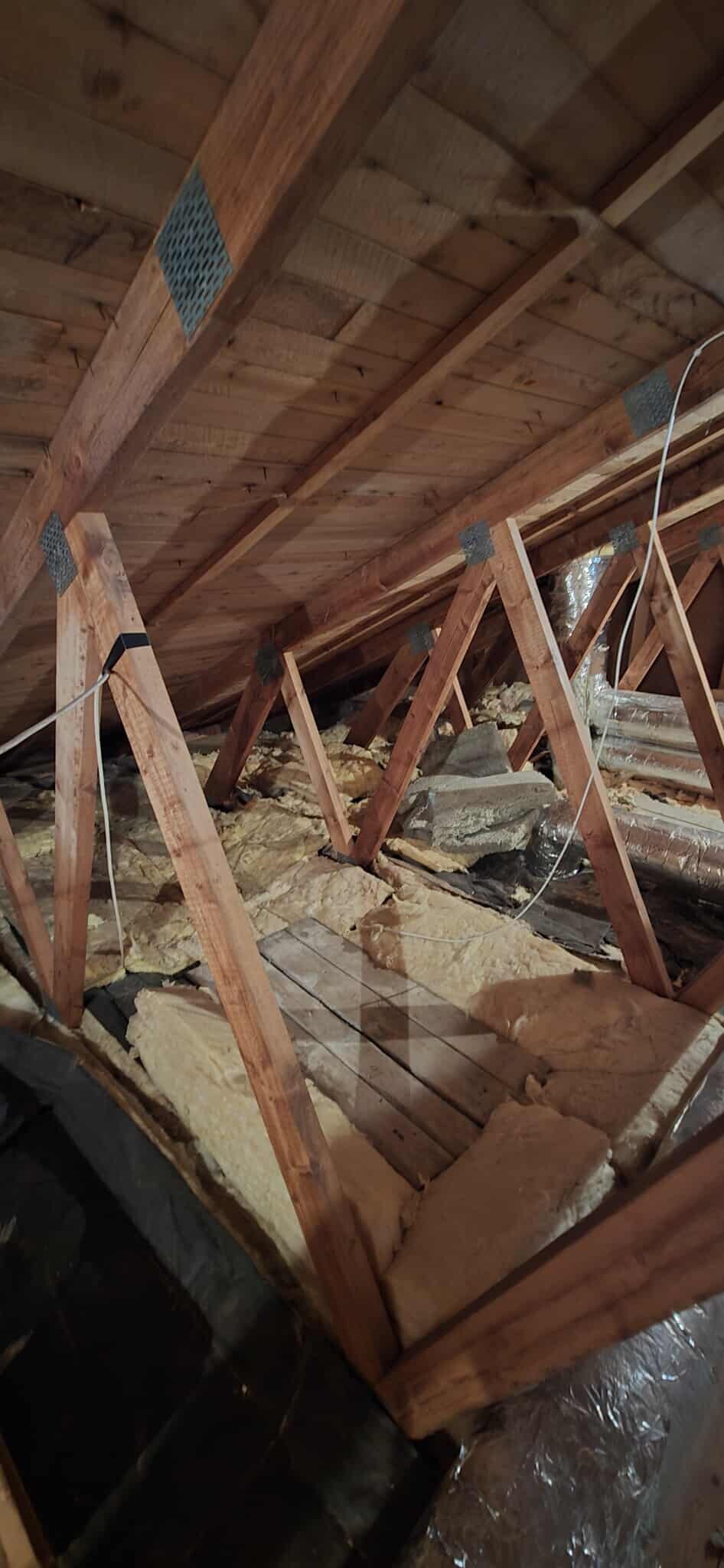
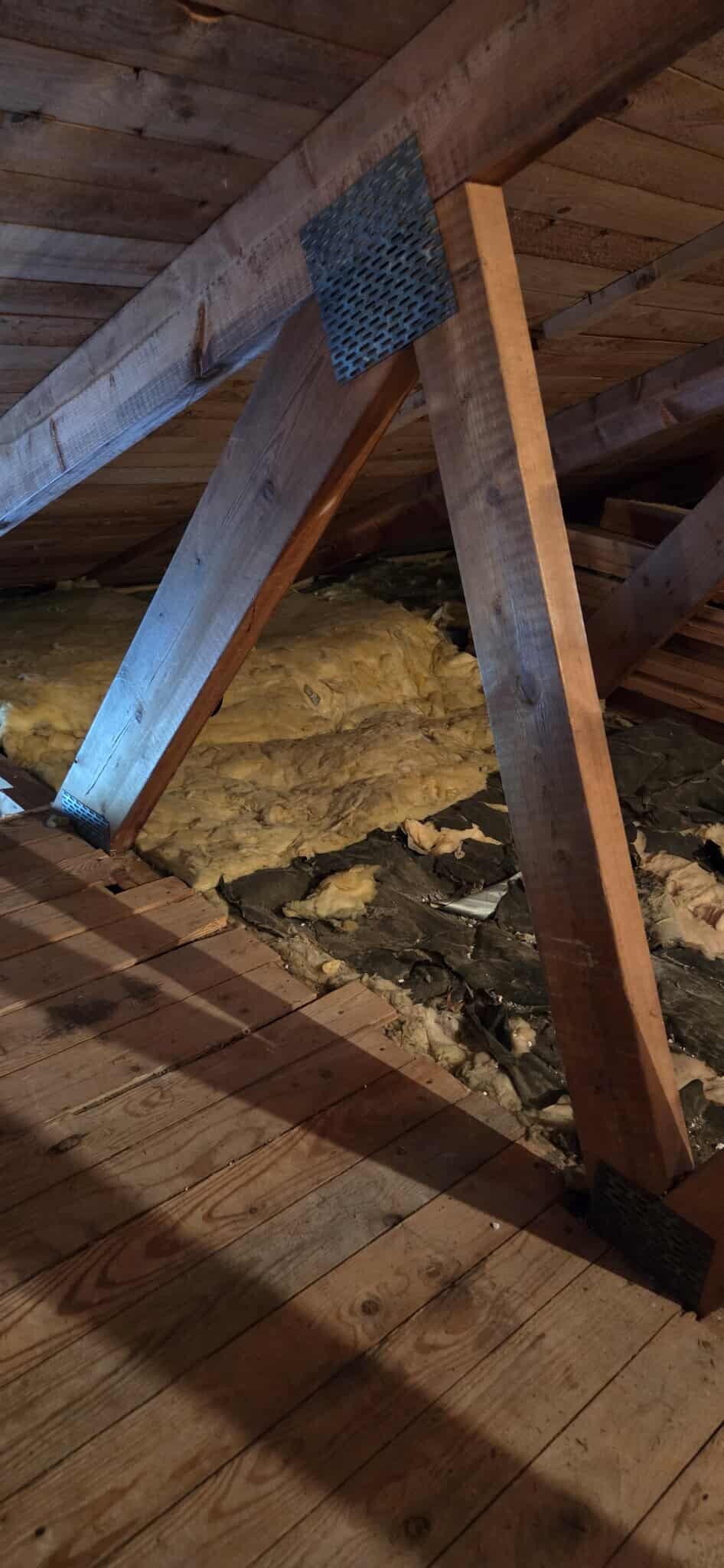
Attached are pictures; all trusses look the same except towards the east, where one part is thicker towards the end, which is shown in the sectional drawing.
Grateful for assistance!
I have a question regarding the roof trusses on our Hultfred house from 1968. The house is a single-story house with a cold attic and a crawl space with Zandapannor tiles. The interior walls consist of fiber planks where all the interior walls have the same dimension, and the exterior wall planks are thicker. As I've read in many threads, truss roof trusses are often self-supporting, and I hope that is the case here as well. I don't have a drawing of the trusses or a document describing the construction, and the municipality does not have any more drawings than the one I have attached.
I have measured the attic's different parts and drawn on the picture for the trusses. The house is located in Skåne, Svalöv, where the snow zone is 1.5. The trusses are spaced at c/c 1200 and are 11 in number.
The previous owner opened up between the kitchen and living room and thus demolished a wall marked "yellow" on the drawing, leaving the red-marked part. I want to remove the doors and tear down that small piece of wall, so my question is, can these fiber planks be load-bearing? The sectional drawing is what makes me uncertain.
Attached are pictures; all trusses look the same except towards the east, where one part is thicker towards the end, which is shown in the sectional drawing.
Grateful for assistance!
How can you tell? I know that the brace on the edge is against the load-bearing exterior wall on the sectional drawing.A a_w said:
But in the large W, the thin interior walls consist of fiberplank. The walls are 70mm thick and 95mm with Tretex as a surface layer.
The fiberplank are 30cm wide. 2 elements are 20cm. The wall consists of 4 elements.
From what I can see, one of the roof trusses runs continuously through the house from the hall to the patio door freely.
I would also say that it is load-bearing, primarily based on the fact that the wall is included in the section drawing, but especially since the slab is reinforced under the middle wall. This strongly suggests that the wall is made to bear loads from the roof trusses.
J JSten said:
The slab consists of Erge Bjälklag where the concrete beams run longitudinally in the same direction as the roof trusses but that might have no significance in the whole matter.J JSten said:
Click here to reply