
50,115 views ·
188 replies
50k views
188 replies
How to make construction drawings?
Absolutely! Since I don't understand anything at all about the entire drawing, it's difficult for me to choose 5 points that I think will help me the most. Do you think I should create a whole new thread to ask or should I do it here?T tgr_se said:


Check the assembly instructions on various manufacturers' websites. Isover has good descriptions of different types of constructions with some explanations. But other manufacturers like Planja, LK, etc., also have good instructions and downloadable brochures from which you can draw many conclusions if you understand the underlying physics. Various industry organizations have publications with general rules, like Säker vatten, which can help to understand why certain methods are always used.
Exactly! Finally someone who understands me! I am very interested in WHY it's built the way it is. Why have a vapor barrier? Why have an air gap? Can it be done in another way? Why have insulation right there? My brain bombards itself with these questions when I see such a drawing. How do you think I can learn this myself in the best way? Is it by taking an example drawing and starting to figure out what each specific part is for and asking here on the forum if I get stuck? It feels like in that case I will need to spam with questions because I can't find much theoretical info about it anywherejoakim_j said:
The most important question to ask as an engineer is "why?" instead of the builder's simpler "what?". For example, on the drawing above: the builder might wonder "what is a vapor barrier?", the answer is "a plastic sheet". One might be satisfied with that, but the engineer wants more: why have a vapor barrier? Can it be done in another way? (The debate about vapor barriers has been written about extensively here on the forum)
And as mentioned, think through things yourself, don't be satisfied with someone’s answer, no matter how confident it is. Just because "everyone" does something doesn't mean it's right. Especially in construction.
It sounds like a good start. Then you should also remember that many standard solutions are just standard. Sure, you can calculate air movements, vapor pressure, and dew points to determine if you really need a vapor barrier or air gap on that particular square meter of wall, but by building the same way all the time, the paid craftsman avoids scratching their head and trying to understand the details on paid work time.
Awesome! You can definitely learn a lot on your own without needing to go to school, but even there, limits exist.R Robert-san01 said:I am an electrical engineer. Everything related to construction I have taught myself, so much can be learned without going to school. I looked at drawings, learned standards, and watched guides for building in wood, concrete, etc.
I'm not an expert in construction, but I have a good understanding of how to build and can understand how structures are built.
Do you have tips on how I can teach myself? Any specific guides that helped you understand?
I want not only to learn how to build. I want to understand WHY you build the way you do. Most guides, etc., only show "this is how you should do it," but there's nothing about why. It's my job as an engineer to understand why.How do you learn that then? Is practical experience in house building the only way to gain knowledge about this? I find it very interesting and want to learn. Even if it's just a little.R Robert-san01 said:
The problem with these guides and AMA, among others, is that they only say "this is how you should do it" but do not explain why. As an engineer, I am interested in WHY it should be built that way. How can I gain that knowledge? Should I try to find an example drawing (like the one I sent earlier, for instance) and start figuring out what each specific part's purpose is and ask here on the forum if I get stuck? It feels like I will then spam the forum with questions because I have not yet found any guide, book, or other source where more detailed explanations are given about why it is built the way it is. Everything I find only states how it should be built but does not explain why. Or maybe I am looking in completely the wrong place. Please drop tips on places where I can find more theoretical explanationsuseless said:
There is plenty to read online about, for example, moisture issues in different constructions. Otherwise, as mentioned, Träguiden and Bygg-AMA are goldmines when it comes to detailed solutions. But as usual, it is important to examine a solution and try to understand why, for example, there is an air gap in a certain place or why the boards should be nailed in a certain way so they don't crack.
It's just a matter of looking at as many drawings as possible and trying to find the common threads.
Yes, asking here usually gives many good answers. Though, one might have to learn to filter through the answers since it is, after all, a public forum. But I would simply start by googling. Start from the "standard construction" and find out what each part is there for, like air gap, wind protection, vapor barrier. Then you can start thinking about the different ways to achieve that effect, or if it is even necessary.B byggingenjören97 said:Exactly! Finally, someone who understands me! I am very interested in WHY it is built the way it is. Why is there a vapor barrier? Why is there an air gap? Can it be done in another way? Why is there insulation right there? My brain bombs itself with these questions when I see such a drawing. How do you think I can learn it by myself in the best way? Is it by taking an example drawing and starting to figure out what each specific part is for and asking here on the forum if I get stuck? It feels like I will need to spam with questions since I can't find much theoretical info about it anywhere
"My" way to approach it is to first try to understand the underlying physics, like capillary action, dew point, etc. But just like with everything else, it's important not to get too bogged down looking for the ultimate answer, but to understand the basics. Then understand what effect the building element has on the physical process (e.g., vapor barrier/dew point, insulation/convection). Then you can look at typical constructions from different house manufacturers or Swedish timber or material manufacturers.
Then the "real engineering work" begins, that is, considering "can this be done in a better/simpler/more efficient way." Such ideas can appropriately be bounced around here on the forum. And of course, check out alternative solutions that already exist.
But, I also want to make a case for common sense that you can only get from practical experience. Otherwise, it can easily lead to grotesque over-dimensioning or getting bogged down in things that don't really matter. So you can't do without practical experience if you want to venture beyond pure standard constructions.
You are probably quite right in what you're sayingB Bjober said:To draw an analogy:
I think you are an aspiring musician trying to become a rock musician by reading and writing sheet music. That might be the wrong approach.
One starts by listening to music, tinkering with a guitar, and imitating, trying to achieve the same sound. Then, much later, one writes sheet music for what has been created.
I believe the constructor must see finished constructions. Compare different constructions.
Experiment, create models. Read up on the type of device you are going to design, how it will be used, what it needs to withstand, what materials are commonly used, can the design be streamlined, etc. Draw lots of messy sketches.
Have the big picture first before diving into the details of the drawing. This applies whether you are reading or writing construction drawings.
Or maybe you're construction-blind!?
Absolutely no offense meant, don't think that.
But some are dyslexic, others mix up numbers even though they're perfectly intelligent otherwise.
Some only see the surface of a device; I'm someone who sees everything in cross-section. I can often describe quite well what a device I've never seen disassembled looks like inside.
I can never say afterward what color or shape the device has. That's one of my many flaws.
How do you think I should start this learning process then? Am I completely powerless until I land a job where they teach me, or can I acquire some knowledge on my own as well? How should I start, in your opinion?
Self-builder
· Stockholm
· 10 526 posts
I usually find it easiest to learn when I have a need or specific problem that needs solving. Then I read up and practice accordingly.
I grew up with a father who was an electrician and brought home everything that "could be good to have," so I've been taking apart and building things since I grew up. It has continued like that, so I build most things myself or have designed/specified what needs to be done. Right now, it's a pool being built, and that has involved many hours of reading up on pools and related aspects.
We are all different, so I can't say that my way is right for you. You should feel it out, and it's a good idea to spend some time going to a building supply store and getting a feel for different materials. Just getting a sense of materials, tools, glue/screws/paint, etc., I think is a good start.
I grew up with a father who was an electrician and brought home everything that "could be good to have," so I've been taking apart and building things since I grew up. It has continued like that, so I build most things myself or have designed/specified what needs to be done. Right now, it's a pool being built, and that has involved many hours of reading up on pools and related aspects.
We are all different, so I can't say that my way is right for you. You should feel it out, and it's a good idea to spend some time going to a building supply store and getting a feel for different materials. Just getting a sense of materials, tools, glue/screws/paint, etc., I think is a good start.
Have you really looked at, for example, the wooden guide's construction examples? I think there is much more information there than just drawings showing how you 'should' do it.B byggingenjören97 said:
Isn't this information together with your knowledge of physics enough to understand why a moisture barrier is usually placed and why it's placed where it is?
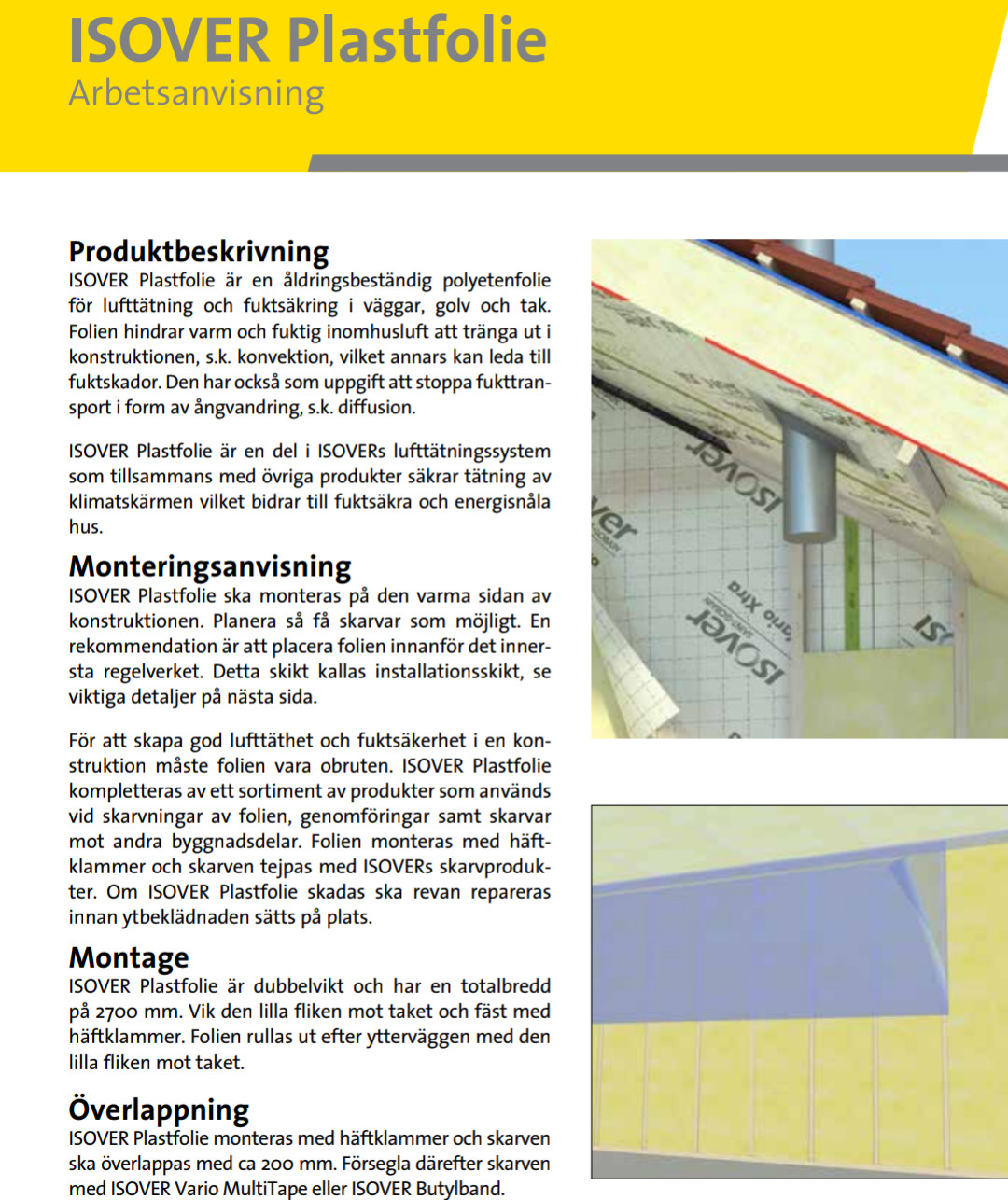
https://www.isover.se/sites/isover.se/files/assets/documents/arbetsanvisning_plastfolie.pdf
Last edited:
Okay! Thank you so much for the awesome tip!Yes, asking here usually gives many good answers. However, one may have to learn to sift a little among the answers since it is, after all, a public forum. But I would simply start with googling. Start from the "standard construction" and find out what each part is for, e.g., air gap, wind protection, vapor barrier. Then you can start thinking about the different ways to achieve that effect, or if it's even necessary.
"My" way to approach it is to first try to understand the underlying physics, such as capillary action, dew point, etc. But just like with everything else, it is important not to delve too deeply and search for the ultimate answer, but to understand the basics. Then understand what effect the building element has on the physical process (e.g., vapor barrier/dew point, insulation/convection). Then you can look at typical constructions from various house manufacturers or svenskt trä or material manufacturers.
Then the "real engineering work" begins, i.e., pondering "can this be done in a better/simpler/more efficient way." Such ideas can suitably be bounced around here on the forum. And, of course, look at alternative solutions that already exist.
But, I also want to advocate for common sense that can only be gained from practical experience. Otherwise, it easily leads to grotesque over-dimensioning or delving into things that don't really matter. So practical experience is indispensable if you want to venture beyond purely standard constructions.
If any questions pop up on the forum in the future, like "why is there insulation here?" you can assume it's me after I've been scratching my head Yes, but such info is great! Will definitely take a look!Have you really checked out, for example, the construction examples in the TräGuiden? I think there's much more information there than just drawings showing how things 'should' be done.
Isn't this information together with your knowledge of physics enough to understand why a moisture barrier is usually placed and why it's positioned where it is?
[image]
Thanks!Many of the details you're thinking about seem to involve the building's climate shell, wasn't that part included in the building engineering education? In Civil and Environmental Engineering, we studied a course where climate shell and heating/ventilation were included and covered thermal bridges and moisture transport, etc. Now I don't remember how many details are shown in the course literature but it is at least the foundation for why the details look the way they do (to avoid problems with moisture damage or heat loss). I seem to recall Carl Hagentoft wrote the book we used, there is also a book "for the public" on the subject called "Vandrande fukt, strålande värme - så fungerar hus" which might be a good start. Should be available to borrow from the library.B byggingenjören97 said:That is my impression as well. I am a university engineer with a great interest in both drawing/modeling and calculating. University engineers are often called designers/building engineers while civil engineers are called calculation engineers or civil engineers. That's how it is according to my experience
I have also understood that all companies have their own template. Do you have any tips on things I can study/learn on my own while looking for a job instead of just twiddling my thumbs at home on the couch?
I would probably look for an online course to take; it's difficult to show a future employer that you know something without a certificate, I think.