
50,166 views ·
188 replies
50k views
188 replies
How to make construction drawings?
Hello! I am a newly graduated civil engineer and my ambition is to work as a structural engineer in the future where I calculate loads, model, create drawing details, etc. Throughout my education, we never learned anything about structural drawings. We only learned how to create simple facade drawings, floor plans, and section drawings. How do you create structural drawings then? How do you learn that? Are there already finished structural drawings that you use as a reference point, or do you have to create everything on your own with the knowledge you have? If so, how do you acquire that knowledge? I studied for several years at Chalmers to become a civil engineer and they taught us none of this. We learned a bit about the properties of concrete, wood, and steel and how to calculate strength. But I have absolutely no idea how to, for example, design a structural drawing for a wall-roof connection. How do you learn that?

Oh, what did you learn that is useful in reality?B byggingenjören97 said:
But I would guess that you might get to intern at an architectural firm or construction company to get the practical experience.
Welcome to the Build a House forum anyway, @byggingenjören97 and good luck with your profession!
Reporting on drawings is largely learned on the job. By looking at drawings from previous projects that the company has completed and receiving feedback from more experienced colleagues.
There is a book series called "bygghandlingar 90" which is very worth reading.
A new book about detailing reporting has also been published, which seems good.
https://www.bokus.com/bok/9789179170097/rita-detaljer/
There is a book series called "bygghandlingar 90" which is very worth reading.
A new book about detailing reporting has also been published, which seems good.
https://www.bokus.com/bok/9789179170097/rita-detaljer/
It's hard for me to answer as I am newly graduated with zero experience. We receive quite a theoretical education. The entire education is fairly impractical, which I strongly dislike. However, we do learn quite a bit of fundamental theory, as mentioned. Everything from calculating strength and reinforcing to conducting geotechnical surveys and drawing and modeling on the computer (CAD/BIM), etc. This is in addition to what you learn for specialization in building construction among many other courses. We also learn a lot of theory about other things, such as project planning, hydraulics, business economics, etc. How useful this is in reality is impossible for me to answer. It is certainly useful to have a basic understanding of various subjects depending on what you want to work with. If, for example, I want to work as a structural engineer, it's pretty important that I have a basic understanding of strength, how concrete/steel/wood behaves, etc., which we learned in school. We do not receive any practical training from the school at all. Chalmers is a well-known university, and all the construction engineers who studied there before me have managed brilliantly in professional life. That's all I can comment on for nowKnockOnWood said:
 I just wonder how structural engineers have learned to create construction drawings when it's not taught in school. I assume the companies teach them.
Thank you!
I have understood it that way too! It's not difficult to do the actual "drawing". A 15-year-old can learn it in three days haha. I wonder how one learns to design the actual construction. Meaning the engineering thinking behind it if you know what I meanHenrik Lindberg said:
Learning to present on drawings is largely learned on the job. By looking at drawings from previous projects the company has completed and getting feedback from more experienced colleagues.
There's a book series called "bygghandlingar 90" which is very worthwhile reading.
There has also been a new book about detailing that seems good.
[link]
How does one gain an understanding of what the various components' purposes are and how they fit together? For example, I have no idea how a wall or roof is constructed on the inside. I can draw most things, but I would love to understand what I am drawing and how it works. Look at the picture I sent as an example. How does one learn to understand how it all fits together and what the different parts' functions are? I can read bygghandlingar 90, but it doesn't help me understand why it looks the way it does. There are just pictures like what I sent below. How can one learn the theory behind it all? You must have an understanding of it to be able to create the actual drawing.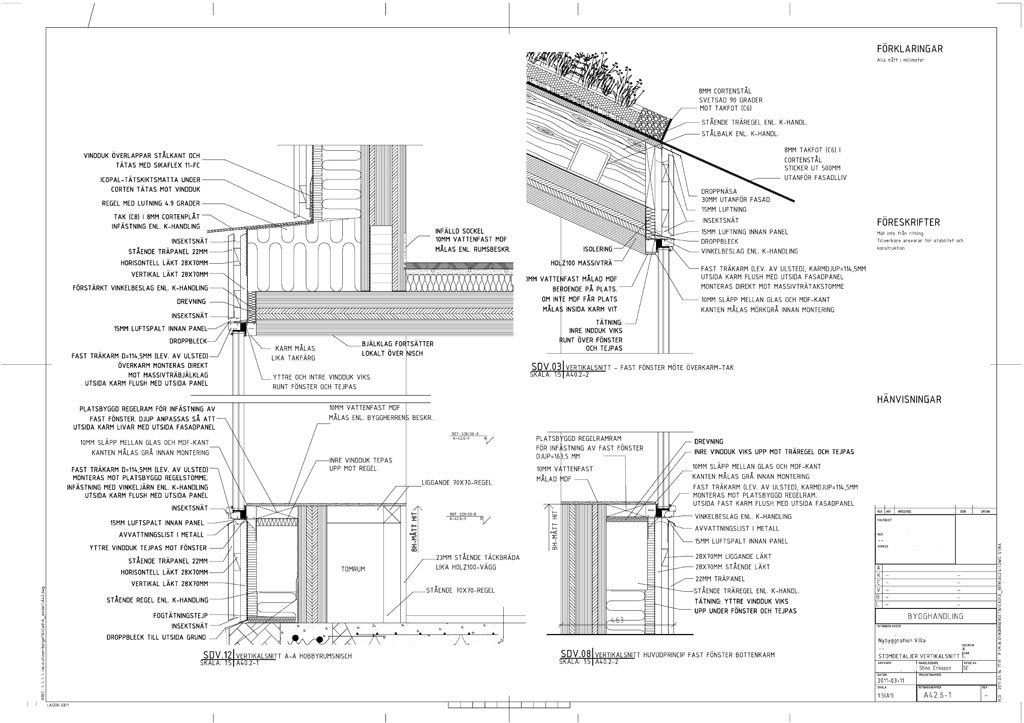
Last edited:
Unfortunately, it's not something you just learn, it's about experience. As a trained construction engineer, you often start with modeling and drawing. The basis for drafting often comes from older, more experienced colleagues. A tip here is not just to copy but to ask and listen to why certain things are done in a particular way. See a lot, listen a lot, try to get a wide variety of projects. Don't be afraid to ask.
Thank you! I appreciate all the info and tips!B bossespecial said:Unfortunately, it's not something you just learn; it's about experience. As a trained construction engineer, you usually start with modeling and drawing. The basis for drawing often comes from older, more experienced colleagues. A tip here is not just to copy but to ask and listen to why certain things are done in a particular way. See a lot, listen a lot, try to have a wide variety of projects. Don't be afraid to ask.
I've also understood it as something you learn at the workplace. I'm looking forward to starting work and learning! Due to corona, I am currently unemployed, so I want to make the most of my time and develop/learn things on my own instead of twiddling my thumbs on the couch. At least as much as possible Do you have any tips on how I can gain some understanding of the subject area on my own? Even if it's just a little, it's better than nothing. I appreciate all the advice I can get. I find this super interesting but can't find a way to learn from it I can only agree with @bossespecial, it's experience.
I studied civil engineering and got a job at a larger company after that. However, not in the same field that the education was intended for.
I've now worked there for 2.5 years, and it's still really fun and educational. I try to learn things every day and use colleagues to discuss ideas.
My closest colleague has had to explain high and low.
What I've learned a lot from is the contact with more experienced people and getting out on site.
So what I can advise you:
Listen, be humble, and don't take offense when someone reviews your work.
Experience comes with the years!
Dare to challenge yourself.
I studied civil engineering and got a job at a larger company after that. However, not in the same field that the education was intended for.
I've now worked there for 2.5 years, and it's still really fun and educational. I try to learn things every day and use colleagues to discuss ideas.
My closest colleague has had to explain high and low.
What I've learned a lot from is the contact with more experienced people and getting out on site.
So what I can advise you:
Listen, be humble, and don't take offense when someone reviews your work.
Experience comes with the years!
Dare to challenge yourself.
Now, I can't say that this is always the case, but my impression is that those who do calculations and graduate from school today have a civil engineer degree, while those who draw/model have a construction engineer degree or have completed a YH-education in it. Then, an interested and diligent bygging. could probably perform certain calculations too if there is a burning interest, since you study a part of the subject. Drawing technique differs between various disciplines within construction, so teaching too strict a template during education, I don't think would do much good. Last but not least, every company has its way of designing its drawings and a drawing manual that describes this.
It's not unusual to feel like you don't know anything "useful" when starting a job; the practical aspect is not covered in today's education. To include that, a gap year with a construction contractor is likely required.
It's not unusual to feel like you don't know anything "useful" when starting a job; the practical aspect is not covered in today's education. To include that, a gap year with a construction contractor is likely required.

After 30 years in the consulting industry, including several years as a manager at various levels, I can only conclude that through higher academic education, you only learn theory and how to count. Working as a consultant/designer is something you learn on the job. It’s best if you also participate in construction sites to see how reality looks and how what you are supposed to/have designed works to build. But 90% of what you work with daily is learned on the job, the remaining 10% comes from school.
Did you not have any associations where it was practiced alongside the studies? Like the Technical Department of the Electrical Section or the robotics association? Though it might be harder to practice construction privately.
Interesting thread but also somewhat alarming. The basics of accounting techniques (projection theory, drawing symbols, line thicknesses, etc.) should have been taught to you at Chalmers. If not, get a book on this quickly. Beyond that, it's just practice that counts. One must think three-dimensionally and realize that a drawing is just a horizontal or vertical section through a 3-D model. Today's youth, who are not taught to draw with pencil and paper (or drafting film), probably face a steeper learning curve. Today's computer-aided technology is not solely beneficial. Additionally, most structural drawings are based on architectural drawings.


Much of how to construct standardized things at a detailed level is described in the AMA books.B byggingenjören97 said:
Self-builder
· Stockholm
· 10 535 posts
30 years ago, I thought it was crap to draw a bunch of figures on foil, etc. What was it good for?
Today, when I draw electrical schematics, design solar panel installations, and provide materials for engineers to calculate strength, etc. Also drew C and A for my own house.
Now I am very pleased to have learned from the ground up.
Today, when I draw electrical schematics, design solar panel installations, and provide materials for engineers to calculate strength, etc. Also drew C and A for my own house.
Now I am very pleased to have learned from the ground up.
Nice! Do you have any tips on things I can study/learn on my own while I'm looking for a job instead of just twiddling my thumbs at home on the couch?fgo said:
I can only agree with @bossespecial, it's experience.
I studied to be a civil engineer and got a job at a larger company after that. However, not in the same field that the education was intended for.
Now I've been working there for 2.5 years and it's still really fun and educational. I try to learn things every day and use colleagues to discuss ideas.
My closest colleague has had to explain everything from high to low.
What I've learned a lot from is the contact with more experienced people and getting out on site.
So what I can advise you:
Listen, be humble, and don't take it the wrong way when someone reviews your work.
Experience comes with years!
Dare to challenge yourself.
I'm not aiming to learn it independently at the same level as a civil engineer with 15 years of experience. But is there any way I can at least prepare myself so that I have a decent start when I finally set foot in the industry so that it doesn't accidentally become a rough start? Anything at all.