
50,308 views ·
188 replies
50k views
188 replies
How to make construction drawings?
We learned all this back at Chalmers and I thought it was awesomeB bossespecial said:Start by drawing a completely ordinary house, I assume you might still have some of your student licenses? There's a lot to find on Träguiden. Calculate U-values to determine wall and roof thicknesses. Also read up a bit on moisture design, there's plenty about this online. Different foundation techniques can also be good to be aware of. If you went to Chalmers, you might still live in Gbg, then pile foundation is always a must to know about.
 Everything from how to calculate heat and moisture flow through walls to different foundation techniques and lots more. But it's all just theory. I'm now interested in how to apply the knowledge practically. In other words, how to actually construct something like a wall. What does it need to consist of and why? If I asked you to give me a detailed drawing of the exterior wall for a villa, what would your approach be?
 Thanks for the tip! I'll do that!joakim_j said:
Well, of course it's difficult, otherwise everyone would be doing it
I would start like this. Find a construction drawing (detail) you want to understand. Think about what the different parts do, what the purpose is, and how they interact. When you feel there's something that just seems mysterious, ask here in the forum!
Another fun thing is to look up one of the hot debates (vapor barrier vs vapor retarder, insulating under basement floors or not, air gap under roof planks or not) and read through the arguments and try to form your own opinion. Don't assume anyone "has the answer," but think it through yourself!

If you add up the knowledge you've gained over the past years, you should probably understand why the wall looks the way it does.B byggingenjören97 said:That's what I'm doing right now. I'm looking at drawings but I don't understand anything. How can I gain an understanding of why it's constructed the way it is? Is it only through work that I can gain that understanding? Am I really so powerless that I just have to twiddle my thumbs on the couch until I land a job where I learn it?
Calculate on steam resistance, insulation, etc.
After that, you calculate the loads.
Then you'll probably have an idea of why the wall looks the way it does.
Something that I've found to be very useful is to understand all the disciplines involved. Why do ducts, pipes, and ladders go where they do?
Everything can be optimized to infinity when designing, but does it make such a big difference on site?
When you finally get to a company, everything will come together. I promise!
Design is an iterative process; the more complex the building, the more times you have to go back and adjust. It's always a good idea to start by drawing how it looks at the bottom and top of the wall, then you've almost solved most of the house. What happens in the middle of the wall is not that interesting. But to try to answer a bit simply, I would start by determining the minimum insulation thickness required, establish the foundation, the floor structure, the roof, and then tie everything together in the aforementioned details.B byggingenjören97 said:We learned all this at Chalmers and I thought it was really fun
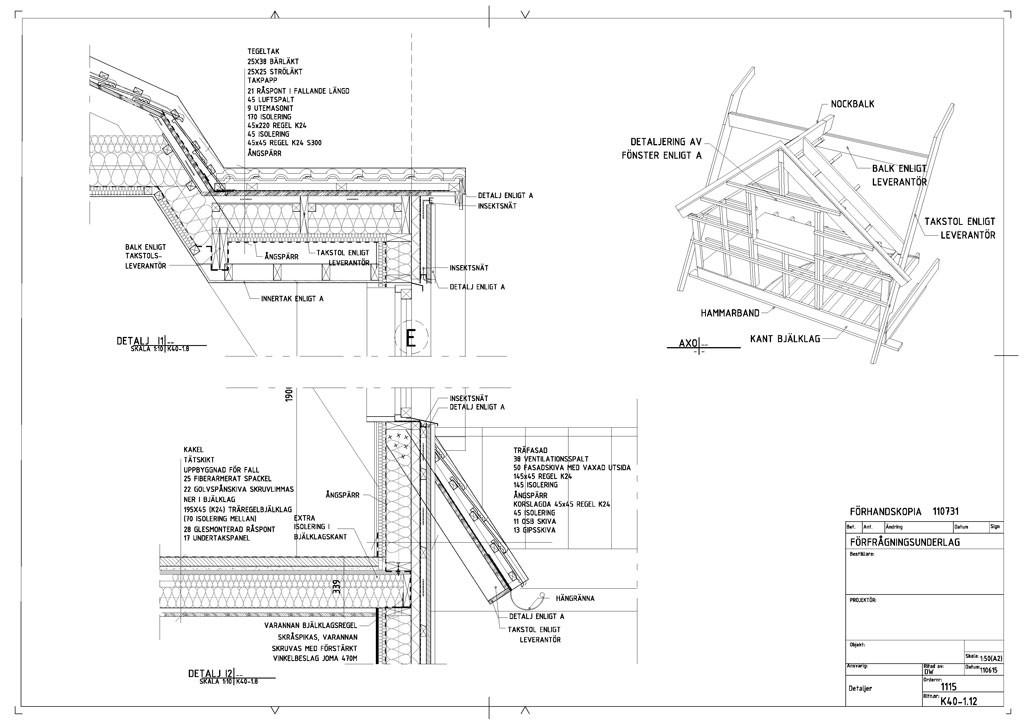
The calculations only take me so far. They are not enough to understand the entire design. Maybe just 5% of it. Take a look at this drawing below for example. How should you go about understanding this?fgo said:
If you add together the knowledge you've gained over the past few years, you should understand why the wall looks the way it does.
Calculate vapor resistance, insulation, etc.
After that, you calculate the loads.
Then you'll probably get an idea of why the wall looks the way it does.
Something I've found very useful is to understand all the disciplines involved. Why do ducts, pipes, and ladders go where they do?
Everything can be optimized endlessly when you're drawing, but does it make that big of a difference on site?
Once you get to a company, everything will fall into place. I promise!
If we ignore studies and the theoretical aspect, what does your life look like? Have you built LEGO, forts, or repaired rusty cars? Do you have any practical hobby? If a device breaks, do you take it apart to see what it looks like inside, even if you are just going to throw it away?
I really think there's a lot of information about why things are constructed in a certain way. The building material stores have plenty of brochures where the material manufacturers show how their products should be used in a construction. I have built everything I own based on such information. I think I've never really talked to a craftsman. The times I've tried, I've quickly shut my ears when I've noticed that they don't work as the product supplier prescribes.
Maybe you're looking for info in the wrong place?
I really think there's a lot of information about why things are constructed in a certain way. The building material stores have plenty of brochures where the material manufacturers show how their products should be used in a construction. I have built everything I own based on such information. I think I've never really talked to a craftsman. The times I've tried, I've quickly shut my ears when I've noticed that they don't work as the product supplier prescribes
.Maybe you're looking for info in the wrong place?
Can't you circle five points on the drawing that you don't understand and give them numbers so maybe we can figure out some answers together in the thread.B byggingenjören97 said:
The most important question to ask as an engineer is "why?" instead of the builder's simpler "what?". For example, on the drawing above: the builder might wonder "what is a ångspärr?", the answer will be "a plastic sheet". That might be enough for them, but the engineer wants more: why do you have a ångspärr? Can it be done another way? (The debate about ångspärr has filled pages of discussion here on the forum)B byggingenjören97 said:
And as mentioned, think through for yourself, don't be satisfied with someone's answer, no matter how confident it is. Just because "everyone" does something doesn't mean it's right. Especially in construction.
Self-builder
· Stockholm
· 10 551 posts
I am an electrical engineer. Everything related to construction I have learned on my own, so much can be self-taught without going to school. I looked at drawings, learned standards, and watched guides for building in wood, concrete, etc.B byggingenjören97 said:
I am not an expert in construction, but I have gotten a good understanding of how to build and can comprehend how structures are constructed.
Last edited:
Self-builder
· Stockholm
· 10 551 posts
Good drawing! The boring answer is that if you know a bit about how to build a house, then you can read that drawing. It shows and explains exactly how walls etc., should be constructed.B byggingenjören97 said:


There is plenty to read online about issues such as moisture problems in different constructions. Otherwise, as mentioned, Träguiden and Bygg-AMA are gold mines when it comes to detailed solutions. But as usual, it is important to examine a solution and try to understand why, for example, there is an air gap in a certain place or why the boards should be nailed in a certain way so they don't crack.
It's just a matter of looking at as many drawings as possible and trying to find the common threads.
It's just a matter of looking at as many drawings as possible and trying to find the common threads.
To draw an analogy:
I think you are an aspiring musician trying to become a rock musician by reading and writing sheet music. That's probably the wrong way to go.
One starts by listening to music, fiddling with a guitar and mimicking, trying to achieve the same sound. Then much, much later, you write sheet music for what you've created.
I believe the designer needs to see finished constructions. Compare different constructions.
Experiment, make models. Read up on the type of device you are going to design, how it will be used, what it should withstand, what materials are usually used, can the design be slimmed, etc. Draw plenty of rough sketches.
Have the overall picture first before delving into the details of the drawing. This applies whether you are reading or writing a construction drawing.
Or are you construction blind!?
Absolutely no offense intended, you mustn't think that.
But some are dyslexic, others reverse numbers despite being otherwise fully intelligent.
Some only see the surface of a device, I'm one of those who sees everything in cross-section. I can often quite well describe how a device that I've never seen dismantled looks inside.
I can never say afterward what color or shape the device has. That's one of my many shortcomings.
I think you are an aspiring musician trying to become a rock musician by reading and writing sheet music. That's probably the wrong way to go.
One starts by listening to music, fiddling with a guitar and mimicking, trying to achieve the same sound. Then much, much later, you write sheet music for what you've created.
I believe the designer needs to see finished constructions. Compare different constructions.
Experiment, make models. Read up on the type of device you are going to design, how it will be used, what it should withstand, what materials are usually used, can the design be slimmed, etc. Draw plenty of rough sketches.
Have the overall picture first before delving into the details of the drawing. This applies whether you are reading or writing a construction drawing.
Or are you construction blind!?
Absolutely no offense intended, you mustn't think that.
But some are dyslexic, others reverse numbers despite being otherwise fully intelligent.
Some only see the surface of a device, I'm one of those who sees everything in cross-section. I can often quite well describe how a device that I've never seen dismantled looks inside.
I can never say afterward what color or shape the device has. That's one of my many shortcomings.

Much in the field of house construction is tradition. No solutions are designed from scratch on theoretical grounds. Development often progresses incrementally. Switching from plank framing to stud framing around 1950 in small house construction is one example. The energy crisis in the 70s, which led to significantly increased insulation requirements, is another. I still find great use in the handbook Bygg from the 60s when it comes to understanding different solutions. Part 6 on Building Technology might be suitable in your case. Then, as several have pointed out, there's nothing that beats hands-on construction practice.
I've never had any practical hobbies. Never been interested in that. It could very well be the case that I'm looking in the wrong place. That's why I created this thread for directionsB Bjober said:If we disregard studies and the theoretical, what does your life look like? Have you built LEGO, forts, or repaired rust on cars? Do you have any practical hobbies? If a device breaks, do you take it apart to see what it looks like inside, even if you're just going to throw it away? I actually think there's plenty of info about why things are constructed a certain way. Building supply stores have tons of brochures where material manufacturers show how their products should be used in a construction. I've built everything I own based on that info. I don't think I've ever really talked to a craftsman. The times I have tried, I've quickly shut my ears when I noticed they don't work the way the product supplier prescribes
I've looked at some brochures, but they only state how things are built. There's nothing about why, which is what interests me. Do you have any tips on brochures with more theoretical info about the construction?