
4,354 views ·
3 replies
4k views
3 replies
How should I cover the hole in the floor?
I have torn down a fireplace in our living room and now there's a cast "foundation" that sits directly on the ground, which is mostly rock throughout the foundation.
The house is from the early 1900s but was renovated in the '60s. Now there's a mix of chipboard and insulation in the floor structure and type of planks as the subfloor as far as I can see.
I have no way to access the crawl space, but I have opened a hole in the floor so I can stick my head down and look around. The space is only 20-30 cm, but it seems to be fine as there was no visible mold or strange smells.
How should I "fill" the hole so I can put chipboard on it afterward? The idea is to insulate as much as I can fit, but should I place insulation directly as it was before, or should I put something in between, or how is it usually done? I'm obviously afraid that it will start to get damp and mold later.
I will place a small pellet stove of 100kg there afterward and connect it, it doesn't need to be specially dimensioned or anything, right?
The house is from the early 1900s but was renovated in the '60s. Now there's a mix of chipboard and insulation in the floor structure and type of planks as the subfloor as far as I can see.
I have no way to access the crawl space, but I have opened a hole in the floor so I can stick my head down and look around. The space is only 20-30 cm, but it seems to be fine as there was no visible mold or strange smells.
How should I "fill" the hole so I can put chipboard on it afterward? The idea is to insulate as much as I can fit, but should I place insulation directly as it was before, or should I put something in between, or how is it usually done? I'm obviously afraid that it will start to get damp and mold later.
I will place a small pellet stove of 100kg there afterward and connect it, it doesn't need to be specially dimensioned or anything, right?
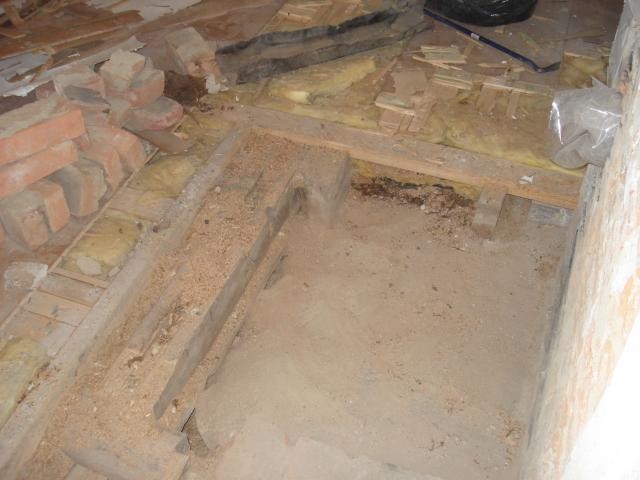
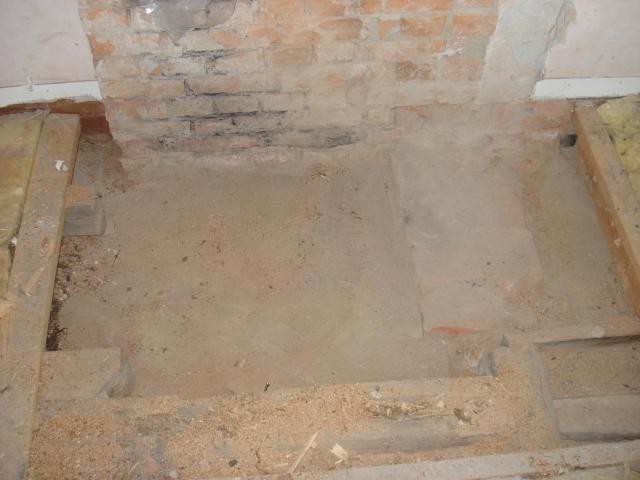
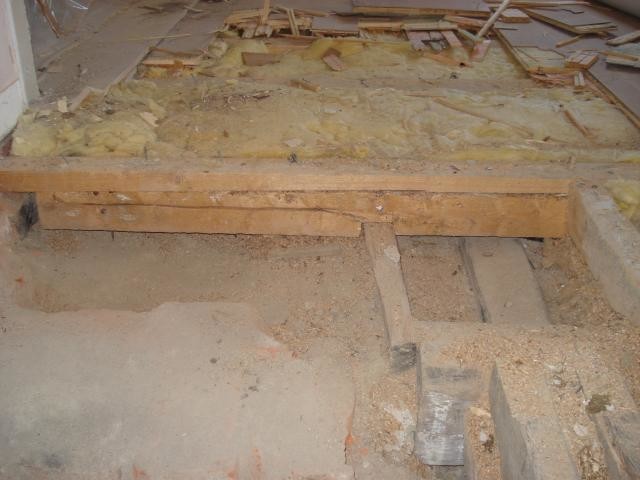
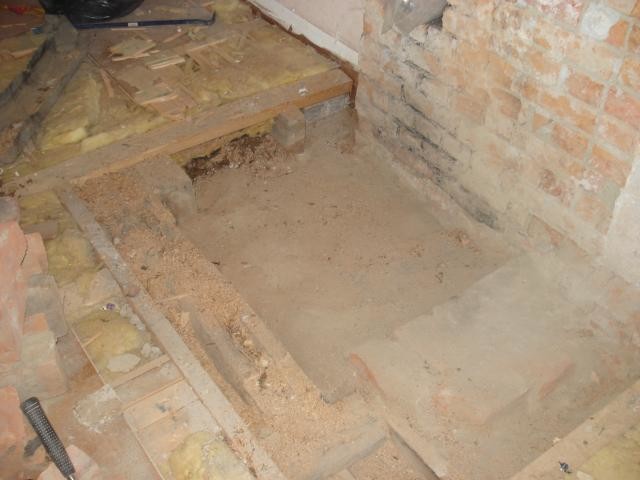
Usually, you have some type of single layer at the bottom, so I would probably put that first, then fasten studs to the existing floor structure and insulate as the insulation manufacturer recommends.
The floor structure seems to be directly on the rock otherwise, so maybe it's silly not just to do the same? That small area doesn't really matter in the grand scheme of things, so the simplest way is to do exactly as it was before; it has obviously worked so far.
The floor structure seems to be directly on the rock otherwise, so maybe it's silly not just to do the same? That small area doesn't really matter in the grand scheme of things, so the simplest way is to do exactly as it was before; it has obviously worked so far.
Since it's cast, you can probably wedge between the floor beams and place it on the foundation (it looks like one of the pins is already on it), add tar paper just as you would on a sill to stop any moisture migration.
Keep in mind that there are special rules for handling fire risk near a chimney (if it is one), if I remember correctly it was 50mm between the chimney and the stud, besides that you should choose a fireproof insulation. Check with the chimney sweep on how they want it since it must be approved before you can connect a stove and light a fire.
If you're worried about moisture, you might want to build a subfloor where you place the insulation that has a small air gap to the cast part, again considering the potential fire risk, you should choose a material that doesn't burn easily - outdoor plaster maybe? But you can always lift some of the other insulation and take a look at how it looks there, and if it looks good, do the same.
Now, maybe all this is over-the-top, but that's probably how I would do it if I didn't check with the chimney sweep, which I absolutely would
Keep in mind that there are special rules for handling fire risk near a chimney (if it is one), if I remember correctly it was 50mm between the chimney and the stud, besides that you should choose a fireproof insulation. Check with the chimney sweep on how they want it since it must be approved before you can connect a stove and light a fire.
If you're worried about moisture, you might want to build a subfloor where you place the insulation that has a small air gap to the cast part, again considering the potential fire risk, you should choose a material that doesn't burn easily - outdoor plaster maybe? But you can always lift some of the other insulation and take a look at how it looks there, and if it looks good, do the same.
Now, maybe all this is over-the-top, but that's probably how I would do it if I didn't check with the chimney sweep, which I absolutely would
Filling with lecakulor as insulation after floor framing is a method I have seen in older houses.
Click here to reply