
6,097 views ·
18 replies
6k views
18 replies
How do I make a new joist in a crawl space?

There was a discussion earlier in the thread about older and newer foundations. It sounds like you might have the older type that ventilates into the room instead of out through small openings. If that's the case, it's possible that you may create problems by insulating the floor.TrumJalle said:
Is it sound at the outer wall and rotten further into the house? Make sure you understand why it rotted so as not to repeat a past mistake. If you need to splice a beam, you can place a piece of beam alongside it that overlaps a few decimeters on both parts. Butt joint and screwing into end grain will not be stable.-How do I best replace the beam that is shot; I can't access its connection to the outer wall, so I would probably need to splice on a new beam after cutting off the beam at its outermost part, i.e., closest to the outer wall, which seems to be in good condition? Can it hold just by screwing to the beam's end grain?
The rest of the torpargrund under the house has more space between the ground and the beams, it's only in this area (the hallway) that the ground reaches up to the beams.A Avemo said:In the beginning of the thread, there was some discussion about older and newer torpargrund foundations. It sounds like you might have the older type that ventilates into the room rather than outwards through wall vents. If that's the case, insulating the floor could potentially cause issues.
Is it solid by the outer wall and rotten further into the house? Make sure you understand why it has rotted so you don't repeat a previous mistake. If you need to splice a joist, you can place a piece of joist alongside that overlaps a few decimeters on both parts. Butt joints and screwing in the end grain won't be stable.
On each side of the foundation, there's a wall vent. They seem to be part of the original construction.
The ground seems completely dry, so I believe the damage has long since stopped. The outside of where the space is has a slight slope towards the house. In the 90s, it was excavated and drained, so I hope that addressed the cause of the damage. The other beams in the space are almost unaffected by rot from what I've found so far.

That's exactly how our foundation looks, mullbänk. We have the joists lying in various debris, stone, gravel, and everything under the sun. We had some bad parts in a bathroom which we believe resulted from an older water damage (not sure) so we cut those out, replaced with new studs. We tore down the kitchen 3 years ago; there was also an older water damage as the previous owners had a shower on the outside of the house, and the shower water ran onto the sill into the house and ruined the floor under the kitchen and also a bit of a beam. It was repaired and everything was put back the same way but now without rot and dry. 3 years later, I have a small part that I can look down between, everything is fine and well. I don't know how long a mullbänk lasts, but ours is probably (uncertain) about 150-200 years old today and still in good condition.Sorry if I'm asking my own questions in the thread, but I have roughly the same question as the original poster and think it might be of interest to someone in the future.
I tore down to the joists in my cottage (built in the 1830s) over the weekend and found that the beams were only attached to the outer wall side and that the material in the crawl space rests more or less entirely against the underside of the beams. One beam is in quite poor condition and would probably need to be replaced, the others are okay. However, the beams are all crooked and have a slope towards the outer wall.
My plan was to attach new studs 45*120mm to the old beams to level the new floor. Also, place studs perpendicular to the new ones at 60 cm centers for better stability for the chipboard flooring.
Directly on the crawl space, the previous owner had insulated with EcoPrim foam boards and stuffed fiberglass wool here and there, i.e., there is no subfloor. Yes, I have had issues with mice!
-Should I dig out loose material to create some distance between the ground and the underside of the studs so I can install a proper subfloor?
-How is the best way to replace the faulty beam? I can't reach its attachment to the outer wall, so I would probably need to splice on a new stud after cutting off the beam at its outermost part, i.e., closest to the outer wall, which seems to be in good condition? Can it hold up if I just screw it into the beam's end grain? Is using a 120mm stud too weak (the length of the studs will be about 170cm)?

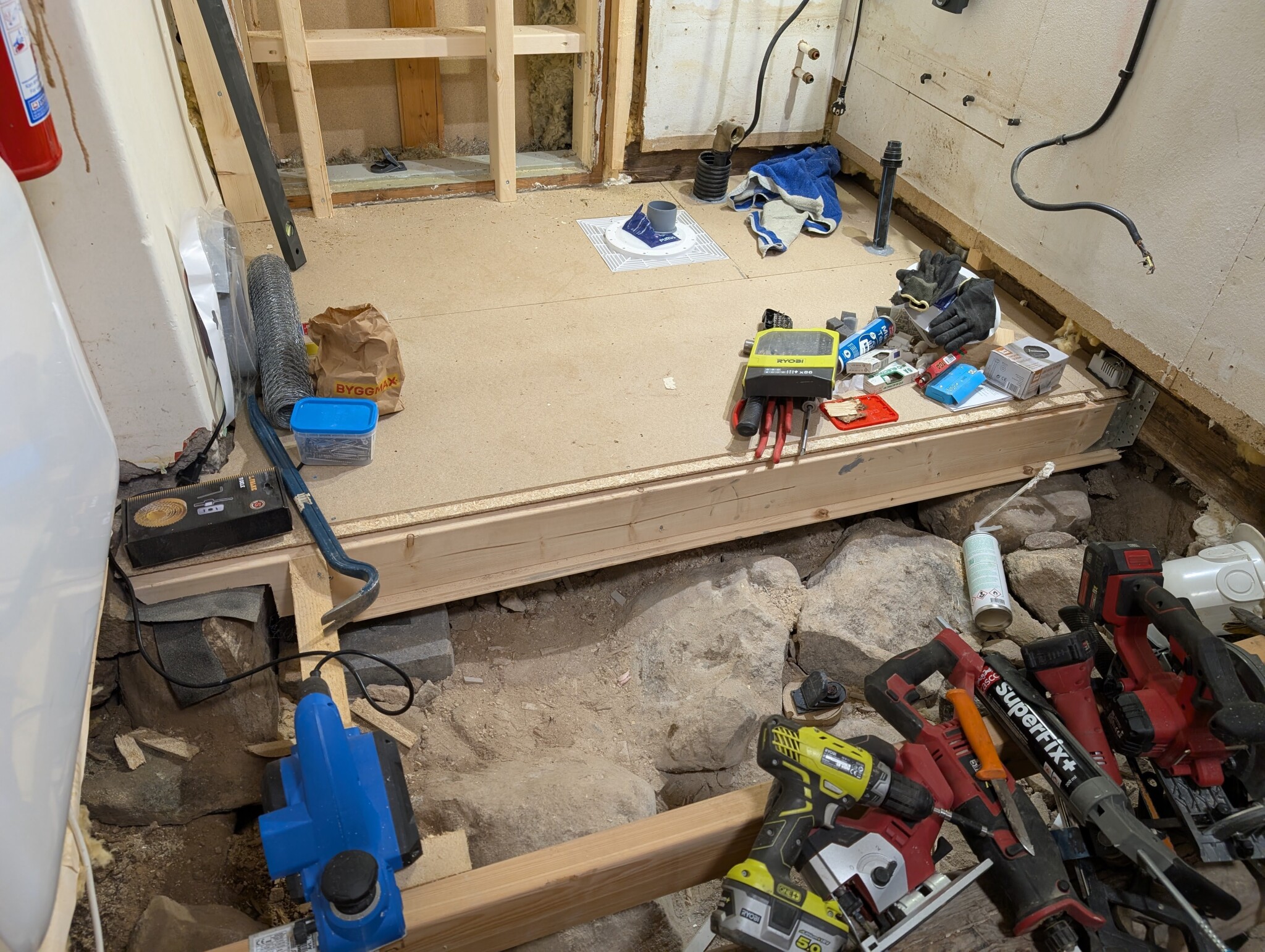
For me, it ended with removing all the old timber beams, digging out to create some distance between the ground and new joists. Installed new joists and trossbotten and filled it with wood fiber insulation. Some of the new joists I could attach to the sill, and some had to be floating and instead held together with noggins and supported against concrete slabs on the ground. Right or wrong, but it feels very stable. All damaged floor structures are gone and it is now level.
Click here to reply