6,082 views ·
18 replies
6k views
18 replies
How do I make a new joist in a crawl space?
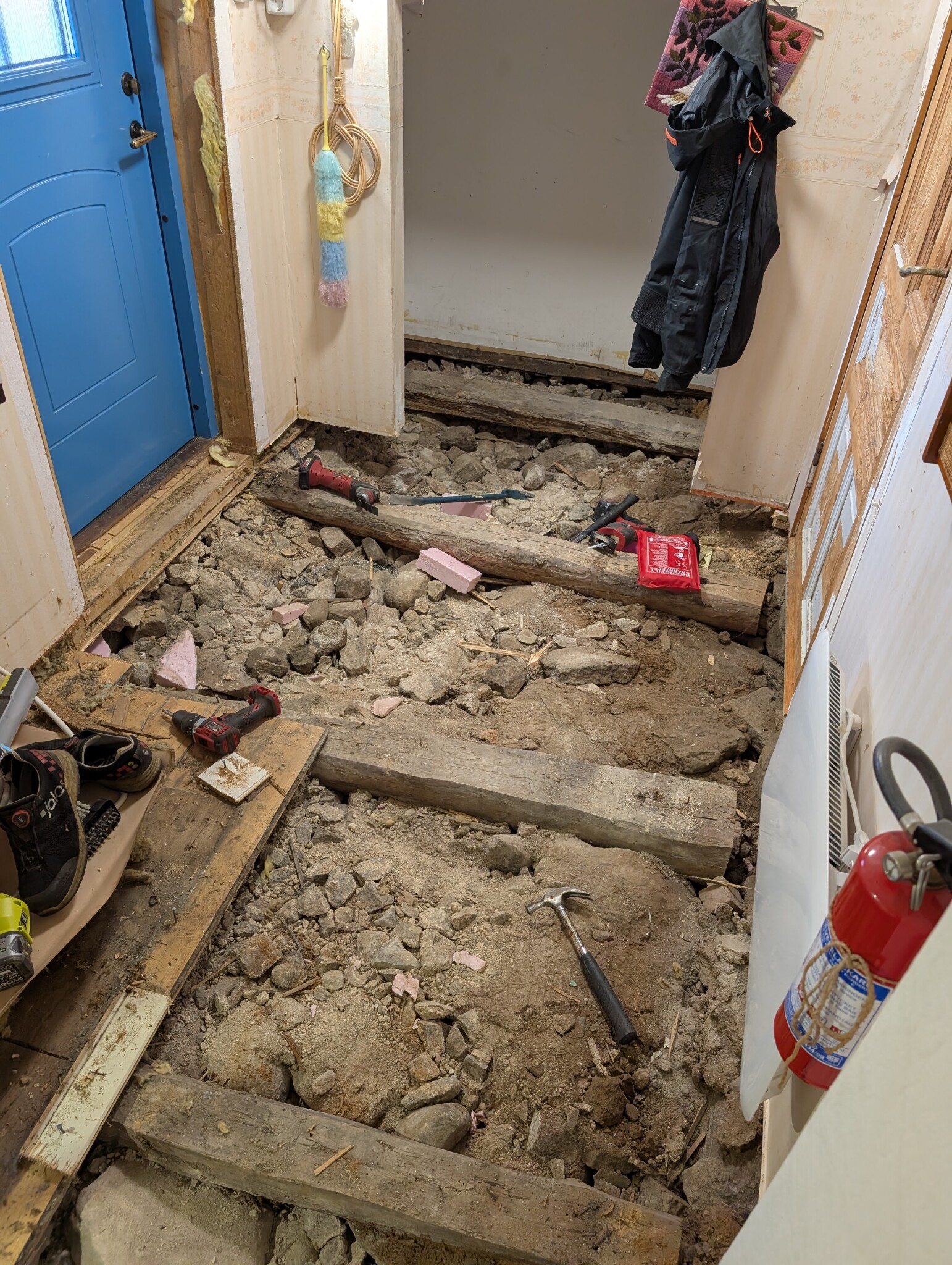
I am renovating a house where the oldest parts are a cottage from the 1880s, rebuilt in the late 1920s. Now I am in a room from the 1880s, and after discovering that the floor and joists were in worse condition than expected, I have now torn down to the remaining floor joists. It's a crawl space foundation and very low under the floor joists. In many places, stone supports the floor joists. I plan to dig out as much loose material (a mix of sawdust that has fallen from the floor joists, sand, and stone). However, there is a lot of bedrock and very large stones that will remain. The material at the bottom feels dry, but the distance between the blind floor and the ground is about 10-20 cm in many places. The floor joists are 15 cm and spaced about 1 meter, so not overly dimensioned directly (on top were floor planks that were 2 inches thick, so it must have been stable once upon a time). The existing floor joists are in varying condition, from okay to completely gone and replaced (in the 1920s?) with new ones that are just placed on stone and screwed into floor planks that are patched and repaired. I suspect an old water damage from above.
How should I now construct my new joists? The house is now permanently inhabited and is located outside Uppsala, so reasonable insulation is required. The plan is solid wood flooring.
How should I now construct my new joists? The house is now permanently inhabited and is located outside Uppsala, so reasonable insulation is required. The plan is solid wood flooring.
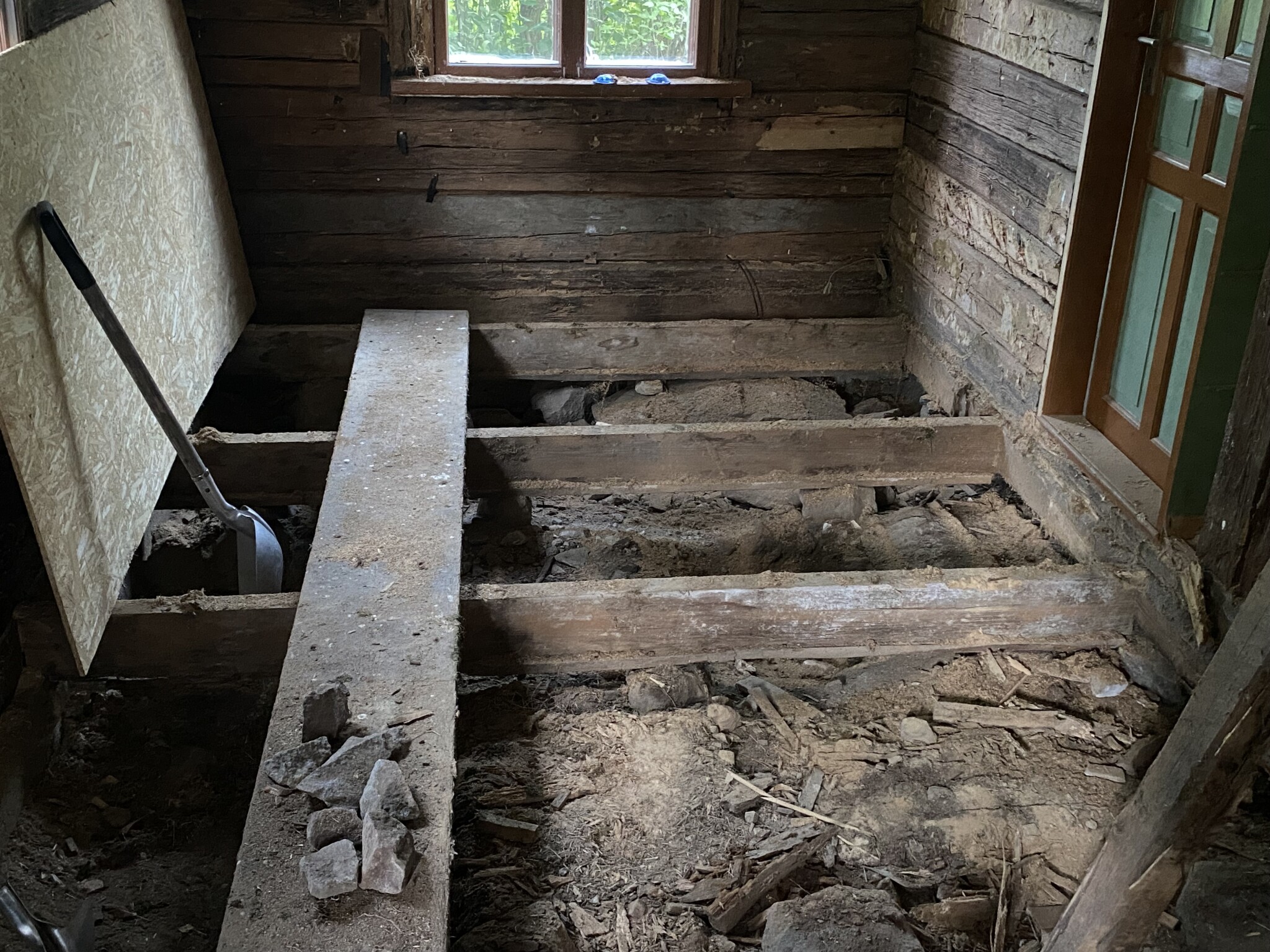

When I renovated a room once upon a time, I simply screwed new joists onto the old ones. That way, I could get everything somewhat level. Insulated with loose-fill since the measurements between the studs varied from 55cm to 75cm. On top of that, solid pine flooring.

An old crofter's foundation works quite differently from more modern crawl spaces. Firstly, it's important that the ground slopes away from the house everywhere so that no water enters. Secondly, the floor must be permeable so that ground moisture that rises can be ventilated into the house. Moreover, the floor must be poorly insulated so that the space between the ground and the floor is somewhat warmed. Unlike newer crawl spaces, there is no ventilation to the outside air. It is not necessarily a good idea to just insulate the framework without making any other changes.
Hello,
I am facing a similar challenge as described in this thread. How did you/should one attach the floor structure, should it be fastened to the wall or should it be kept floating? Does the floor structure then just rest on stones or lecablock?
How did you handle the air gap between the ground and the floor structure, is there any rule of thumb for this distance?
I am facing a similar challenge as described in this thread. How did you/should one attach the floor structure, should it be fastened to the wall or should it be kept floating? Does the floor structure then just rest on stones or lecablock?
How did you handle the air gap between the ground and the floor structure, is there any rule of thumb for this distance?
Hello!
Hi! I attached with joist hangers to the wall. Poured support pillars in the middle for extra support even though the span was not very large. I don't know what the rule of thumb for the distance is, but it is probably greater than what I could achieve... I dug out what I could and the height varies, but it's rocky underneath. Dry and fine though. In the lowest places, it is probably not more than about 20 cm between the ground and the underfloor panels.E Erka20 said:Hello,
I am facing a similar challenge as described in this thread. How did you/do you recommend handling the floor structure, should it be attached to the wall or should it be left floating? Does the floor structure then just rest on stones or lecablock?
How did you manage with the air gap between the ground and the floor structure, is there any rule of thumb for this distance?

Sorry if I'm asking my own questions in the thread, but I have roughly the same inquiry as the original poster and think it might be of potential interest to someone in the future.
I tore down to the joists in my cottage (built in the 1830s) over the weekend and found that the beams were only attached to the outer wall side and that the material in the crawl space is more or less completely against the underside of the beams. One beam is in fairly poor condition and probably needs to be replaced, the others are okay. However, all the beams are crooked and have a slope towards the outer wall.
My idea was to attach new studs 45*120mm to the old beams to level the new floor. Also, place studs perpendicular to the new ones on 60cm centers to get better stability for the floor chipboard.
Directly on the crawl space, previous owners had insulated with EcoPrim foam boards and pressed fiberglass wool here and there, meaning there is no sub-floor. Yes, I've had problems with mice!
-Should I dig out loose material so I get a little distance between the ground and the underside of the studs so I can install a proper sub-floor?
-How should I best replace the beam that is done for? I cannot access its attachment point in the outer wall, so I might need to splice a new stud after cutting off the beam at its outermost part, i.e., closest to the outer wall, which seems to be in good condition? Can it hold up by just screwing into the beam's end grain? Is it too weak to use a 120mm stud (the length of the studs will be about 170cm)?
I tore down to the joists in my cottage (built in the 1830s) over the weekend and found that the beams were only attached to the outer wall side and that the material in the crawl space is more or less completely against the underside of the beams. One beam is in fairly poor condition and probably needs to be replaced, the others are okay. However, all the beams are crooked and have a slope towards the outer wall.
My idea was to attach new studs 45*120mm to the old beams to level the new floor. Also, place studs perpendicular to the new ones on 60cm centers to get better stability for the floor chipboard.
Directly on the crawl space, previous owners had insulated with EcoPrim foam boards and pressed fiberglass wool here and there, meaning there is no sub-floor. Yes, I've had problems with mice!
-Should I dig out loose material so I get a little distance between the ground and the underside of the studs so I can install a proper sub-floor?
-How should I best replace the beam that is done for? I cannot access its attachment point in the outer wall, so I might need to splice a new stud after cutting off the beam at its outermost part, i.e., closest to the outer wall, which seems to be in good condition? Can it hold up by just screwing into the beam's end grain? Is it too weak to use a 120mm stud (the length of the studs will be about 170cm)?