Ntr-a should last 20-40 years in the ground. I built a fence myself about 10 years ago in this way. It was still standing when we moved out of the house after 9 years. The posts we removed were still healthy when we finally got them out. (The posts outlived the fence)
But why use plintjärn if you're going to put the post in concrete anyway?
No problems with NTR-A embedded in concrete for simpler constructions like fences and planks. I have done some myself and even though I'm only up to 17 years after the casting without a hint of rot.
The advantage of this is that it becomes very stable since the post and the plinth are in one piece. Plinth metal is, as mentioned, an OK alternative, but not post shoes that just lead to wobbling.
What protects the wood from rot is the impregnation combined with the strongly alkaline concrete that keeps microbes away.
I would consider casting down the new post again if it is NTR-A rated. Just cast it down with the right loose mixed fine concrete. Make sure the fine concrete is sifted so that there are no stones upwards of 4-6 mm. Dip the wooden post in a bucket with the concrete so that all the wood is covered. Smear concrete on the inside of the plinth and push down the post. Insert concrete so that there are no cavities. Fixate for a day.
A question regarding the method of casting the post. Personally, through my work, I have done plenty of such jobs where we built fences around, for example, preschools/companies/HOAs, mounted play equipment, benches, etc., but I have never cast a wooden post. The standard procedure is some form of galvanized/stainless steel that is cast into the ground to then attach the wooden structure to it.
Serious question, why do we who work with this never cast wooden structures into the ground? I understand myself that the stability of, for example, a fence is excellent if the entire post is buried and cast instead of being screwed into a metal cast structure. But does it have to do with cost? Is class A timber that much more expensive compared to casting a metal part? Our warranty is only 10 years and if one believes those with personal experiences, it's not a problem to manage if you cast the post directly into the ground.
A question regarding the method of casting the post. Personally, through my work, I've done plenty of such jobs where we've built fences around, for example, preschools/companies/HOAs, installed play equipment, benches, etc., but I've never cast a wooden post. The standard procedure is some form of galvanized/stainless steel that is cast to then attach the wooden structure to.
Serious question, why do we who work with this kind of thing never cast wooden structures? I understand myself that the stability in, for example, a fence becomes great if the whole post is dug down and cast instead of screwing the post into a cast metal structure. But does it have to do with cost? Is class A timber so much more expensive compared to casting a metal part? Our warranty is only 10 years, and if I listen to those with personal experience, it seems like it's no problem if you cast the post.
My guess is simply that you build for it to last forever, and when an HOA, the public sector, or a company builds something, they do it thoroughly. Maybe more thoroughly than necessary. It also benefits you who sell this as you can charge more than for simpler solutions.
I have not directly experienced municipalities building for durability, but it is probably cheaper to replace a pole if it is screwed instead of embedded, as maintenance does not have high priority either, so it becomes a factor to consider. My guess is also that it is cheaper to embed iron than a wooden pole. It is at least easier.
Hi.
I couldn't really find anything good with that search term. I chose to cut out the bottom with the angle grinder. Treat the surface with cold galvanizing or zinc.
/J
Ntr-a should last 20-40 years in the ground. I built a fence myself about 10 years ago this way. It was still standing when we moved from the house after 9 years. The posts we removed were still healthy when we finally got them loose. (The posts outlasted the fence)
But why plinth iron if you're still going to put the post in concrete elements?
Hi.
I see option 2 above as through posts holders. That is, both cast/fix the post and screw with the holder. I'm unsure how well I can get the casting in the block, hence the post holder as well.
/J
Place the post in waste oil overnight and then cast it in the hole. It will last a long time, as the oil penetrates the end grain and slows down the decay process.
I'm bumping this old thread as the reasoning in the thread is the same as what I'm contemplating. I'm planning to build a straight, completely solid fence at a height of 2.2m and a length of 25m.
I'm considering casting 70x70 posts about 900mm into the ground. I would prefer to use plinth iron instead since it seems to be the "right" option, but I'm concerned about what the lateral forces might do to such a mounting. The thickest and longest plinth iron I've seen is 600mm in length.
300mm below and above ground doesn't sound like much considering the lateral forces in such a construction. Or am I thinking incorrectly?
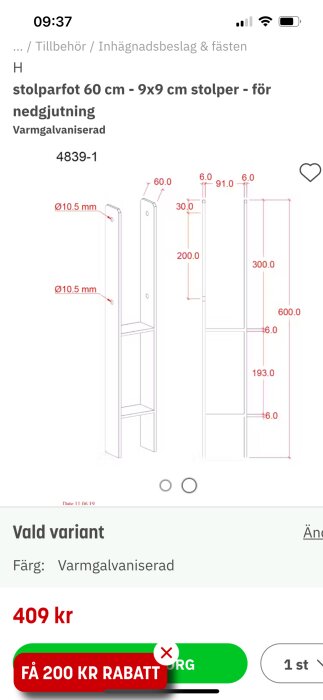
I've also found something called an H post foot, which is also only 600mm in length but seems more sturdy. However, the price of 405 SEK each is off-putting.
If you buy profiles instead of flat steel, there is much to gain. Flat steel is also available by the meter, allowing you to choose thickness, length, and width. Spread out over an entire plank, it is not much more expensive to add a millimeter or two.
If you buy profiles instead of flat iron, there's a lot to gain. Flat iron is also available by the meter so you can choose thickness, length, and width. It's not much more expensive to add a millimeter or two when spread over an entire plank.
What kind of profiles are you thinking in that case?
I looked at flat iron and, for instance, Biltema has 25x4mm x2m to buy. Could that work? I think it also works as reinforcement in the concrete.
You should have galvanized flat bars, contact a metalworking company. I made brackets for a pier with galvanized L-sections, they are super strong.
It is possible to cast the posts, but they need to have a special classification for the impregnation. Standard posts don't work. I have 95x95 posts for my fence which is just over 2m high, then I added an inclined top rail of 45x145 to stiffen everything up.
You should have galvanized flat iron, contact a blacksmithing company. I made brackets for a dock with galvanized L-iron, they are super strong.
It's possible to cast the posts, but they must then have a special classification on the impregnation. Standard posts don't work. I have 95x95 posts for my fence which is just over 2m high, then I put a sloping top piece of 45x145 to stiffen everything up.
Then it feels like I'll go with casting the posts with ntr-a classification after all!
What kind of profiles are you thinking of in that case?
Looked at flat bar and for example, Biltema has 25x4mm x2m to buy. Could that work? I think it might also work as reinforcement in the concrete.
U- or I-beam is what I've seen used.
I doubt that any profiles I have seen or have are galvanized, but the oldest are only 70-80 years old, so how they hold up in the long term, no one knows.
A layer of galvanizing paint on what is cast in and normal metal painting and/or linseed oil paint on what is above ground should go a long way.
I have a fence with embedded posts (previous owner), and now that we need to replace it, the options are to place new footings or cast something in the holes and simultaneously drill in new mounts. If they had used the same U-beam as they used on the storage, I would probably just need to clean and paint.






Larsa said:
You should have galvanized flat iron, contact a blacksmithing company. I made brackets for a dock with galvanized L-iron, they are super strong.