
I'm a bit unsure which part of the forum to write in, so I'll try here.
Last year, I built a new bathroom. Since I had previously hired a plumber whom I was satisfied with, I used the same plumber again. The rest (it was previously a hallway), renovation, insulation, tiling, etc., was contracted out to a company.
Today (when it was -8), the pipes (that run in the outer wall) froze. My question is whose fault it is. My first thought is that it's the carpenter's fault for not insulating sufficiently. I can't see how it's the plumber, as he installs the pipes based on the conditions built by the carpenter, or am I wrong?
I'm happy to receive some opinions so I have some backing when I contact the companies this afternoon.
/Andreas
Last year, I built a new bathroom. Since I had previously hired a plumber whom I was satisfied with, I used the same plumber again. The rest (it was previously a hallway), renovation, insulation, tiling, etc., was contracted out to a company.
Today (when it was -8), the pipes (that run in the outer wall) froze. My question is whose fault it is. My first thought is that it's the carpenter's fault for not insulating sufficiently. I can't see how it's the plumber, as he installs the pipes based on the conditions built by the carpenter, or am I wrong?
I'm happy to receive some opinions so I have some backing when I contact the companies this afternoon.
/Andreas
Both will probably blame each other, but I believe the plumber has the responsibility. However, pipes in exterior walls should have an electric heating cable in them since freezing does happen. So bring in the plumber and have him install one. Then, pipes in walls might not be the first choice, but sometimes you have to.
Thank you for the answer! What I was thinking was that the plumber can only install the pipes according to the conditions that the carpenter has built. If I want the pipes in the wall, then the carpenter must insulate enough so that the plumber can lay the pipes as close to the interior wall as possible, or am I thinking wrong?
But sometimes you can't add more insulation without extending the outer wall, insulation takes up space. If, for example, there is 120+45 insulation, there is a risk that the pipes will freeze if they run in the middle of the 120 part. The freezing point can come quite far into a wall, the temperature inside is what counteracts it.
Thanks again! I can add that we tore down all the interior walls before the construction started, so it wouldn't have been a problem to add more insulation, and then the carpenter would have had to extend the wall so the plumber could run the pipes further in. I don't know how much insulation there is, but it's probably only about 120 or something, and the pipe is installed in the middle. Attached is a picture of how it looks.
So it seems like the pipe runs in the middle of the wall, but on the inside, there is both drywall and wood fiberboard and tiles, so I guess the pipes are actually closer to the outer wall than the inner wall.
Even if the plumber should have pointed out how it looked, isn't it still the carpenter's responsibility to build out as much as needed?
So it seems like the pipe runs in the middle of the wall, but on the inside, there is both drywall and wood fiberboard and tiles, so I guess the pipes are actually closer to the outer wall than the inner wall.
Even if the plumber should have pointed out how it looked, isn't it still the carpenter's responsibility to build out as much as needed?
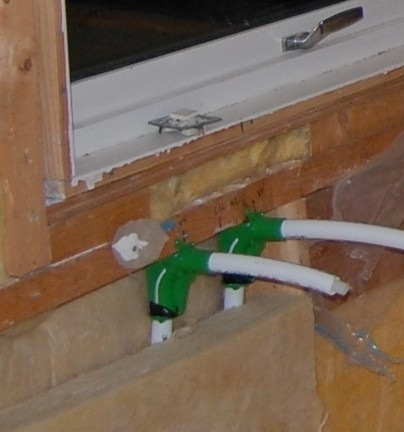
Most likely it has frozen in the floor, there is probably a horizontal beam there that they have drilled through for the pipes, and the beam also works well as a cold bridge. Otherwise, it might be that further down the pipes have bowed against the outer wall.
But the pipes are supposed to go up between two floors, and to bring the pipes from the outer wall you would have to go through the joist and build out the wall about 45mm on the inside. Otherwise, the alternative is to add insulation on the outside.
But it is not the carpenter's responsibility if no one has informed them, I think the plumber should point out that the placement is less suitable, or suggested installing a heating cable from the start.
But the pipes are supposed to go up between two floors, and to bring the pipes from the outer wall you would have to go through the joist and build out the wall about 45mm on the inside. Otherwise, the alternative is to add insulation on the outside.
But it is not the carpenter's responsibility if no one has informed them, I think the plumber should point out that the placement is less suitable, or suggested installing a heating cable from the start.
Thank you pbengtsson for bouncing ideas with me!
One hopefully final point. But if the carpenter knew that pipes would run through the outer wall, shouldn't he have known? Maybe it's just me who thinks so, that a carpenter building a bathroom should know better if pipes are going in the wall. Then he should know that there must be more insulation on the outside than the inside to adequately insulate.
But it goes through a stud and this is against the sill or whatever it's called. It could be that it's there that it freezes. I've made a small hole in the basement floor and removed some insulation so a little air can flow up to where the pipes go into the sill.
One hopefully final point. But if the carpenter knew that pipes would run through the outer wall, shouldn't he have known? Maybe it's just me who thinks so, that a carpenter building a bathroom should know better if pipes are going in the wall. Then he should know that there must be more insulation on the outside than the inside to adequately insulate.
But it goes through a stud and this is against the sill or whatever it's called. It could be that it's there that it freezes. I've made a small hole in the basement floor and removed some insulation so a little air can flow up to where the pipes go into the sill.
One cannot have insulation on the "inside" of water pipes, everyone should understand that, especially when it's quite a "thin" outer wall (if I'm not completely mistaken). And whose fault is it? Well, it's likely all parties involved share the responsibility. The client has the overall responsibility and decides how he wants the work carried out, the carpenter because he probably didn't understand the consequence of insulating towards the room, the plumber for not suggesting a different routing. But the greatest responsibility probably lies with the builder for not providing clear enough instructions. Unfortunately, it's quite common for this type of mistake to occur.
Thank you for all the great answers, so I am considered a builder even though I let someone else perform the work? And it is always the builder who is responsible if I understand you correctly? No wonder there is trouble in the industry if craftsmen can make as many mistakes as they want and then just walk away without any responsibility.
Yes, the developer is the client, the one who says what should be done, in other words, you. The various contractors you hire are responsible for doing their part according to your instructions and, within those guidelines, doing it in a professional manner.
I understand your frustration, but the problem is not the wall or the pipe installation but the combination of them. This makes it difficult to place the responsibility on any single executor. It would have been a different matter if the carpenter had taken on a turnkey contract for the bathroom and then, in turn, hired the plumber as a subcontractor. But it doesn't sound like that was the case.
Then again, I find it a bit strange that the plumber wasn't able to see and warn about this risk. Frozen pipes should have been encountered before in their work. I don't think it's as obvious that the carpenter would consider it.
I understand your frustration, but the problem is not the wall or the pipe installation but the combination of them. This makes it difficult to place the responsibility on any single executor. It would have been a different matter if the carpenter had taken on a turnkey contract for the bathroom and then, in turn, hired the plumber as a subcontractor. But it doesn't sound like that was the case.
Then again, I find it a bit strange that the plumber wasn't able to see and warn about this risk. Frozen pipes should have been encountered before in their work. I don't think it's as obvious that the carpenter would consider it.
Thank you Farzan!
In hindsight, I can consider that they should have extended 45 and insulated "the other way" to reduce thermal bridges, etc. I still think this should be up to the carpenter to at least suggest, as mentioned, the wall is thin. What I've also found is that he shouldn't have placed insulation behind the pipes against the interior wall.
I, being quite uninformed, trust that they will make my requirements work. If I want pipes in the outer wall, I believe it is up to the craftsman to insulate more if needed. I don't know how much insulation is needed to solve it, or is it that if I don't micro-manage, the carpenter can do as they please and then blame it on my lack of clarity. The problem then is that I don't have the knowledge required for micro-management. If I had that, I might as well have built the frame myself and just outsourced the tiling. And that's why I find it a bit strange that I still bear responsibility when it's the craftsmen who have the knowledge and solutions.
I have talked to the plumber and his theory was that there could be a cold draft at the threshold.
In hindsight, I can consider that they should have extended 45 and insulated "the other way" to reduce thermal bridges, etc. I still think this should be up to the carpenter to at least suggest, as mentioned, the wall is thin. What I've also found is that he shouldn't have placed insulation behind the pipes against the interior wall.
I, being quite uninformed, trust that they will make my requirements work. If I want pipes in the outer wall, I believe it is up to the craftsman to insulate more if needed. I don't know how much insulation is needed to solve it, or is it that if I don't micro-manage, the carpenter can do as they please and then blame it on my lack of clarity. The problem then is that I don't have the knowledge required for micro-management. If I had that, I might as well have built the frame myself and just outsourced the tiling. And that's why I find it a bit strange that I still bear responsibility when it's the craftsmen who have the knowledge and solutions.
I have talked to the plumber and his theory was that there could be a cold draft at the threshold.
>yoxler
You are right in theory, what you can do yourself, you do yourself, what you can't, you bring in help for, and then you assume that the person you pay to do the job does it as it should be done and better than you could do yourself. But that's unfortunately not the case in practice, you need a bit of luck when choosing a craftsman because some don't quite get it, and some are surprisingly incompetent. Try to find craftsmen through neighbors, acquaintances, etc., who have had someone at their place who was good. This increases the chance that it will be better next time.
You are right in theory, what you can do yourself, you do yourself, what you can't, you bring in help for, and then you assume that the person you pay to do the job does it as it should be done and better than you could do yourself. But that's unfortunately not the case in practice, you need a bit of luck when choosing a craftsman because some don't quite get it, and some are surprisingly incompetent. Try to find craftsmen through neighbors, acquaintances, etc., who have had someone at their place who was good. This increases the chance that it will be better next time.
It is a fairly common problem when "people" take on project management and coordination in "construction" instead of purchasing that service. If you buy the service as a split contract, a significant responsibility lies on the buyer; if you buy a turnkey contract, you specify the finished result and the contractor decides how it will be executed and hands over a finished "product." In the latter case, the entire responsibility rests with the contractor while in the former, with the builder. Of course, you can agree on other solutions, but it is important to determine in advance who is responsible for what.
I have almost always had a split contract, meaning it is my responsibility to ensure it is done correctly and well. I have succeeded in doing so every time except once. It's important to have a good dialogue with the craftsman who comes, allowing them the opportunity to actually provide suggestions, advice, and expertise. I must ensure that all information is made available and that the person who comes knows what I expect, and I must dare to ask the silly questions.
Click here to reply