
Hello.
I'm renovating and want to lay flooring in the attic (which is insulated) to store Christmas decorations and other stuff...
Currently, the attic joists are CC120 and I'm wondering if 22 mm chipboard will suffice or if I need to reinforce it to CC60? Additionally, I'm a bit concerned about the weight. The chipboards are quite heavy and my joists are only 140 mm thick with a span of almost 4 meters, will it hold?
Now I plan to reinforce these joists so there's room for some more insulation in the floor structure, but will that help with the load-bearing capacity?
I'm renovating and want to lay flooring in the attic (which is insulated) to store Christmas decorations and other stuff...
Currently, the attic joists are CC120 and I'm wondering if 22 mm chipboard will suffice or if I need to reinforce it to CC60? Additionally, I'm a bit concerned about the weight. The chipboards are quite heavy and my joists are only 140 mm thick with a span of almost 4 meters, will it hold?
Now I plan to reinforce these joists so there's room for some more insulation in the floor structure, but will that help with the load-bearing capacity?
I would have installed battens and laid OSB if it's just for simpler storage. There's not much weight you can put up without it bending, and a few Christmas items, etc. usually turn into rugs, books, skates, skis over time, and then 140mm over 4m is not much to rely on.
If you already know that you will need more sturdy items, then add new joists parallel to the existing ones at 60cc.
If you already know that you will need more sturdy items, then add new joists parallel to the existing ones at 60cc.
I've been thinking about that too, but the question is how I should attach the studs.pbengtsson said:
As it is now, there's a long stud that the raw paneling is attached to, meaning at a 45-degree angle. And the floor joists are attached to this on the side and nailed with five 100mm nails. So, no nail plates or anything like that. Will this arrangement hold for additional load, meaning a nogging between the floor joists and then a long stud parallel to the floor joists?
Hard to explain, but you probably understand...
You don't have a simple sketch?
Here's a simple sketch.
The black is how it looks today, and the red dots are nails.
The green is new studs that I plan to install. So, firstly, a stud "crosswise" that I nail onto existing studs, then extend the existing studs by about 10-15 cm. And finally, install new studs between the existing ones so it becomes CC 60 instead of CC 120.

- Magnus
The black is how it looks today, and the red dots are nails.
The green is new studs that I plan to install. So, firstly, a stud "crosswise" that I nail onto existing studs, then extend the existing studs by about 10-15 cm. And finally, install new studs between the existing ones so it becomes CC 60 instead of CC 120.
- Magnus
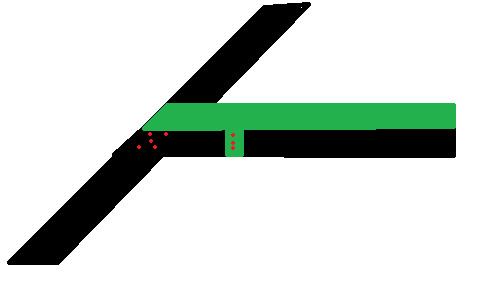
The existing "floor" joists (black) are not intended to bear any downward load at all; they are a support to prevent the 45 joists from moving apart or being compressed by wind loads.
Building on the joists will solve the deflection problem, but it will affect the 45 joists as they are not dimensioned for the load you might put on. What happens is that the roof bows inward slightly or, in the worst case, cracks at the attachment points (red dots).
But I assume you want a reasonably good floor (better than OSB), so add blocking between the joists at 60 cc and lay 22mm chipboard as you considered initially (without adding extra long joists). Place a steel band between the ridge and floor joist or 45x95 joist if accessible, screwed from the side, to resist the deflection.
Then be careful not to load everything you have in the garage, and it should be okay.
Wood holds more than you think; it's the settling and deflections that are troublesome.
Building on the joists will solve the deflection problem, but it will affect the 45 joists as they are not dimensioned for the load you might put on. What happens is that the roof bows inward slightly or, in the worst case, cracks at the attachment points (red dots).
But I assume you want a reasonably good floor (better than OSB), so add blocking between the joists at 60 cc and lay 22mm chipboard as you considered initially (without adding extra long joists). Place a steel band between the ridge and floor joist or 45x95 joist if accessible, screwed from the side, to resist the deflection.
Then be careful not to load everything you have in the garage, and it should be okay.
Wood holds more than you think; it's the settling and deflections that are troublesome.
Okay, thank you for the answer. Now it's not 4 meters everywhere, only on one section, so there I could skip the flooring boards, and just install it where I have a wall in the middle (under the joists), which in that case will eliminate the risk of sagging. And then I'll have to settle for a smaller storage space.
Is it then okay to build on top of the joists, I want to do it to accommodate more insulation under the boards.
Is it then okay to build on top of the joists, I want to do it to accommodate more insulation under the boards.
You can build as much as you want in height for insulation. Just wanted to point out that it doesn't increase the load capacity.
If it's as you describe and there's a wall underneath, I would go for it. Common sense applies.
If it's as you describe and there's a wall underneath, I would go for it. Common sense applies.
Click here to reply