
186,072 views ·
173 replies
186k views
173 replies
Filling crawl space with foam glass / cellular glass / hasopor?

Building conservationist
· 3 534 posts
Nice to see the thread is alive!S Snickeboa said:

Not that I want to question your knowledge, but mostly out of curiosity: Are there any examples of houses that have been affected by dry rot because of leca? I've seen claims that leca in foundations increases the risk of dry rot but never any concrete examples. Considering how much lime is normally found in a traditional Skåne house, I have a hard time imagining that leca in particular could increase the risk significantly. The stone foundation is generally mortared with lime mortar, so the lime is already there. Moreover, it was common in the past to sprinkle lime in the house foundation to keep rodents away. Couldn't it be that leca helps to reduce the risk of rot by making the climate in the foundation drier?
Summer cottage!
No, you're right, I don't have any concrete examples, but I've received information from, among others, Ljungby Fuktkontroll, which is an expert on mold and moisture in houses. However, I don't know his source, or if he has cases where this has happened. I also wasn't thinking specifically of a Skåne-longhouse as I missed that this was the topic. But as you say, there are often many lime sources. If the insulation is thick or good enough, it should absolutely dry out. With too little insulation, the heat from the house otherwise goes down and warms the ground, which then starts releasing water in vapor form. But there are many viewpoints on this. As long as it isn't built in the wrong place, or if one doesn't divert rainwater / poor drainage, it should be fine.
No, you're right, I don't have any concrete examples, but I've received information from, among others, Ljungby Fuktkontroll, which is an expert on mold and moisture in houses. However, I don't know his source, or if he has cases where this has happened. I also wasn't thinking specifically of a Skåne-longhouse as I missed that this was the topic. But as you say, there are often many lime sources. If the insulation is thick or good enough, it should absolutely dry out. With too little insulation, the heat from the house otherwise goes down and warms the ground, which then starts releasing water in vapor form. But there are many viewpoints on this. As long as it isn't built in the wrong place, or if one doesn't divert rainwater / poor drainage, it should be fine.
Building conservationist
· 3 534 posts
Snickeboa, it's true that in this thread all kinds of old buildings have been discussed. For my part, my head is full of Skånelänga, so I just assumed the same applied to you....
The measure discussed in this thread, namely filling the foundation with something capillary-breaking/insulating, is particularly suitable for Skånelängor and their special foundations (if you don't want to cast, of course).
Yes, it was probably on Ljungby fuktkontroll's page that I saw the advice against Leca, and I've wondered ever since.....
The measure discussed in this thread, namely filling the foundation with something capillary-breaking/insulating, is particularly suitable for Skånelängor and their special foundations (if you don't want to cast, of course).
Yes, it was probably on Ljungby fuktkontroll's page that I saw the advice against Leca, and I've wondered ever since.....
If you have problems with house fungus, the moisture content is far too high. Träulit works well in foundations despite containing lime.
Last edited:

In any case, I have finished the renovation and did as I planned. It turned out well! The indoor climate has been very pleasant despite very dry air (around 39% RH all winter) 44% at the moment, at about 20-23 degrees Celsius. The wooden floors without heating have still felt very comfortable and not cold at all. The clay floors with underfloor heating have also met expectations.
We sealed all the ventilation in the foundation and made sure the foundation was carefully sealed with a clay mortar with a high clay content. Then about 50-80 cm of hasopor was laid in the entire foundation up to the desired level. On top of the hasopor, clay mortar was applied directly and then a paperboard before the wooden floors were installed. For the underfloor heating, a clay slab about 3-5 cm thick was first cast before the heating pipes were installed. On top of this, an additional 3 cm of clay mortar was added and then a fine plaster of 1 cm where about 1% raw but heated linseed oil was mixed in. The clay floors were then treated three times very liberally with heated raw linseed oil (100 degrees) and then four layers of egg oil tempera. So far, no damage to the floors despite heavy wear from small children and family life.
It was very labor-intensive to make the clay floors, but I also have nothing else to compare it to. But I assume it's much easier to use self-leveling compound than to cast with clay that must be spread by hand. The clay also takes an extremely long time to dry (up to several weeks), and you have to use quite a lot of fans and possibly heat if it's cold. Despite everything, the effort felt very reasonable for what we got.
We sealed all the ventilation in the foundation and made sure the foundation was carefully sealed with a clay mortar with a high clay content. Then about 50-80 cm of hasopor was laid in the entire foundation up to the desired level. On top of the hasopor, clay mortar was applied directly and then a paperboard before the wooden floors were installed. For the underfloor heating, a clay slab about 3-5 cm thick was first cast before the heating pipes were installed. On top of this, an additional 3 cm of clay mortar was added and then a fine plaster of 1 cm where about 1% raw but heated linseed oil was mixed in. The clay floors were then treated three times very liberally with heated raw linseed oil (100 degrees) and then four layers of egg oil tempera. So far, no damage to the floors despite heavy wear from small children and family life.
It was very labor-intensive to make the clay floors, but I also have nothing else to compare it to. But I assume it's much easier to use self-leveling compound than to cast with clay that must be spread by hand. The clay also takes an extremely long time to dry (up to several weeks), and you have to use quite a lot of fans and possibly heat if it's cold. Despite everything, the effort felt very reasonable for what we got.
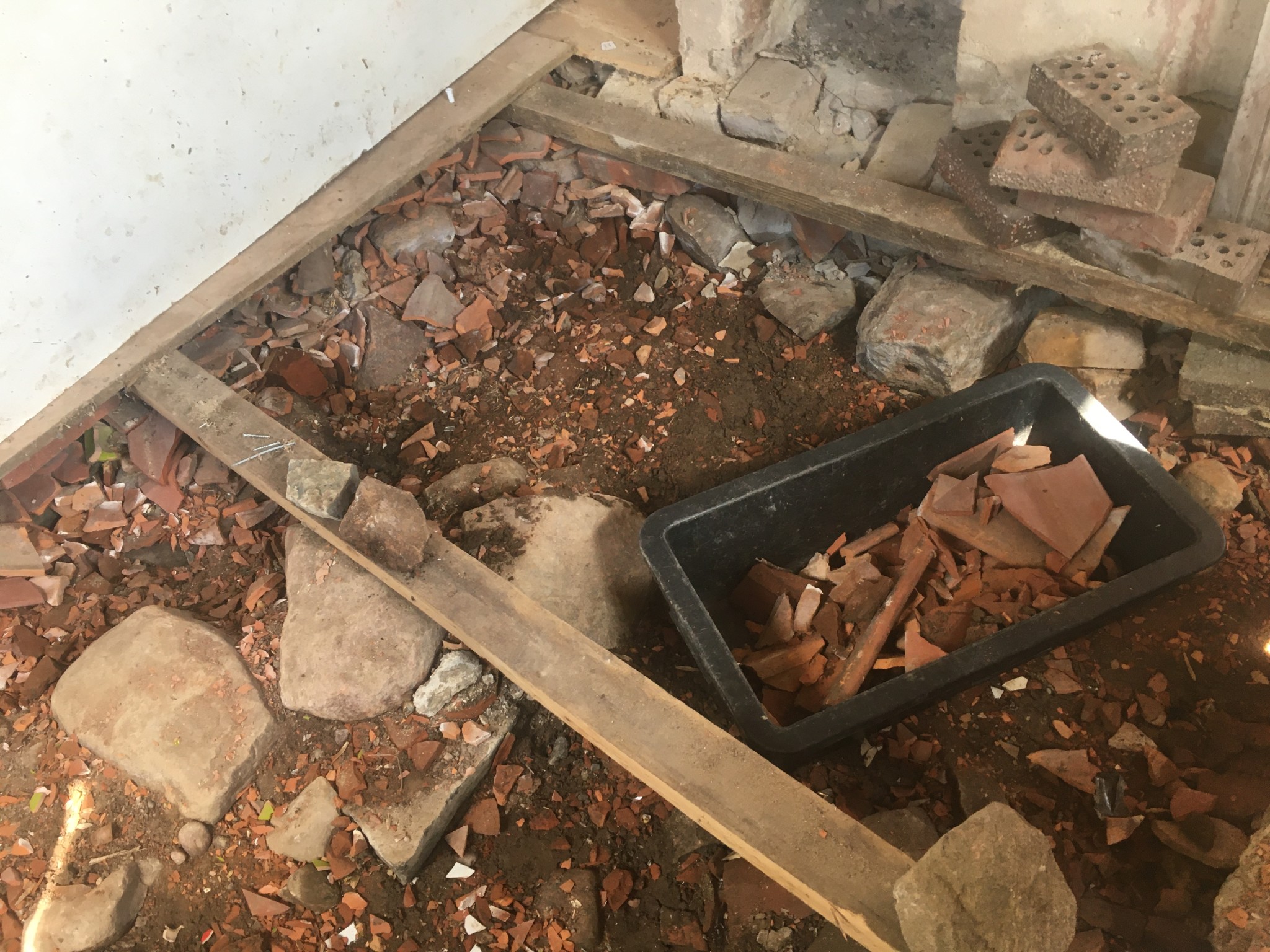
Sooo, in a log house/cabin where the floor is torn up
- Remove stones and other debris.
- New floor joists without direct contact with the outer wall.
- Place a ground cloth underneath and seal with wind barrier on the sides to prevent drafts through the foundation stones from the sides.
- Fill with Pelrik/Hasop/Leca all the way up to under the floor.
- Lay the floor on top, free from the walls.
- Seal the floor against the walls with Lin/gullfiber/rock wool between the floor and wall and then baseboard.
Does anyone see anything very strange in this?
//Henrik
Last edited:
T
träglans
Homeowner
· Norra VästraGötaland
· 16 posts
träglans
Homeowner
- Norra VästraGötaland
- 16 posts
No, not in the slightest. I never filled the foundation myself but regret that I didn't. In my case, the moisture comes from the air, not the ground, so removing as much of it as possible is just good. Your foundation looks dry, so go for it is my advice.Z Zebula said:
Good luck!


Isn't it the other way around? Cellulose and flax absorb and release moisture so that the humidity stabilizes.
Looked at prices, and Hasop costs quite a bit. To keep the cost down, I'm considering laying down landscape fabric at the bottom, then some small stones and crushed stone, and filling the last bit with Hasop. Stone and gravel are cheap, Hasop expensive.
Building conservationist
· 3 534 posts
Hasopor insulates. Stone and gravel, I don't know what their insulation value is....Z Zebula said:
We ourselves have considered doing the same thing possibly next year. I think filling up with ballast so there is room for at least 20-30 cm of Hasopor will work excellently. But it won't be as insulating as only Hasopor, of course. But for a solid wood floor or heated stone floor of some kind, it should work fine; I don't think there's any risk in doing so other than a lower insulation value compared to only Hasopor.Z Zebula said:
I've understood that it's best to lay radon fabric against the ground at the very bottom. I don't know if it applies everywhere for all houses, but it might be worth considering.
I've also been told that it's important for the foundation wall around the space to be filled to be tight.
Good luck and please let us know the results!