No no. If you let it blow right into the insulation (foam glass/Hasopor), it will lose its insulating ability. You use foam glass as a base and insulation under a poured slab (skip gravel and polystyrene) or as filling in an unventilated foundation (sometimes called "modern mullbänk") with, for example, a clay floor on top.
Hey! Hope I'm not stirring up emotions by reviving an old thread. But I'm so incredibly curious about how it has gone. I'm currently considering starting a new build of a simple extension where I imagine using hasopor as insulation in the foundation.
My thought goes to ventilation. I plan on a foundation wall of lecablock that I fill with hasopor. But how have you dealt with ventilation in your old foundations? Do you still have holes in the wall to ventilate the hasopor or is it not needed?
A bit off-topic, but what will your base for the lecablocks look like? Will you cast a concrete strip/foundation? If I were to build, I would want to avoid using concrete, at least keep it to a minimum. But I assume building directly on macadam won't be stable enough. Tjälldens uses a support plate in their construction (object 7 in the image) https://www.tjallden.se/wp-content/uploads/2018/01/Hybridgrund-400-sektion.png
Hope that someone who tried this in the thread is still on the forum, or that someone else has joined, of course.
In theory, I think this sounds like the answer to all problems, but in my experience, theory and practice sometimes differ, and with the foundation at stake, one becomes extra careful in trying to make the right choice. So if someone who has used this wants to share their experiences, it would be invaluable!
I placed a plastic sheet at the bottom & then we blew in Isodrän pellets & filled the crawl space. Works great.
How old was the house? Did you have any moisture problems in the foundation before? How long ago was this?
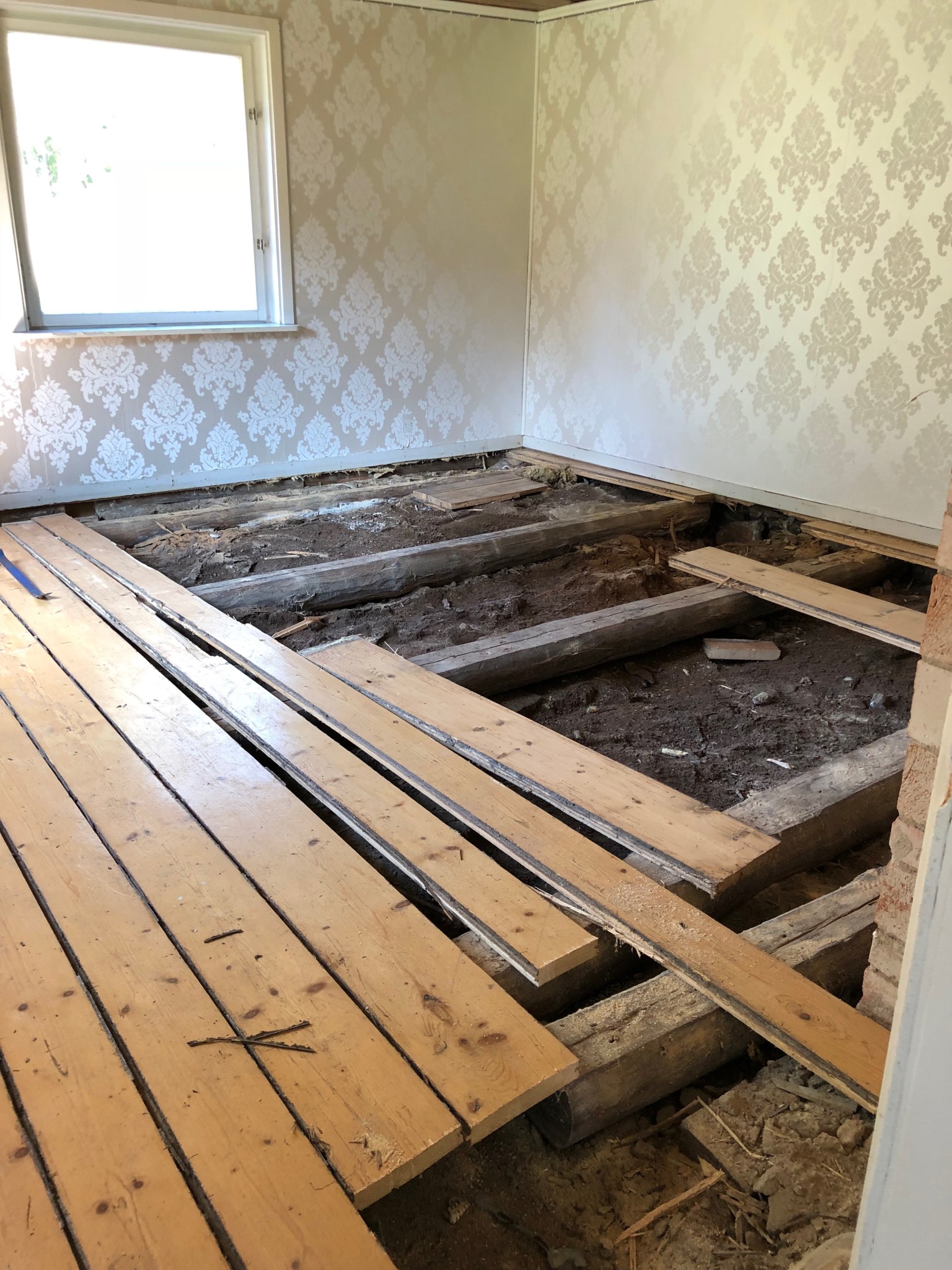
We bought our house just under a year ago and the floor in the living room was rotten in one spot. When I removed the floor planks, they were nailed to logs lying on the ground. Ventilation was scarce in some areas and non-existent in others. The logs were placed edge to edge against the foundation wall in most places, and there were two ventilation holes, "kattgluggar," in the entire area of 25m2.
I don't know when they redid the floor, but I have a pretty good reason to believe it was done in the 50s. The logs lying on the ground were surprisingly well-preserved, some were completely intact, most were a little rotten on the side facing the ground, one or two centimeters.
The sill was slightly damaged in some places, but at most halfway into the log (horizontal timber in the walls in that part of the house), so I removed the rotten parts and patched with pieces of lumber.
Due to the aforementioned reasons and the fact that there have been plastic mats on the other floors for some years now that are terribly uneven and creak, I want to lift the floors and see how the sill looks around the rest of the house.
How old was the house? Did you have any moisture problems in the foundation before? How long ago was this?
We bought our house just under a year ago, and the floor in the living room was rotten in one spot. When I removed the floorboards, they were nailed to beams lying on the ground. Ventilation was limited in some areas and nonexistent in others. The beams lay snugly against the foundation wall on most spots, and there were two ventilation holes, small windows, over the entire area of 25m2. I don't know when they redid the floor like this, but I have a fair reason to believe it was done in the 1950s. The beams lying against the ground were in surprisingly good condition, some were completely undamaged while most were slightly rotten on the side facing the ground, one or a couple of centimeters. The sill was slightly damaged in some spots, but at most halfway into the beam (horizontal timber in the walls on that part of the house) so I removed the rotten parts and patched in with studs. Due to the aforementioned plus the fact that there have been plastic mats on the other floors, which are terribly uneven and creak, for some years now, I want to lift the floors and see how the sill looks around the rest of the house.
Take it easy now and don't rush things. Many old foundation types lack ventilation completely. It is some sort of modern "truth" that foundations "should" be ventilated. This can certainly be done, but one must understand what, for example, happens when moist summer air is ventilated into a cold foundation.
Plastic mats are a nuisance as they prevent the diffusion of ground moisture through the floors. Cause of much trouble in old foundations!
It is not uncommon for floor joists to lie directly on the ground, this is done in earth banks for example, and if there is no moisture problem in the foundation coming from inadequate roof drainage, poor grading away from the house, or drainage of the ground, it can last for a very long time. Such foundations are designed so that if the floor joists rot, you take the furniture out of the room, remove the baseboards, lift the floorboards, and replace the joists! Then put everything back in place. Simply designed to be repaired.
I am not familiar with your house, but the sill beam should be visible from the outside or accessible behind the siding. If not, there is likely a historical mistake made, for example, the ground level has been raised against the foundation, or plastering/concreting has been done against the foundation. Very bad in both cases.
you must understand what happens when, for example, you ventilate humid summer air into a cold foundation
Yes, I try to remember to close the ventilation during the "rötmånad" and open it up in spring. The moisture-carrying capacity of air is something that has made my head spin for decades periodically. The conclusion is always the same; there's nothing perfect and absolutely nothing that fits all houses.
Ttompaah7503 said:
Plastic mats are a nuisance as they prevent the diffusion of ground moisture through the floors. Cause of much trouble in old foundations!
Amen
Ttompaah7503 said:
It's not uncommon for floor beams to lie directly against the ground, that happens in "mullbänkar" for instance.
True, but you also fill up between the timbers with some kind of mixture of sand and... I don't know, but the purpose is not to have any air there, mostly for insulation's sake, I presume? Or were people aware of the potential evil of air when they started using "mullbänk"?
*edit I didn't have a "mullbänk," if that was unclear. But I would have been curious to try it.
Ttompaah7503 said:
The sill beam should be visible from the outside or should be accessible behind the panel. If not, something is likely historically wrong.
Haha, yes the historical mistake is that there's an aluminum facade on the house that I really don't want to mess with
The reason for my little story was partly to describe what you pointed out about plastic mats, they're not my favorite either in an old house, and also that there doesn't seem to be much moisture from the ground. Where the rot damage was in the floor and sill was in connection with the vents. I suspect that because there were only two vents, all the moisture passed through, concentrated, at these two points and "overloaded" the wood's ability to dry out in between.
In theory, I think foam glass sounds perfect, it would be exactly as already mentioned like a kind of "mullbänk." The ultimate goal (if it can be achieved practically) is to get rid of both ground moisture and air from the foundation. Then the question, of course, arises of how the wood that is against the foam glass reacts. But if it really is and remains completely dry (the foam glass), then I can't see any problems with it?
As mentioned, it would be very interesting to hear about experiences from people who have actually tried this and also some kind of history about how the house and the land look, so you might be able to distinguish those that are completely unlike your own situation, but still interesting.
In my case, it is an old cottage on well-drained sandy soil, non-ventilated crawl space foundation, joists with organic insulation that I had to open due to a leak.
The blind floor was about 3-4 decimeters above the ground, and in some places decayed (about 100-150 years old).
How long ago was this and what difference did it make to the indoor climate?
In a way, it's fascinating that it can last so long, but on the other hand, it's based on what I've "always" heard - you must ventilate! As is well known, it's rarely that simple.
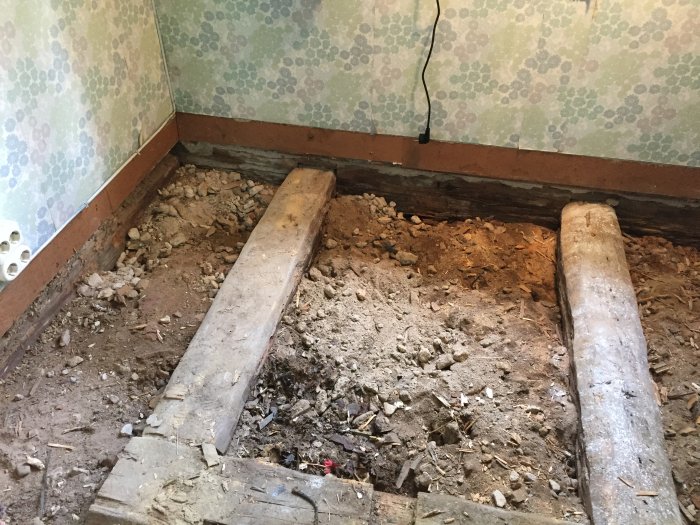
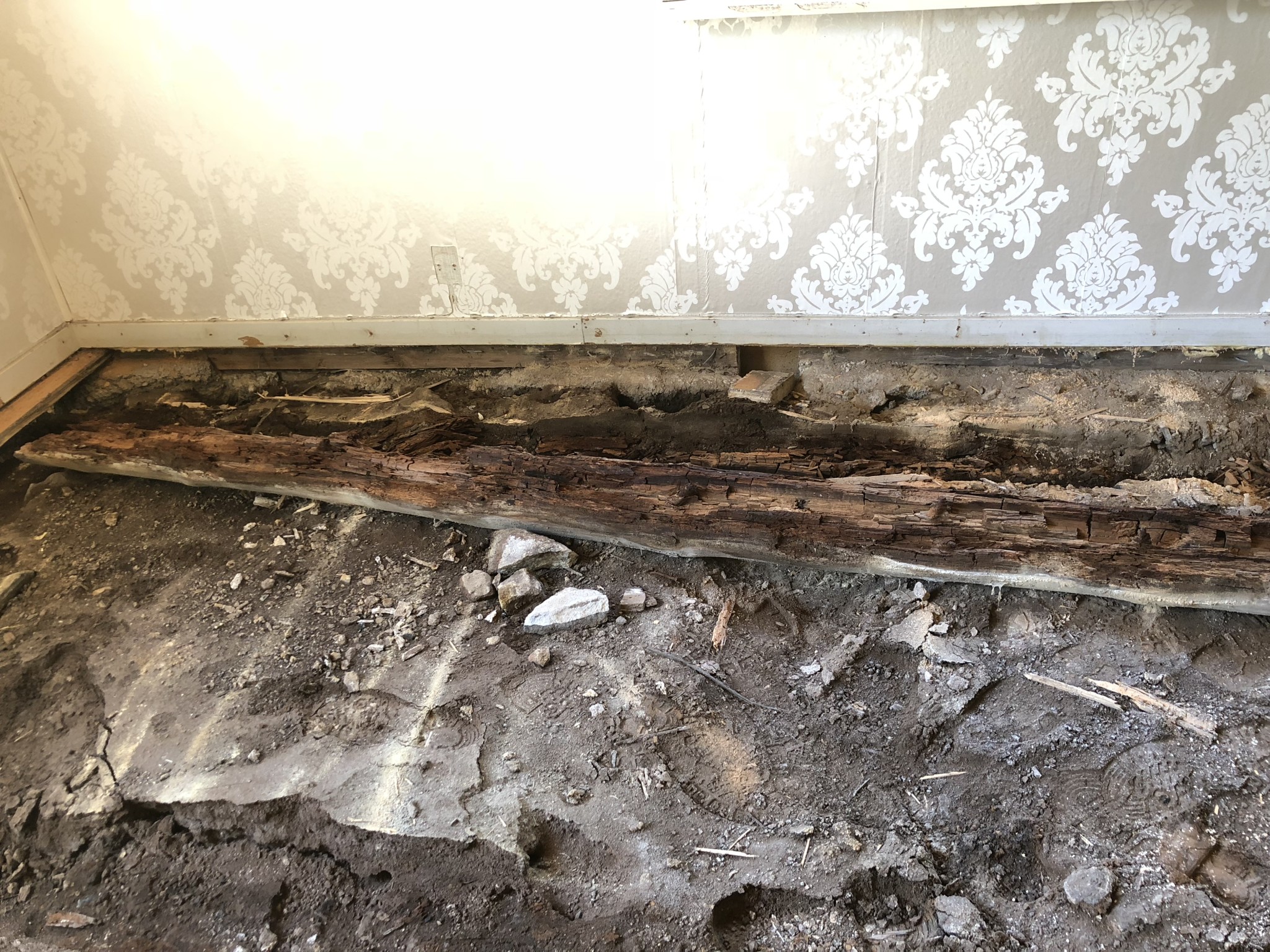
We have an old 19th-century cottage where the kitchen floor was completely rotten due to a plastic mat and some kind of paper board they had nailed on top of the floor. The moisture couldn't go anywhere, so it took the floor and even partially went towards the walls. It looked like in the first picture.
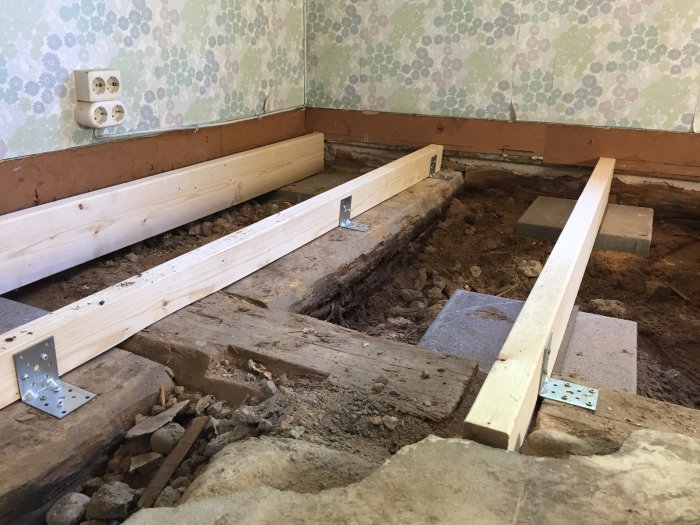
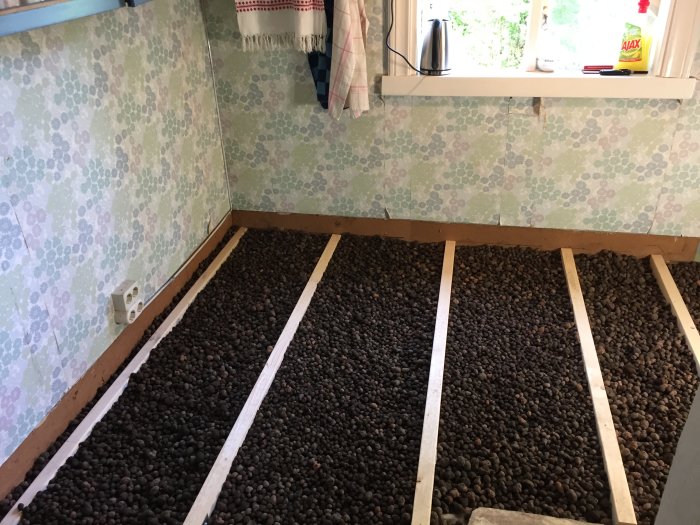
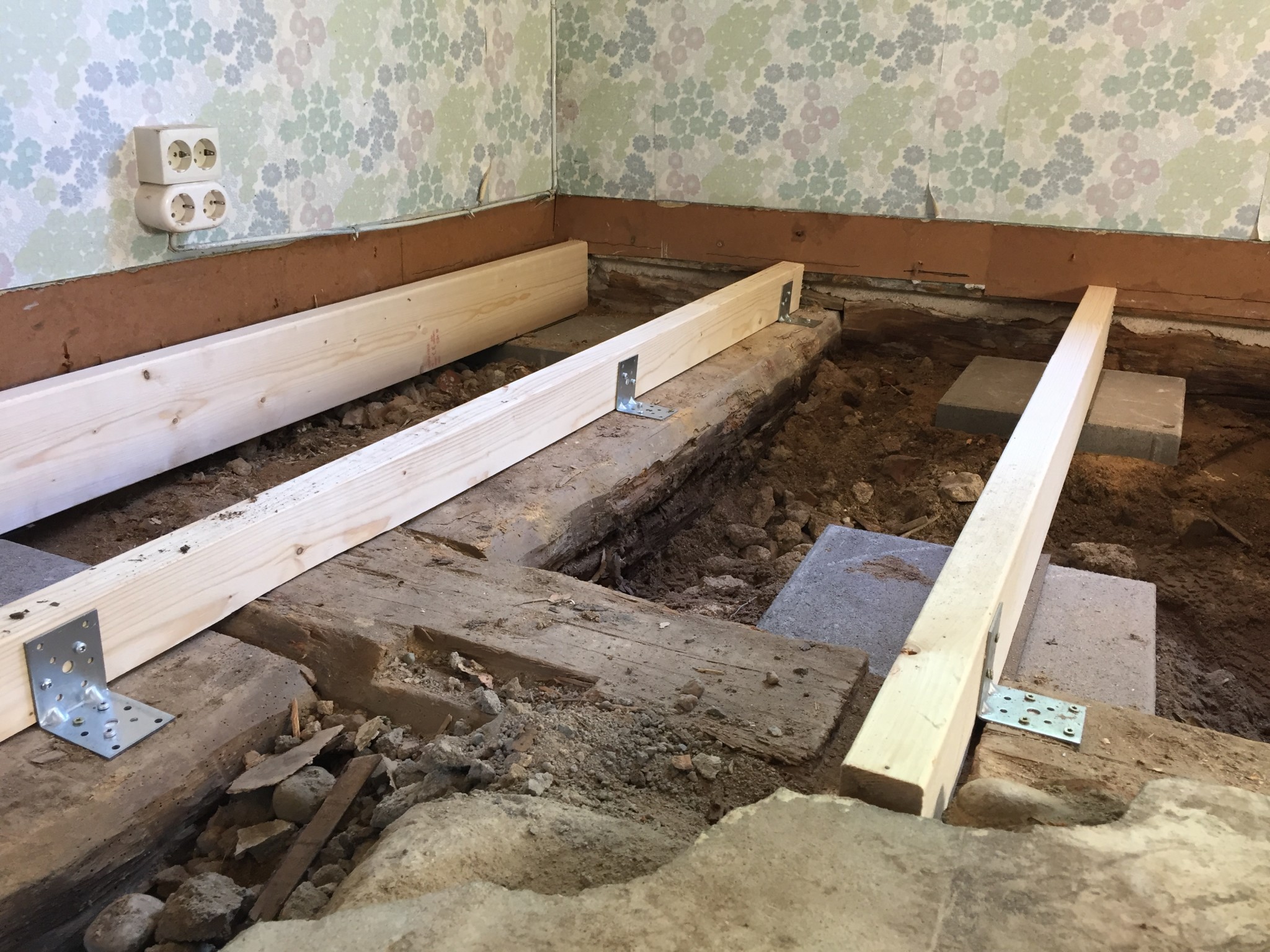
I dug out a bit, shoveled up a little towards the walls, and removed all the organic/wooden material I could find. Built a frame and then filled with leca. I've googled extensively and would have preferred Hasopor, but it was difficult to arrange logistically. Some say it will definitely get moldy, while others say it won't. Building conservation is a bit like dog and horse people, only black or white. Either paradise or it goes straight to hell
Then I screwed the floor on, sealed with linseed against the walls, and then put on baseboards. MUCH warmer than before but it's still socks and rugs required during wintertime. The previous owners foolishly nailed the floor to the sill, which is supposed to be bad according to everything I've read. Now the floor is completely independent and separate from the walls. Sill replacement can be done without ruining the floor and vice versa.
Some say it will definitely become moldy while others say it won't
Sometimes there is no limit to how much some people know and can do
Thanks for the pictures and info!
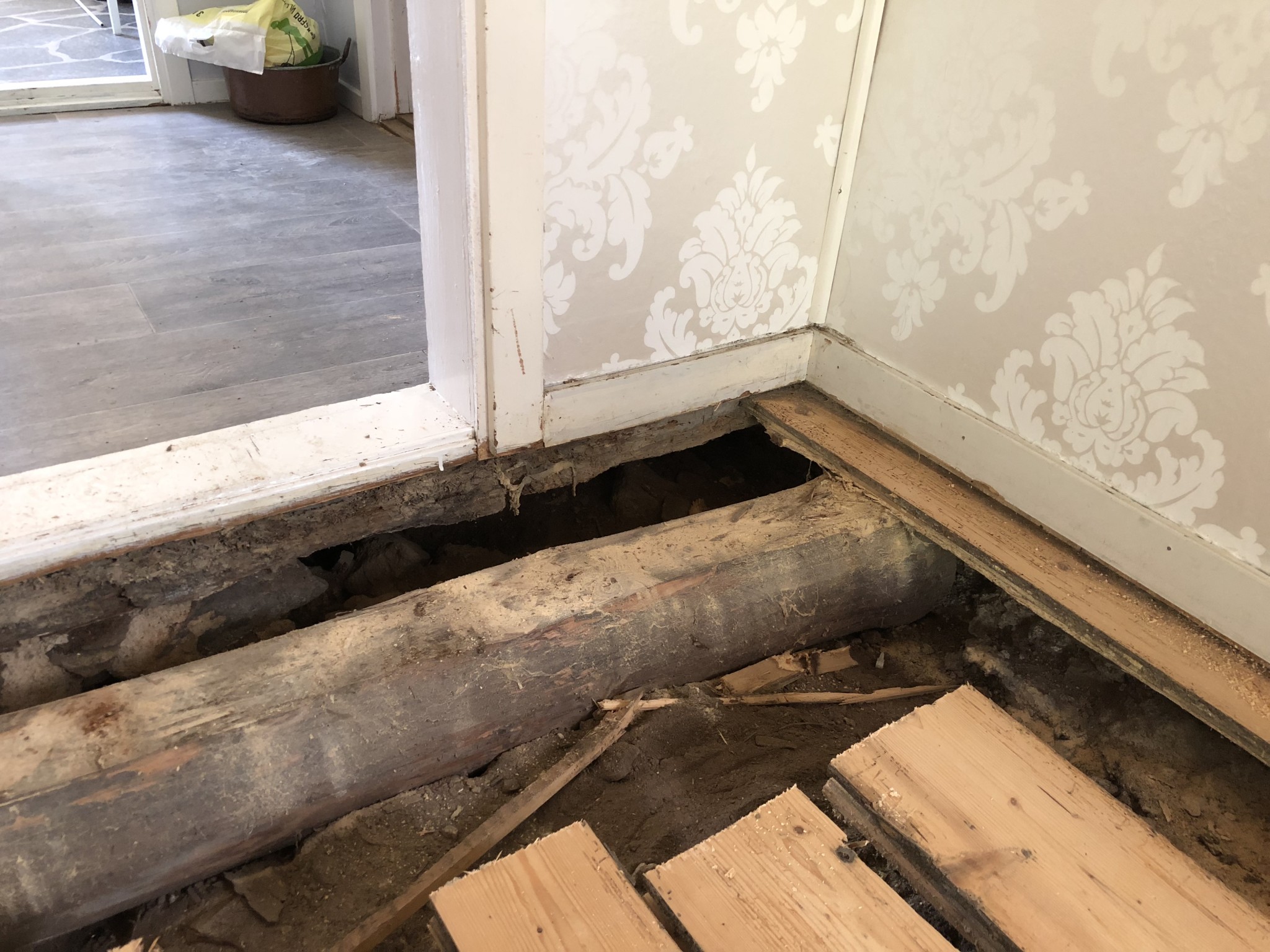
It looks almost exactly like under my living room floor when I removed it. I can also tell you that if you thought it was silly to nail the floor into the sill, you can ponder how they had done it here at my place; A tongue-and-groove plank floor that was nailed together at the ends with long "strips," which were embedded in the foundation. The only logical conclusion I can come up with is that they once moved the house and then embedded the floor first and then rebuilt the house on the floor?
See the first picture, the "strip" that remains (under the baseboard in the picture) was nailed from the outside into the floor planks, the top of the floor planks was then level with the foundation on which the sill rested.
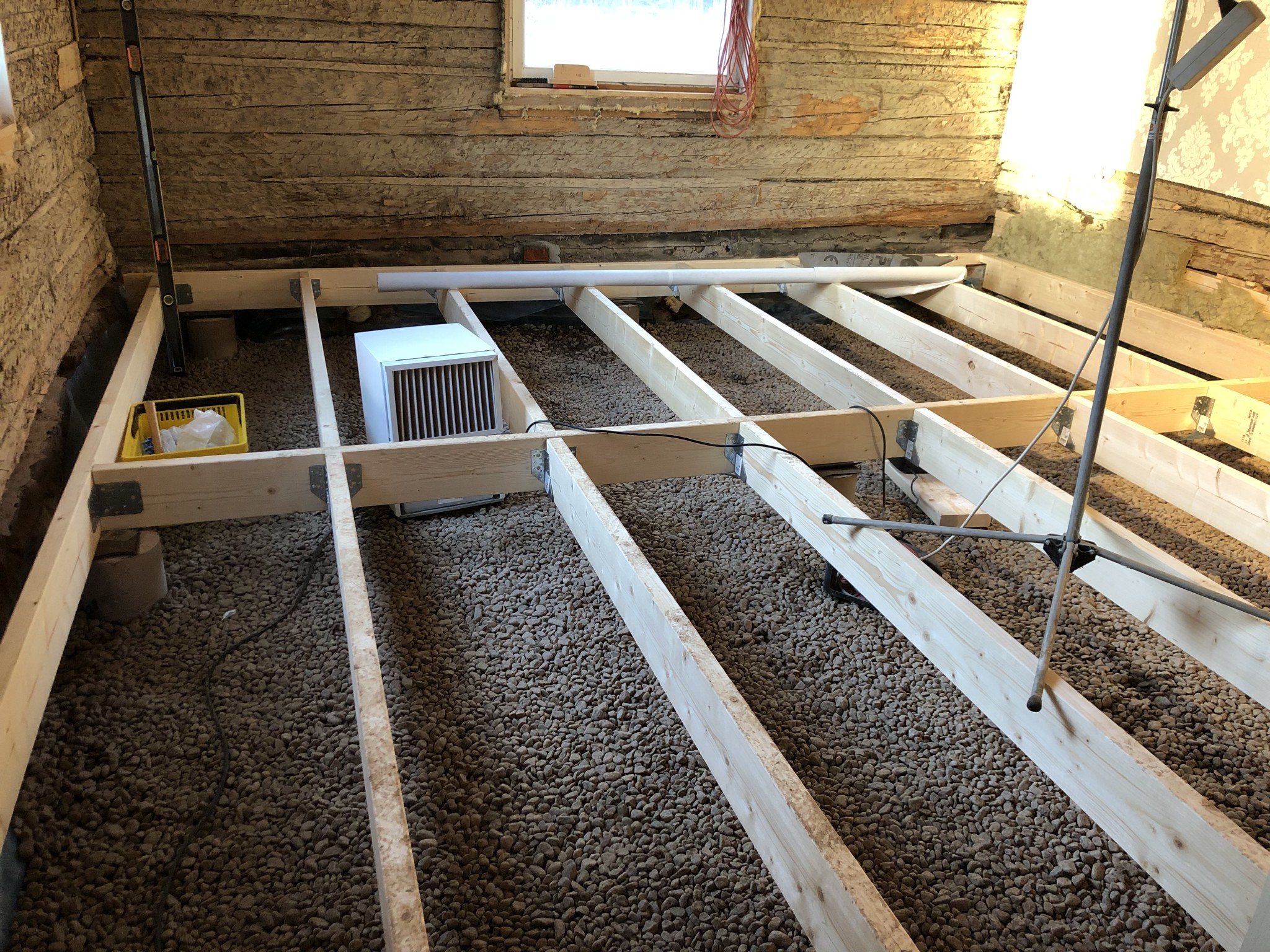
I also included a picture of the joist structure as it ended up in that room. At the bottom plastic, 10cm macadam, 10cm air, and a 170mm joist structure insulated with wood fiber boards. As it seems right now, I wish I had encountered the solution with cellular glass a bit earlier...
It costs 600 SEK/cubic meter if you order in bulk. The price includes shipping and excludes VAT, and is applicable for large orders in the range of 30-40 cubic meters. For smaller quantities, it will of course be more expensive. Call them and ask.
Where did you purchase from? Hasopor doesn't sell to individuals and otherwise I've only seen big bags which are more than double the price.
I am considering Perlite that can be blown in, so there is no need to take up the entire floor.
A bit of an old thread that's gained new traction on some social media platforms.
Perlite has better values than foamed glass (e.g., Hasopor). Comparable to EPS foam board in practical lambda value because it's a seamless material that doesn't absorb moisture.
The engineer calculated about 80 cm of Hasopor, or 30 cm of Perlite for new construction in 2018. Lightweight expanded clay aggregate should not be used in foundations with wooden joists because they contain lime, which provides nutrients for true dry rot.
Perlite is also capillary breaking and doesn't absorb moisture.
I think it's mostly a question of how it fits into the specific project. It can probably be blown in with a machine.
Vi vill skicka notiser för ämnen du bevakar och händelser som berör dig.




nikasp said:
pelrik said: