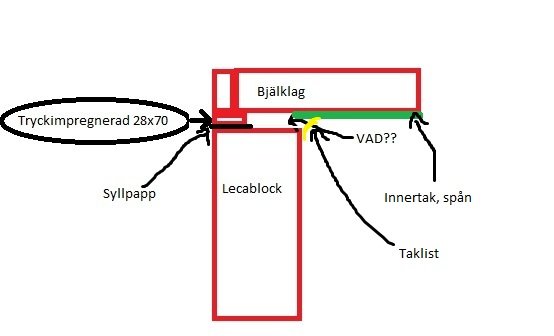
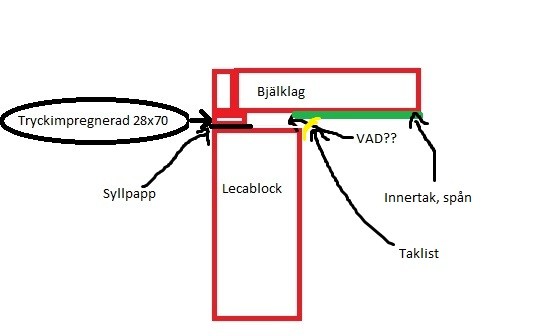
It should be warm in the basement, yes, that's why I'm considering what I should fill it up with. But of course, there is insulation in the floor as well (since my new basement used to be a crawl space). So even more precisely how it looks is probably like this:
I need something that won't absorb any moisture from the lecablocken, is mineral wool better than fiberglass wool? Other materials? (cellplast is good, but it doesn't seal so well).
It looks like you're going to have indoor climate down there?
Then there will be moisture transport outward in the construction above ground, and the treated board will be a thermal bridge.
It can probably handle the condensation well, but you risk getting an unpleasant odor.
It's tricky when you're fiddling like that. Ideally, you should have tried to seal both against convection and diffusion, but that brings a lot of other things with it and it's too late now.
I think you should avoid mineral wool in any case - contains urea which also starts to smell.
PU foam might not be a bad idea - it becomes convection-tight and insulates.
How should I have done it? I still have a room without a ceiling yet (which will be sealed as it will become a bathroom).
When I was building, I thought it's no worse than the gaps between door openings and frame/window openings and frame, so you just seal it. It's exhaust air, meaning I have a slight negative pressure in the house, but maybe that doesn't compensate for the vapor pressure due to the heat from the inside.
The disadvantage of PU foam is that it's harder to monitor. With wool, I can just remove the trim/wool and see how it looks. It will be quite a "wide" PU joint, around 15-20cm (2-4 cm thick), so it should be diffusion-tight, one would think. I do like moisture sensors, so if I use PU foam, I'll place a sensor against the board behind the foam, so I can keep an eye on it.
It looks like you're going to have an indoor climate down there?
Then there will be moisture transport outward in the structure above ground, and the pressure-treated board is a thermal bridge.
It can probably handle the condensation fine, but you risk getting a nasty smell.
It's tricky when you're doing things like that. Ideally, you should have aimed for airtightness against both convection and diffusion, but that brings a lot of other issues and it's too late for that now.
I think you should avoid mineral wool in any case - it contains urea which also starts to smell.
PU foam might not be a bad idea - it becomes convection-tight and insulates.
I clicked like because in theory, what you write is probably correct.
How it works in practice is a bit harder to know.
If you have a finished basement, I believe that most people choose not to install a vapor barrier on the walls.
And it seems TS hasn't done it, and doesn't plan to do it on that top section near the ceiling either.
Sure, there will certainly be vapor pressure outward in the structure in question, but it will apply to the entire wall, so if you have problems in that basement, it won't be limited to just the top 3 cm of the wall, near the ceiling.
If it were my basement, I would fill the gap there with almost anything that's inorganic. But I would mostly lean towards some kind of foam, polystyrene, etc.
Yes, like what nombz linked to, or foam sealing, or maybe EPS polystyrene. But the last option is probably the hardest to get in place while also being convection-tight.
Then it's just a matter of crossing your fingers.
Eh, there are so many places on a house where things can go wrong, you can't secure everything.
I clicked like because, in theory, what you write is probably correct. How it works in practice is a bit harder to know.
If you have a finished basement floor, I believe that in most cases you choose not to use a vapor barrier on the walls. And it seems the OP hasn't done so and doesn't plan to either on that upper bit by the ceiling.
No, putting a vapor barrier on all the walls seems a little crazy to me. My idea is to have a solution that doesn't have anything organic and to make sure it ventilates well. But the upper part does contain something organic (since there's wood there). I've never heard of a diffusion-tight basement wall, but maybe they exist.
Mikael_L said:
Surely there will certainly be a vapor pressure outward in the construction in question, but that will apply to the entire wall, so if you have problems in that basement, it won't be limited to the top 3 cm of the wall, closest to the ceiling.
If it were my basement, I would fill the gap there with pretty much anything that's inorganic. But mostly I would lean towards something like foam plastic or polystyrene. Yes like what nombz linked to, or cell plastic base sealing, or maybe EPS polystyrene. But the last option is probably the hardest to install and still be convection-tight.
Is PU foam considered inorganic?
Mikael_L said:
Then it's just a matter of keeping your fingers crossed. Ahh, there are so many places on a house where things can go wrong, you can't secure everything.
Exactly, and in this case, it's somewhere where I at least KNOW it can be sensitive. Additionally, if I install a moisture sensor, I can monitor how it progresses.
Click here to reply
Vi vill skicka notiser för ämnen du bevakar och händelser som berör dig.