7,071 views ·
27 replies
7k views
27 replies
Fill space between lecabase and joists with what?
I am in the process of converting my crawl space into a basement and I am now considering one last thing (probably not the last...)
The joists and sill plate rest on a piece of pressure-treated wood that sits on the edge of the concrete block wall. But what is the best way to fill the space inside this? Just a strip of insulation or should I use spray foam?
See the attached image that might better show what I mean.
The joists and sill plate rest on a piece of pressure-treated wood that sits on the edge of the concrete block wall. But what is the best way to fill the space inside this? Just a strip of insulation or should I use spray foam?
See the attached image that might better show what I mean.
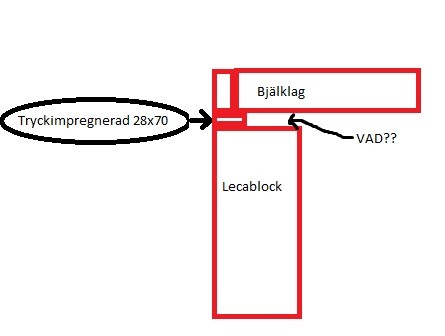
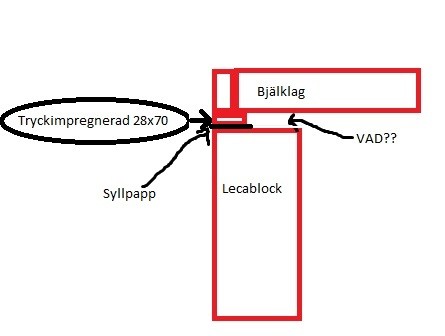
Do not know why they put a pressure-treated board between the syllpapp and the joist layer, I guess they wanted to provide extra protection against moisture migration from the lecablocks...
I would be careful about inserting anything that destroys the moisture migration protection between leca and the joist layer.
/ATW
I would be careful about inserting anything that destroys the moisture migration protection between leca and the joist layer.
/ATW

But a little mineral wool or EPS foam should be possible to insert there, right? Both are diffusion-open and absorb water capillarily to a very marginal extent. Moreover, there should never be free water there that can be absorbed capillarily, and if so, then you probably have a problem that needs urgent fixing.

Nothing is broken or wrong, so you don't need to do anything.
But if you do want something there:
EPS-cellplast.
Syllpapp and an extra board.
What does the trossbotten look like, because there will probably be gaps when you add support for it?
But if you do want something there:
EPS-cellplast.
Syllpapp and an extra board.
What does the trossbotten look like, because there will probably be gaps when you add support for it?

Nothing is needed there, right?

I have a similar construction.
Leca, sill paper, sill, joist. The cavity is filled with insulation. Feels dry and good, but it might differ from other environments.
Never used plastic because it's a basement part.. Right or wrong, I don't know.
Leca, sill paper, sill, joist. The cavity is filled with insulation. Feels dry and good, but it might differ from other environments.
Never used plastic because it's a basement part.. Right or wrong, I don't know.
You mean the inside of the basement walls then?D09 said:
It might have been a correct decision. Outside the wall is below ground, where it is usually assumed to be 100% RH, as there is an "unlimited" supply of water.
So plastic on the inside would mean it could be 100% RH right behind the plastic as well. Then it might be better for the moisture to be able to migrate into the basement instead and be ventilated out.
Yep, the inside.Mikael_L said:You mean the inside of the basement walls then?
It might have been a correct decision. Outside the wall, it is below ground, where it's usually assumed to be 100% RH, since there is "endless" access to water.
So plastic on the inside might mean it could be 100% RH right behind the plastic as well. Then it might be better for the moisture to migrate into the basement instead and be ventilated out.

Good to hear
We'll see in 50 years if it was right or wrong
I'm not 100% sure, but if it were my basement, I would skip the plastic.
And many have testified to how bad it gets with basement walls painted with a "dense" acrylic paint, instead of a diffusion-open silicate paint. The paint flakes off.
And it's usually advised to only apply a waterproof layer in the shower corner itself and not on other walls or the floor when decorating a basement bathroom.
And many have testified to how bad it gets with basement walls painted with a "dense" acrylic paint, instead of a diffusion-open silicate paint. The paint flakes off.
And it's usually advised to only apply a waterproof layer in the shower corner itself and not on other walls or the floor when decorating a basement bathroom.
No, nothing is wrong at all. BUT as mentioned, I will furnish the basement and it's a bit drafty there.Workingclasshero said:
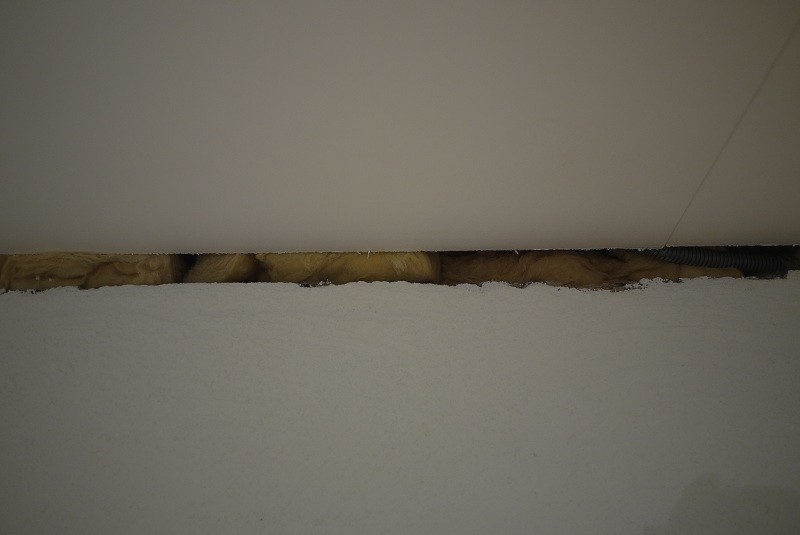
Here's how it looks today. I've put in some fiberglass insulation there now to prevent drafts, but I thought I'd check here if there are any opinions on that before I nail a ceiling molding in place. It's easy to switch to mineral wool. Cellplast will be difficult to make "tight," I guess?
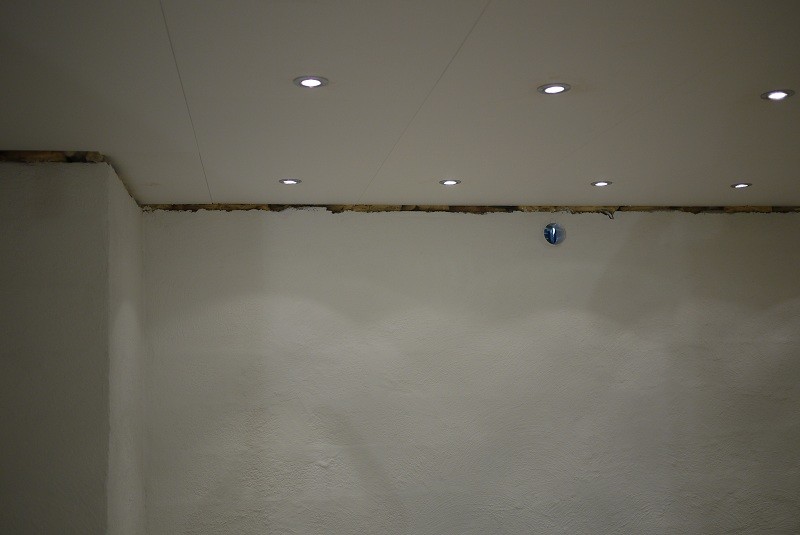
A bit closer.