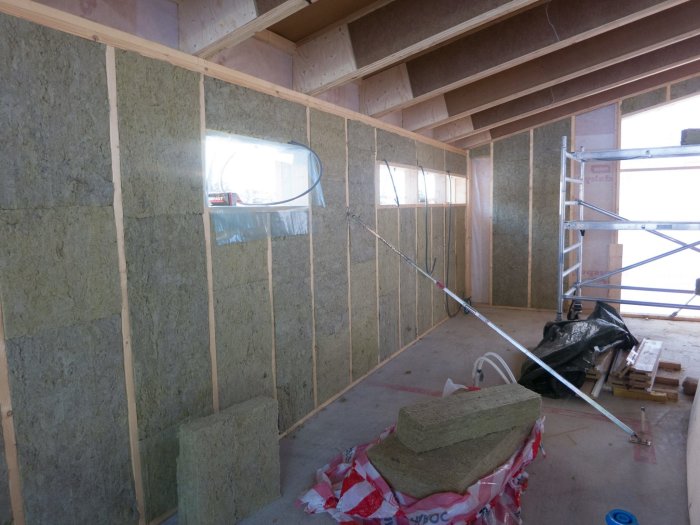
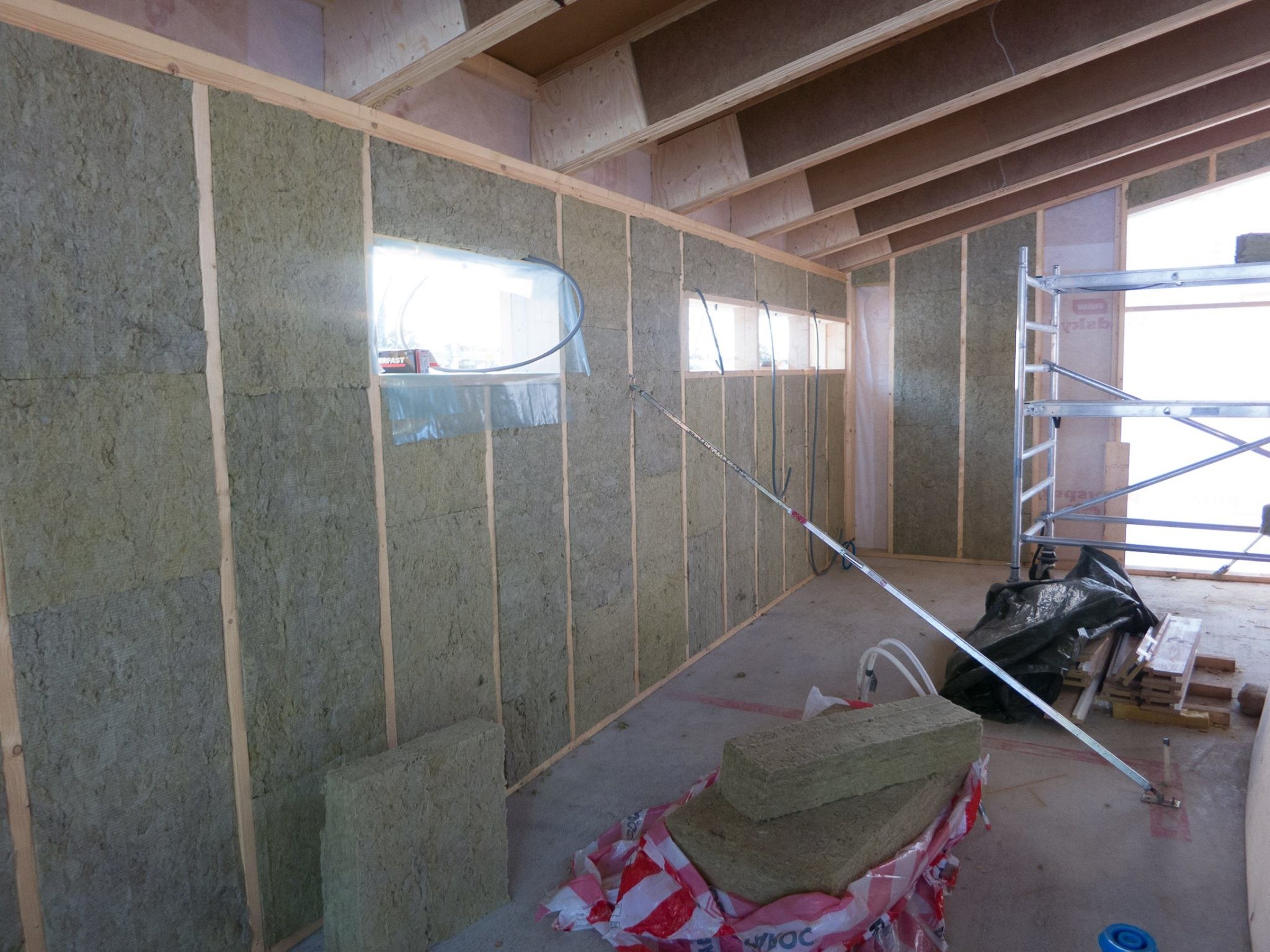
I've hit a bit of a snag in the construction, which is irritating with Christmas coming up when there are some free days to get things done.
After the municipality visited, they questioned whether the attachment of the roof trusses would hold and wanted us to provide a construction basis for the attachment concerning wind loads.
We have chosen light beams from Hunton in the roof with cc 600 and 1200 depending on the span. According to the manufacturer, with roof slopes under 15 degrees, these should be placed on a wedge and skew-screwed with 2 pcs of 5x100mm on each side/attachment point. That is 8 screws per beam. (Construction example D21)
The screws we used are Essve corrseal 5x100.
The beam itself is, of course, calculated to withstand snow loads and breaking points concerning span, but for the attachment, both I, the architect, and the carpenters assumed that the manufacturer's recommendation works.
After talking to the manufacturer, the architect, and the carpenter, none of them can recall ever having done a separate calculation on this part.
With a regular roof truss, you usually only use 2 angles + anchor nails, and then nobody worries about whether it's over/under-dimensioned?
I have received help from the manufacturer to perform a calculation of the loads the beam's attachment will be exposed to. However, he did not dare to guarantee that the screw would hold as this depends on which screw is used, etc.
Does anyone have experience with something similar and have some input regarding my problem?
Maybe even someone who can comment on how this attachment will work based on the attached information?
As you can see in the picture, the attachment is still open, and I can easily attach an angle bracket on each side to ensure functionality. However, the question is then how I deal with the construction basis for the municipality
The construction regulations (EKS) by the National Board of Housing, Building and Planning contain detailed rules on how to calculate wind load. The parameters include, among others, location in the country, height above sea level, and a shape factor that depends on the type of roof. With these rules, one can calculate the maximum load (in this case, a lifting force) per beam attachment. Then, this lifting force should be compared to what the attachment brackets can withstand. The best type of bracket should be a form of fork anchor. I don't think such exist in the current width, but they should be easy to manufacture using flat iron.
Yes, Hunton has already calculated that force. However, I find it a bit difficult to calculate what the fasteners can handle, in my case 8 skewed screws 5x100 or perhaps more commonly angle brackets 90x90 with anchor screws.
Do you need to submit and have documentation approved before you can continue or did they make a note in the minutes stating that the calculation is required to obtain the final certificate?
Four skewed 5x100 screws provide good fastening force, essve should have strength figures for their specific screws. If you have the loads in different directions from hunton, shouldn't it be possible to calculate and compare with the screws?
Do you have to submit and get the documentation approved before you can proceed, or did they make a note in the protocol stating that the calculation is required to obtain the final proof?
Four skew-screwed 5x100 provide good holding power, essve should have figures for the strength of their screws. If you have the loads in different directions from hunton, it should be possible to calculate and compare with the screws?
It's more that a calculation is required for it to be approved. However, it's now before I seal the roof next week that I have the chance to fix it.
After a late consultation with the designer, he thought it would hold. But calculating it to be sure is as costly as putting in angle irons.
So I'll screw in the angle irons this weekend, and then I'll get a certificate from the designer without calculation that I am well above the requirement. Low tech solution but probably the most sensible in this situation.
Click here to reply
Vi vill skicka notiser för ämnen du bevakar och händelser som berör dig.