
I'm quite an amateur when it comes to construction. I don't even know if I'm asking this question in the right forum category.
I want to screw together two desktop panels, but since it's laminate, I can't mill out the material and insert countertop connectors, nor can I try to drill holes on the sides since there's "plastic" around the entire panel.
However, I've seen that you can have a similar connection that screws ON (or rather under) the panel and then tightens, without needing to drill large holes in the panels (except for a couple of small screw holes to attach the connector).
As mentioned, I'm looking for something similar; it doesn't have to be exact. Just as long as it's possible to join two desktop panels without major invasive procedure.
I want to screw together two desktop panels, but since it's laminate, I can't mill out the material and insert countertop connectors, nor can I try to drill holes on the sides since there's "plastic" around the entire panel.
However, I've seen that you can have a similar connection that screws ON (or rather under) the panel and then tightens, without needing to drill large holes in the panels (except for a couple of small screw holes to attach the connector).
As mentioned, I'm looking for something similar; it doesn't have to be exact. Just as long as it's possible to join two desktop panels without major invasive procedure.
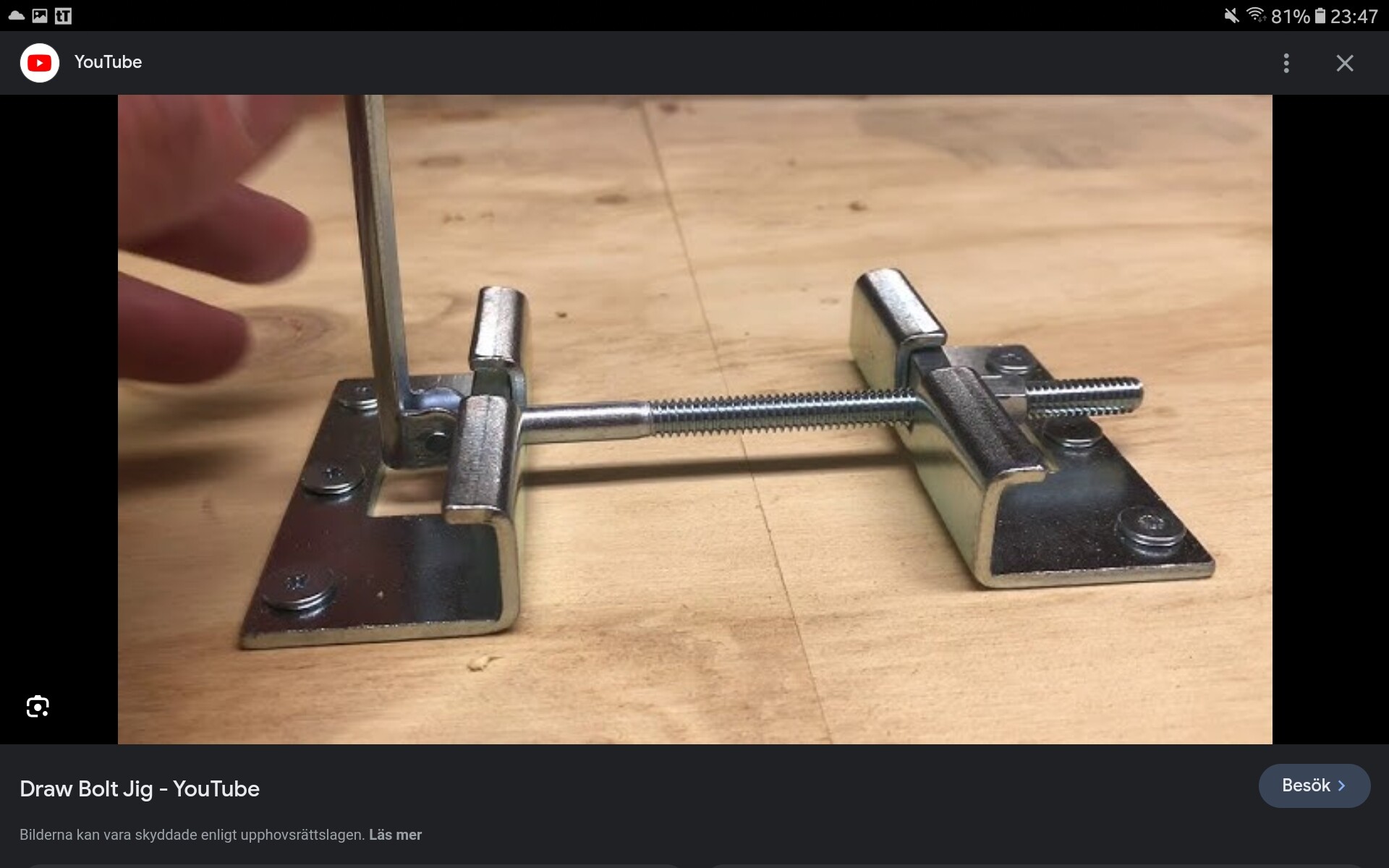

It's perfectly fine to use regular joint brackets on a laminate countertop, but it's naturally more complicated than the variant you're looking for. The advantage is that the clamping force goes exactly where you want it, while the other tends to bend the boards, but that may not be an issue in reality.
Unfortunately, I don't have a good tip on where you can find it.
Unfortunately, I don't have a good tip on where you can find it.
The boards are laminated on the edges, won't it just chip and come off?Rickard. said:
It's perfectly fine to use regular jointing brackets on a laminate countertop, but of course, it's more complicated than the variant you're looking for. The advantage is that the clamping force is exactly where you want it, while the other method tends to bend the boards, but that might not be an issue in reality.
Unfortunately, I don't have a good tip on where you can find it.
I'm thinking of improvising a similar apparatus to the one in the picture I showed, where I keep the "cylinder" and nuts of a regular jointing bracket. However, I attach with L-shaped plates on each side of the countertops. Can it work then, you think? Do you have any idea which different parts are best to combine?
I'm not in any way an expert on the subject, so take my words for what they're worth.H Herman.H said:The boards are laminated on the edges, so it will probably just chip and come off.
I can think of improvising a similar apparatus to the one I showed in the picture, where I keep the "cylinder" and the nuts from a regular joint fitting. However, I attach with L-shaped plates on either side of the countertops. Could that work, you think? Do you have any idea which different parts are best to combine?
Joining factory edges together will never be particularly concealed, and the bonding will only be as strong as the adhesive holding the laminated edge in place. But with good joint fittings, I wouldn't be worried about it. I think typically you join cut edges, but you do as you like.
You can drill through the plastic with a regular wood drill without problems; it's just a thin plastic strip.
I don't have any good tips for a more creative solution than to follow the instructions in the usual way.
Click here to reply