The fact that measurements deviate from the standard or that they vary doesn't matter.
But distinguishing between compressive and tensile forces in a truss design is important. If both aren't present, then the truss is not stronger than the bottom chord. In this case, there are a lot of struts distributing the load down to the bottom chord without corresponding braces making it a truss. TS of course will do as he wishes. I would spend half a day adding braces. I wouldn't wait for snow load to see if it was necessary.
Regards, Findus
If I follow the example above, how do I do it with the "odd" truss a step further in? It seems to have the wrong construction to be able to set the diagonal braces.
Only make changes where you make modifications under the rafters. Theories aside, if it has held up so far, it will likely continue to do so in the future, in places that have remained the same since the house was built. Currently, the supports are not exactly where they should be. But it shouldn't be a problem if you complete it like this.
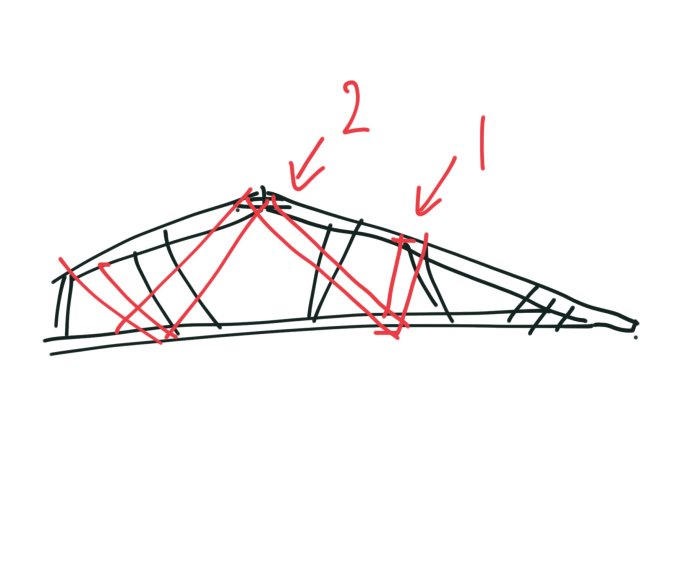
First, an additional supporting board according to no1 should be placed so that it supports the middle of the rafter leg. Then braces according to no2 that you can screw on the outside without any hassle. Same on both sides of the rafter that you need to reinforce. Then what you have is a rafter according to the simple-v model. The ones already there surely also serve a purpose.
Such trusses you have are basically found in all summer houses from the 60s. I don't think the post is load-bearing, but the trusses might have started to "sag." Test how much the ceiling sags on the other trusses in the main room, then you'll get an idea if the post you want to remove has counteracted this.
If you don't have a long, straight edge, you can test by stretching a string parallel to the truss and measuring how much it differs from the ceiling. My ceiling with a span of 5m sagged up to 4 cm in the middle.
I agree with findus42.
Feel free to add new supports. The old ones are definitely not a self-supporting truss construction, they just transfer the force downwards. With findus's suggestion, there will be tensile forces in the supports towards the ridge mid-point (2) and compressive forces in the others (1), which should be considered during installation.
Then quick has observed another thing. High moisture load. It's likely that the generously sized insulation in the attic has lowered the temperature so that rising room air is cooled to condensation against the roof decking.
There doesn't seem to be any ventilation, you can try opening vents at the gables. They might help ventilate out moist air. Or they might bring in as much moist air from outside as they ventilate out, hard to know with moisture migration in old houses.
You can never rely on ventilating away moisture in an attic with passive ventilation. It could just as well be a day when it has the opposite effect (e.g., weather change from very cold to rain and humidity).
Is the cabin used in the winter? Then moisture from the living area will likely rise due to the lack of a vapor barrier. This can be reduced through mechanical ventilation (fan) to create more negative pressure.
Otherwise, a humidity-controlled fan is needed in the attic to ventilate at the right times.
Or a dehumidifier of some sort, but then, of course, you need to close the ventilation first.
I think it's smart to install a thermometer with a hygrometer up there, possibly with logging, to understand when there is a problem and thereby why, so that you target the right issue.
It cannot be a regular humidity-controlled bathroom fan, though. It must compare the absolute moisture content outside and in the attic and only ventilate when it is (absolutely) drier outside than inside.
Click here to reply
Vi vill skicka notiser för ämnen du bevakar och händelser som berör dig.