I am remodeling the kitchen but am about 70mm short to fit the floor cabinets I want.
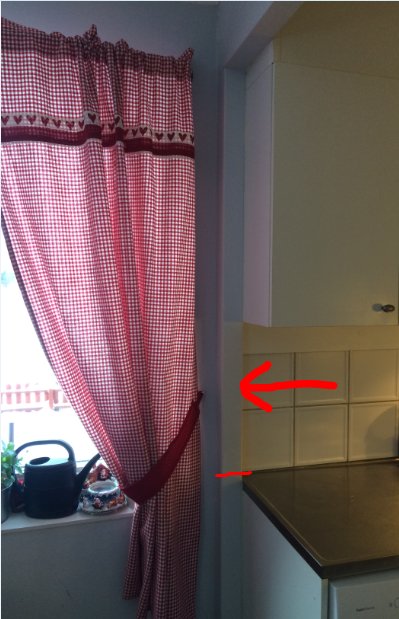
There is a stud that conveniently is 68mm. If I cut it, I can fit everything.
But the stud goes from the floor up to a transverse beam in the ceiling and I am unsure if the stud has any load-bearing function.
I wonder if anyone with construction knowledge has anything to say about this?
I also wonder how/where one can generally see which structures in a house have a load-bearing function?
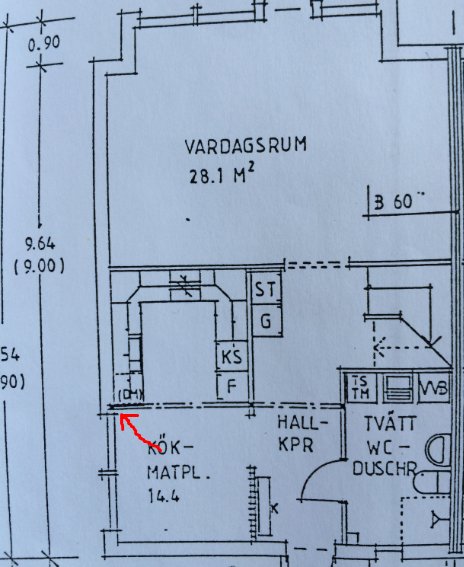
Two pictures. Red arrows point to the stud and the red line on one picture is where I want to cut it.
It looks load-bearing in the picture. What does it look like above, is it a roof or another floor? Depending on which direction the rafters/floor joists lie, one might be able to "rule out" that it is load-bearing.
Yes, almost certainly load-bearing, intended for the glulam beam in the ceiling.
The rule/post might be able to be recessed into the wall instead, and maybe a bit of a trick with a small steel bracket or something up there for the glulam beam to rest on.
Most likely, it is the pillar for the glulam beam in the ceiling.
However, it doesn't seem to protrude much from the wall. Could you extend the whole wall and build the kitchen outside the pillar instead? The small bit the pillar sticks out from the wall should be enough.
Doubtful, it might be load-bearing but probably not. Why would you place a load-bearing post there and not inside the wall instead? Which is also as flimsy as a non-load-bearing partition wall? Are you sure that there wasn’t a partition wall between the kitchen and dining area that previous owners removed? Perhaps he added the post and glulam beam just in case.
The other wall that goes right through the house is placed in the middle of the house, so it is likely load-bearing. You have the same distance in the living room from the exterior wall to the partition wall without support, and I assume the intermediate floor holds up for it.
The post holding up a glulam beam doesn't need to be particularly strong; it might be that it actually goes into the wall but for some reason couldn't go further in.
It could also simply be that they didn't want to complicate things by embedding the post, where it is it doesn't interfere with anything.
Considering that there's an upper floor in the house, there could be several load-bearing walls, or perhaps previous owners removed the wall and noticed that the floor above wasn't quite right, so they put up the beam.
I wouldn't touch it; I'd cut the corner off the cabinet instead.
If you calculate a bit, you'll probably conclude that the beam in the ceiling needs a stud with a thickness equivalent to the stud in the wall plus the one that protrudes. There are tables on the Svenskt Trä's website. You could generally check there how thick a post is required for the beam you have in the ceiling. However, there might be a possibility to still embed it in the wall as suggested. This would, however, require quite a bit of impact on the surface layers.
I would not have touched it, just cut out the corner of the cabinet instead.
Yes, that's probably the easiest solution. It doesn't take long to cut out the cabinet + the beam will be a bit more hidden. The glulam beam doesn't seem to get in the way of the cabinet doors anyway.
It may be that the beam and the post are not load-bearing (or at least important) if the previous owners have removed a non-load-bearing wall there but did not know the situation (or dared to chance) and therefore installed a laminated beam in the ceiling completely unnecessarily.
What speaks against this, however, is that in the drawing it can be seen that the span for the intermediate floor seems to be over 9 meters, and this is quite long to achieve a floor without annoying sway with only a central wall.
So my main guess remains that the beam is load-bearing and that the rule on the wall is a necessary post for the beam.
Missing information to determine that. If there's a window beside it, there should be a stud in the wall, so why hasn't the laminated beam been connected to it? It seems like a wall has been removed and then a stud placed on top of the old wall. Remove the cabinet at the stud and then the surface layer between the stud and the window. I'm quite sure you can recess everything into the wall so that it's not visible.
What goes against this, however, is that the span for the intermediate floor appears to be over 9 meters on the drawing, and that is at the longest for getting a floor without disturbing sway with only one load-bearing wall.
That struck me as well, and then I started to wonder if the floor beams really go in that direction. The window section in the living room at the top of the drawing doesn't exactly suggest that it lies in that direction.
It might be a good idea to figure out which direction the floor beams are placed.
You are damn helpful. Much appreciated.
The kitchen is original. Several similar houses in the village.
I'll take a smaller sink so everything fits. Maybe I'll have the countertop round the rule in some stylish way.
Thanks again for the commitment.
Click here to reply
Vi vill skicka notiser för ämnen du bevakar och händelser som berör dig.




 Much appreciated.