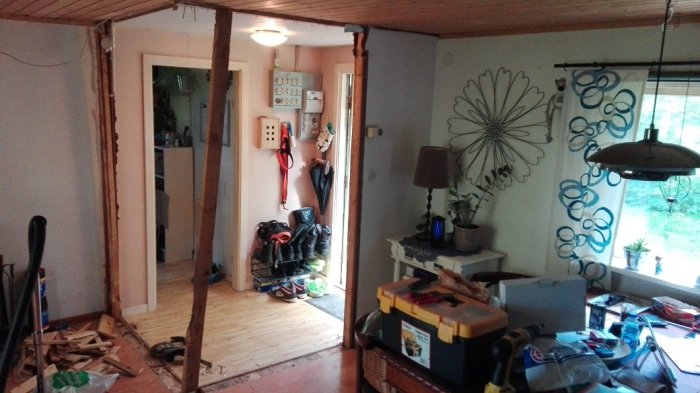
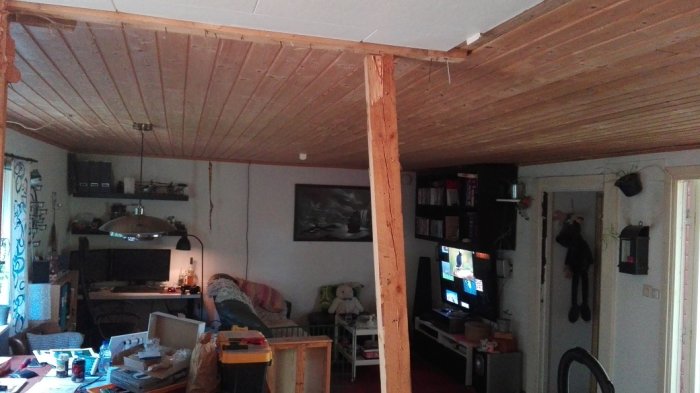
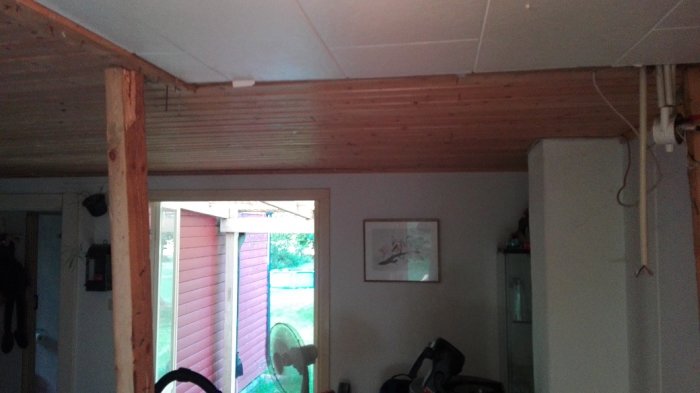
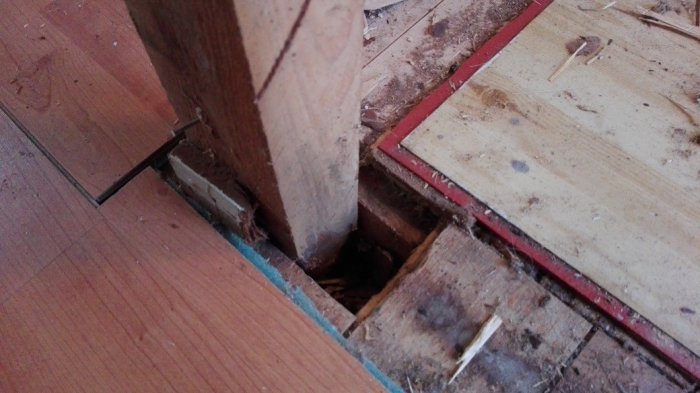
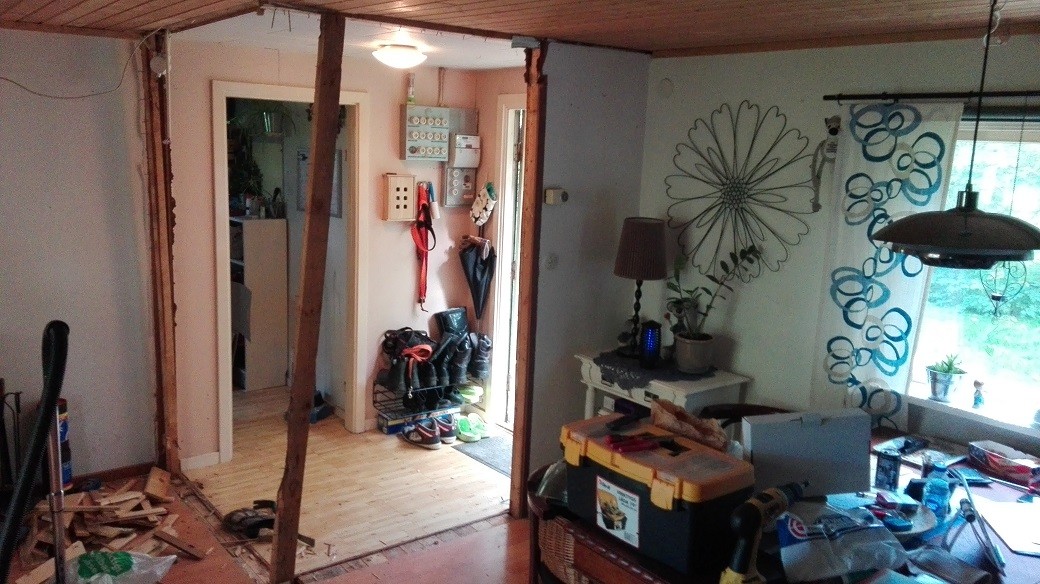
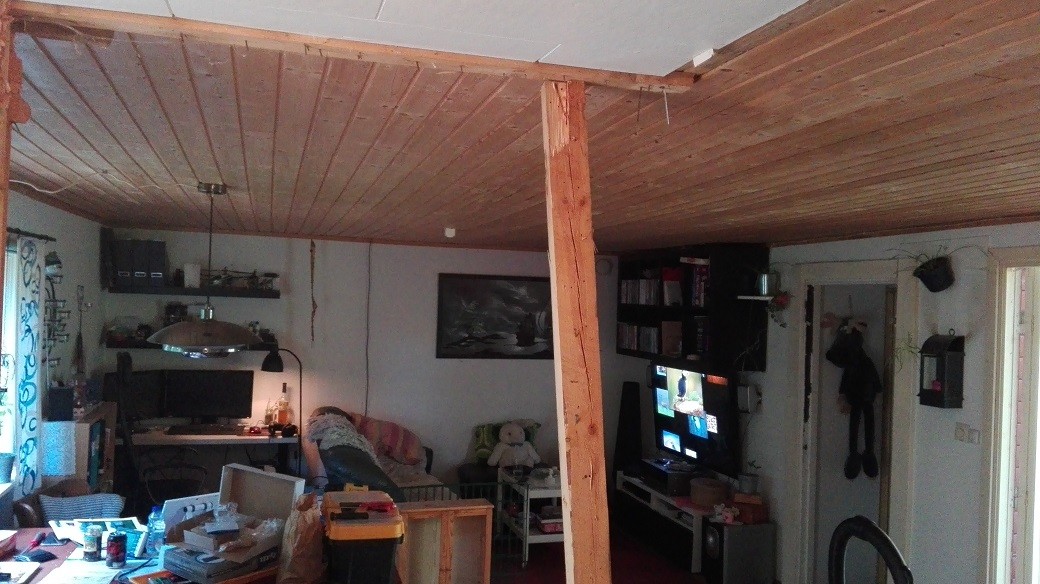
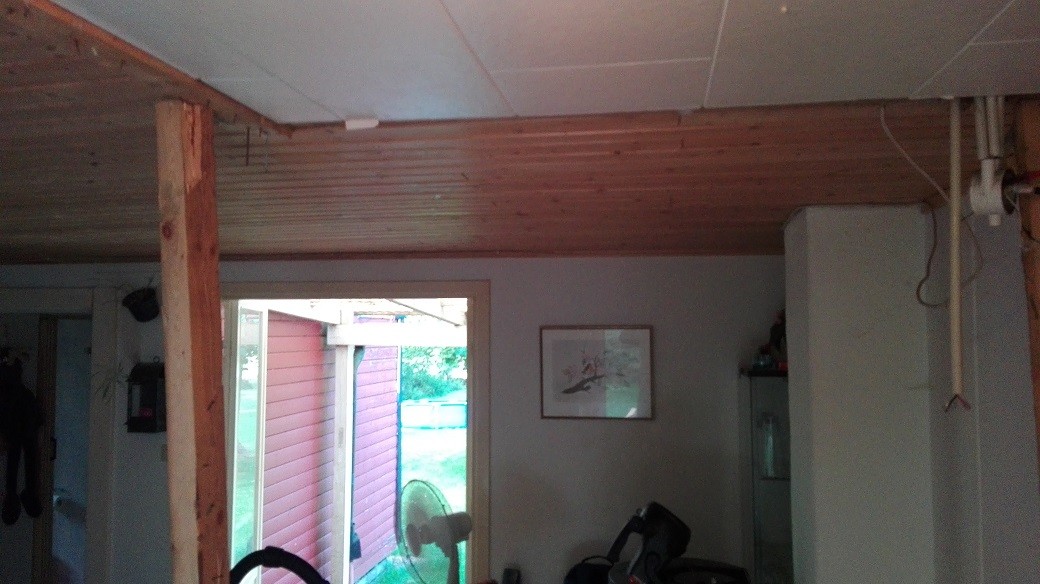
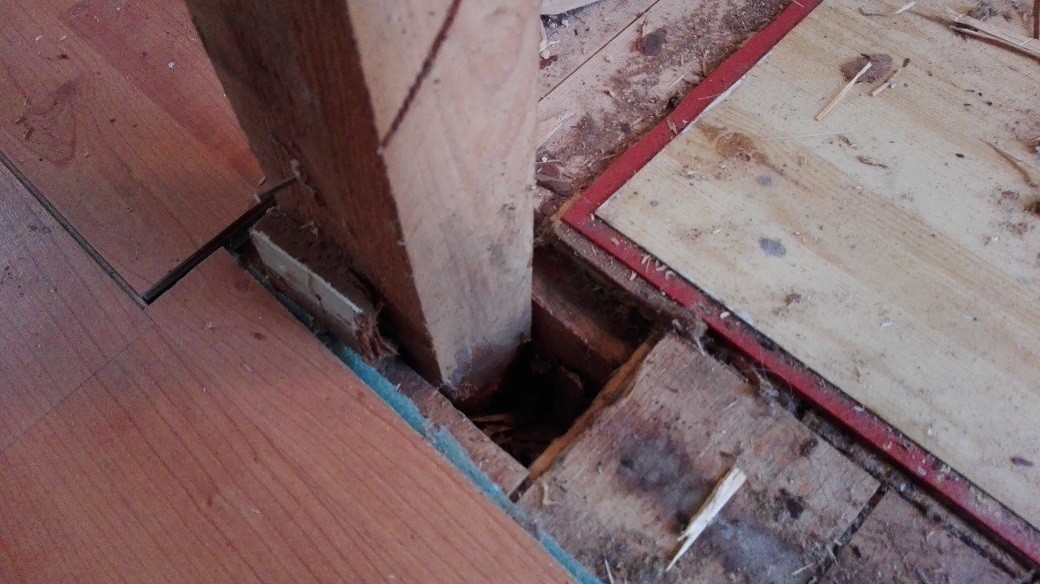
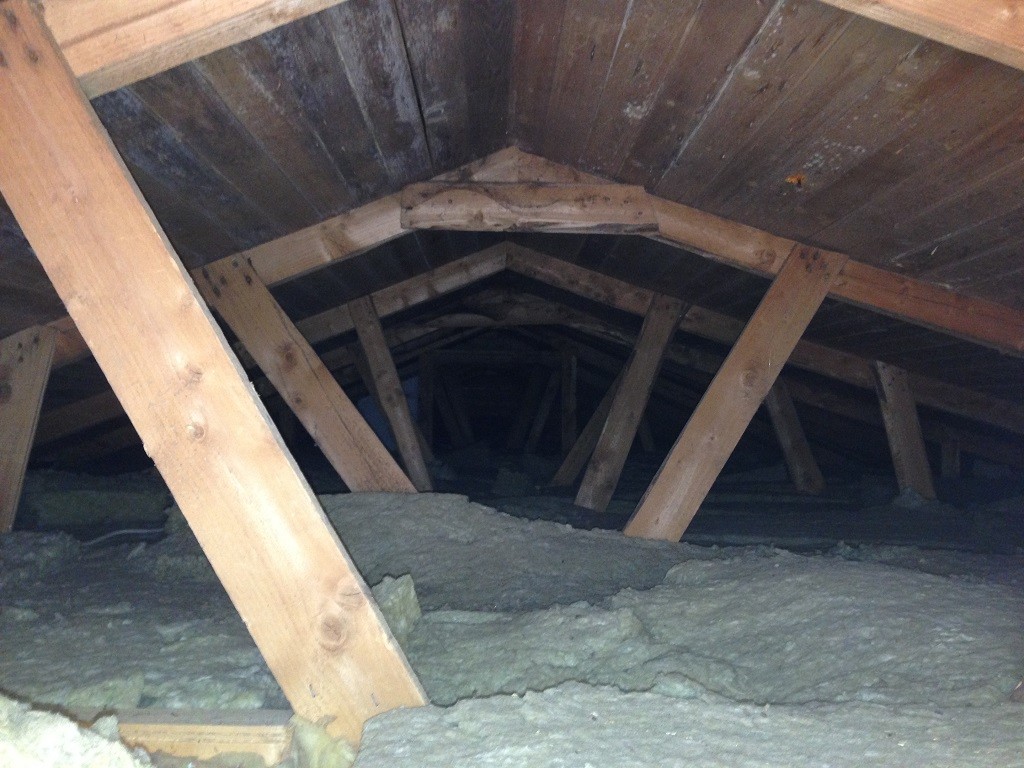
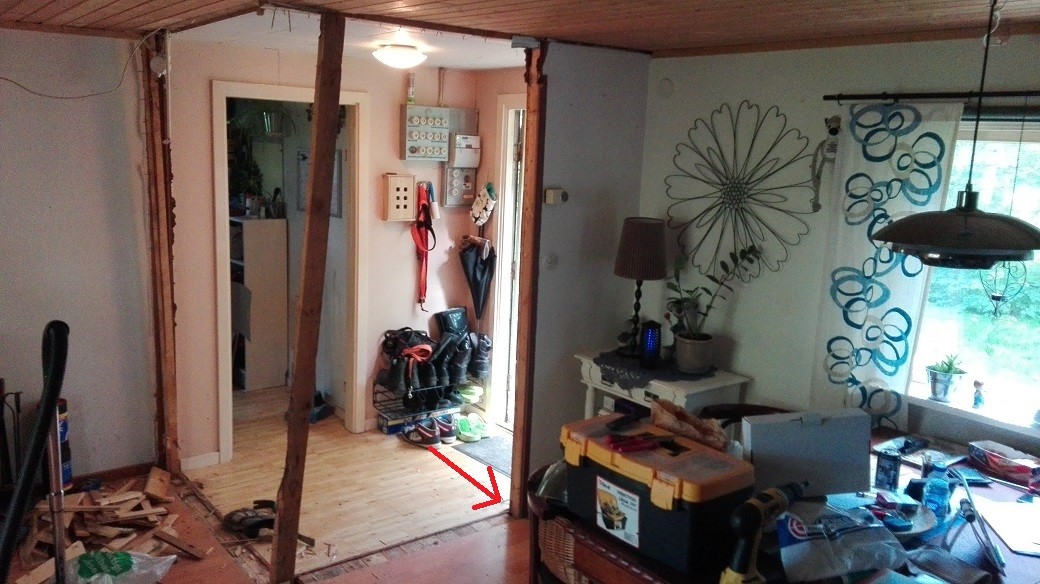
I'm in the process of renovating a bit at home and I'm going to tear out the hallway. But when I took down the corner post (see pictures below), the ceiling "sank" just a little. You could see it bounced slightly. So now I'm really unsure because I have always assumed that none of these walls are load-bearing since 70% of the cabin lacks interior walls.
See pictures and give me some feedback as I myself became unsure. I understand, of course, that no one can say 100% but an opinion wouldn't hurt.
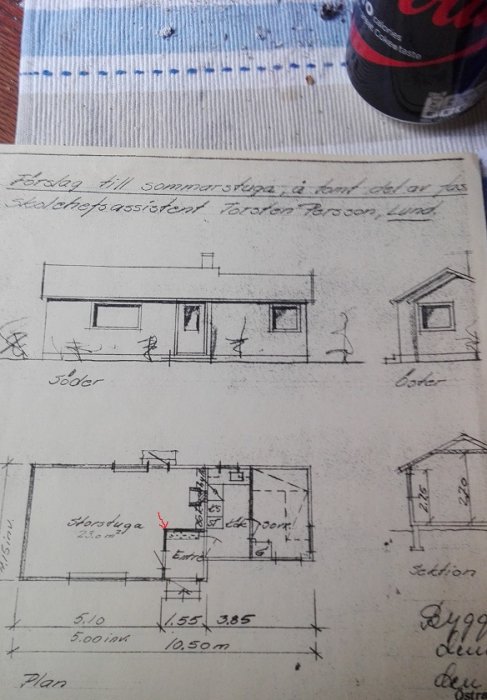
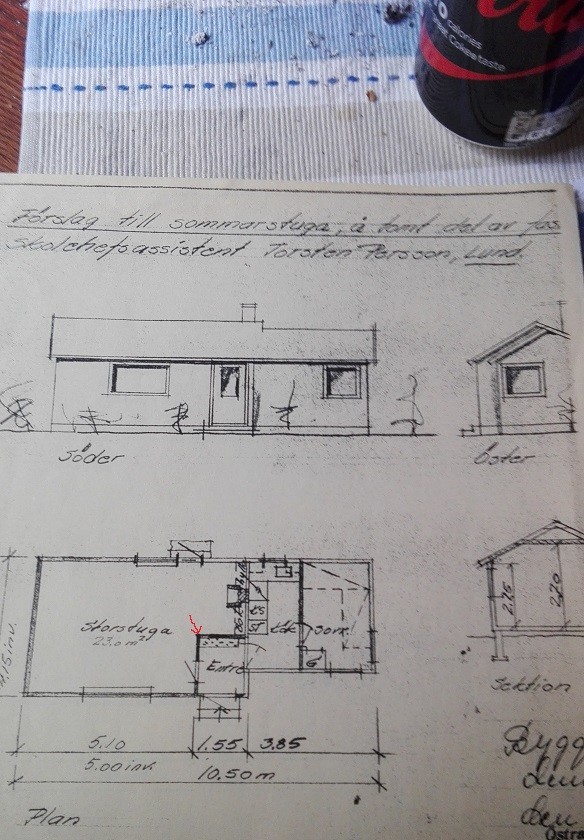
I am attaching the drawing, which seems to be the drawing for the building permit, as well as how it looks now. I made a little red arrow to highlight which corner it is about.
You can delete the second thread yourself, log in via a browser - switch to "desktop version" available, for example, at the bottom of the page - click edit the post - check the delete checkbox.
A bit tricky when that particular roof truss above seems to be constructed differently from the others and the rule seems to go down into the floor
The roof won't come down because you remove it; it's probably been pressing against the roof with quite a bit of tension, which is why you felt the roof lower slightly when you loosened it. You could measure the ceiling height, place a temporary support that's a few centimeters too short, remove the current one, and see what happens. Keep an eye on the situation and see if the roof starts to sag by winter. The house is unlikely to collapse; the worst that can happen is that you might have to put some support back there.
A bit tricky when just the truss that seems to be above is built differently than the others and the rule seems to go down to the floor
The roof won't come down because you remove it; it probably rested against the roof with quite a bit of tension, so you experienced the roof coming down a bit when you loosened it. You could measure the ceiling height, place a temporary post that is a few centimeters short, knock it away, and see what happens. Keep an eye on things and see if the roof starts to sag in the winter. The house is unlikely to collapse; the worst that can happen is that you have to put some support back there.
Thanks for the input!
I was thinking about something, for some reason the other support (which was against the door frame) also goes down to the floor. However, it's so close to the outer wall that supporting the truss seems a bit excessive? Because that part of the wall will also be removed.
For my part, I wouldn't have hesitated to tear away; the posts were probably tightened a bit from the beginning and may have had to bear a bit more load over time, but their purpose is hardly to support the construction.
Unusual trusses. Just supports, no braces. Closest resemblance is "framed-up" according to the Truss Book, but as if the person who made them was a bit too deep in the bottle and set everything crooked.
As the trusses are made, the supports transfer load to the lower frame. Certainly not a danger as the house is small, but risk of settlements.
If you want to play it safe, you can crawl up into the attic and add diagonal braces from the ridge to the lower frame on the trusses affected by your remodel. This will make the trusses self-supporting. Google "truss" and look at images to understand what I mean.
Best regards, Findus
Strange trusses. Just supports, no braces. Closely resembles "uppstolpat" according to the Truss Book, but as if the person who made them took a deep look into the bottle and set everything crooked.
It usually looks like that in old attics, everything is crisscrossed and nothing is straight. Measuring and using a level are modern inventions:wow: When I renovated the attic, the c/c distance of the floor joists varied between 62 and 82 cm. You would think the eye measurement would be more precise than that, but back in the day, it probably wasn't so important.
Over time, all walls become load-bearing, an experienced old engineer once told me. It's to be expected that there's some movement when you remove a wall, I would say. Measure the ceiling height carefully and compare with other points. Check if it changes. Check when there's snow this winter.
If measurements deviate from the standard or vary, it doesn't matter. But distinguishing between pushing and pulling forces in a truss construction is important. If both are not present, then the truss is not stronger than the bottom frame. In this case, there are many struts, which distribute the load down to the bottom frame, without corresponding braces to make the whole thing a truss. TS should, of course, do as he wishes. I would spend half a day adding braces. I wouldn't wait for snow load to see if it was needed.
Best regards, Findus
Vi vill skicka notiser för ämnen du bevakar och händelser som berör dig.