
2,893 views ·
2 replies
3k views
2 replies
Does this insulation method work for a steep roof
I am in the process of building a heated garage of about 50 sqm with a storage room that might eventually be converted into a living space. It is a slab on grade with embedded underfloor heating and masonry walls (insulated blocks).
Now I'm considering the roof structure. It will be a pitched roof to get the height for a car lift. I don't want to spend time building a ceiling. So the idea is to make the ceiling consist of the tongue and groove boards resting on visible rafters. I think it will look nice too.
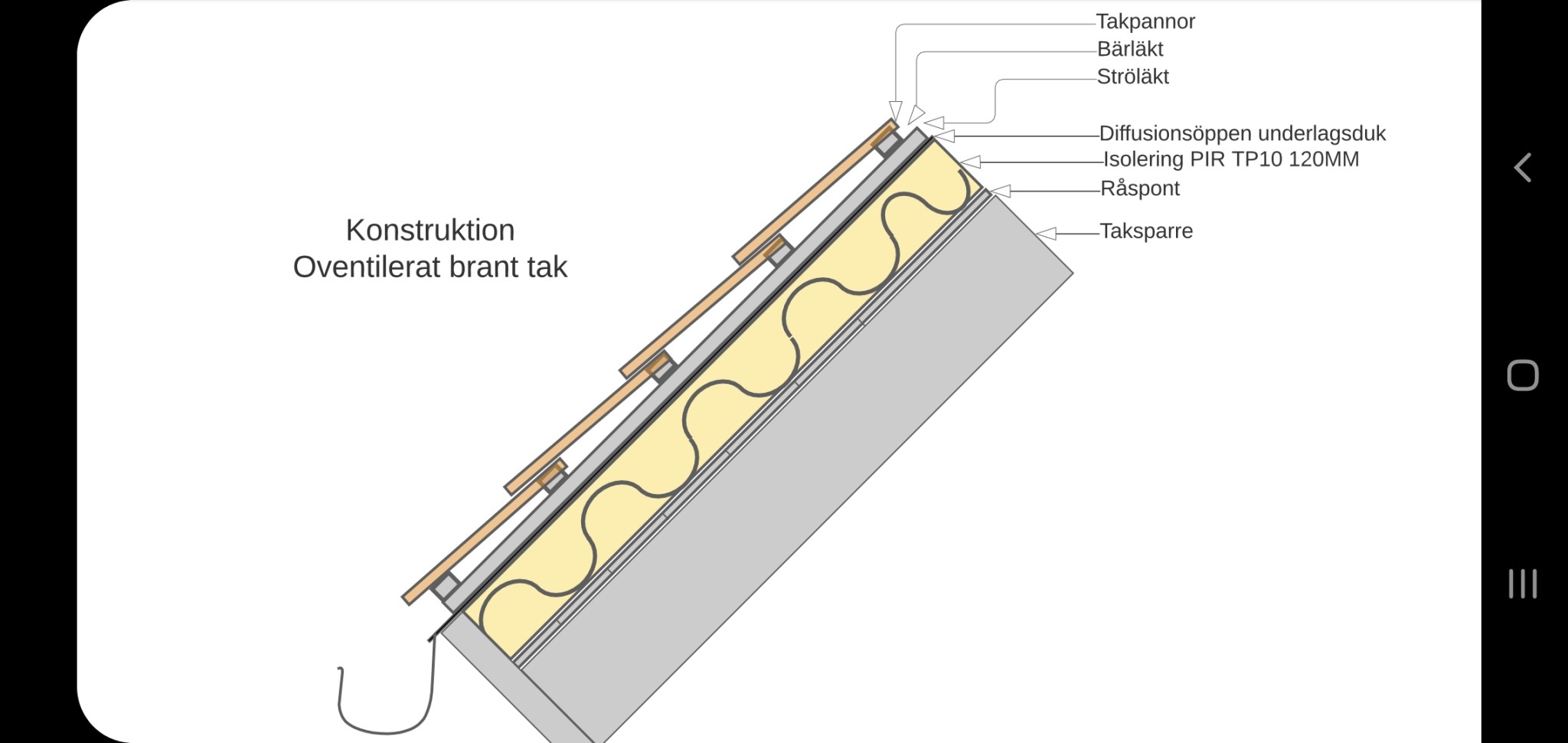
As a result, the insulation will be placed on the outside, and I plan to use insulation boards of the PIR type, which is a kind of polystyrene. U-value 0.18 at 120mm. The construction will be similar to this sketch.
Now to my question. Does this construction work in terms of insulation capability and moisture issues? I assume that 120 mm PIR should be equivalent to at least double the regular insulation and there should be no risk of trapping moisture. Also, vapor on the inside will only affect the tongue and groove boards, which can easily dry out from the inside.
Link to the insulation I plan to use
https://www.kingspan.com/se/sv-se/produkter/isolering/therma/therma-tp10-takisolering
Now I'm considering the roof structure. It will be a pitched roof to get the height for a car lift. I don't want to spend time building a ceiling. So the idea is to make the ceiling consist of the tongue and groove boards resting on visible rafters. I think it will look nice too.
As a result, the insulation will be placed on the outside, and I plan to use insulation boards of the PIR type, which is a kind of polystyrene. U-value 0.18 at 120mm. The construction will be similar to this sketch.
Now to my question. Does this construction work in terms of insulation capability and moisture issues? I assume that 120 mm PIR should be equivalent to at least double the regular insulation and there should be no risk of trapping moisture. Also, vapor on the inside will only affect the tongue and groove boards, which can easily dry out from the inside.
Link to the insulation I plan to use
https://www.kingspan.com/se/sv-se/produkter/isolering/therma/therma-tp10-takisolering
The difficulty with this type of solution is achieving a well-insulated eaves. To determine if this solution is a good option, I would recommend starting by drawing the eaves to scale.
Click here to reply