
5,810 views ·
26 replies
6k views
26 replies
Dimensions for American porch
No, the price should correspond to what the seller considers the right price; if then the buyer purchases, the price is right. Expecting forest owners, sawmills, and timber sellers to sell and only cover costs is naive.H Huzzbutt said:
A simple rule of thumb when determining whether you're paying too much for your timber is to look at the cubic price. Simpler products like raw planed wood and battens generally relate to each other as multiplications with some variation. A 45x95 often costs nearly double a 45x45, while tongue and groove 22x95 is closer to half the price of a 45x95. When it comes to more unusual items such as rough-sawn construction timber, prices at larger chains can sometimes be exorbitant.F fribygg said:
Or as they say on the internet, "Holy derail batman" (the attitude, despite my lack of clarity, might be more suitable for the local Facebook group's complaint thread).
It's mostly about the risk you're willing to take that the roof might collapse from the snow. The snow load is the dominant factor in the dimensioning. If you are willing to shovel in heavy snowfalls, you can easily reduce the dimensions.Y Yttebyn25 said:
What is the reason you want them slimmer? Is it the price, appearance, or ceiling height? Depending on that, there are different choices you can make.
It's partly about the height and then hand in hand with the appearance. The wall is from the lowest panel board to the highest panel board 3.7m. The height of the windows with the upcoming molding is 2.7 measured from the lowest panel board....Q qvirre said:It's mainly about the risk you're willing to take that the roof collapses from the snow. The snow load is completely dominant in the dimensioning. If you can imagine shoveling when there's a lot of snow, you can easily reduce the dimensions.
What is the reason you want it slimmer? Is it price, appearance, or ceiling height? Depending on that, there are some different choices you can make.
Shoveling the roof is something we always have to do, so we're used to it, but of course we prefer a stable construction!
Then you can reduce the cc measurements of the roof beams and place the posts closer together.
With cc 600 and 1500 between the posts, you can go down to 145x45 for both the roof beams and the truss.
If you want to reduce the overall height further, you can mount the roof beams against the side of the truss instead of on top. The most aesthetic way is to mount a 45x45 on the inside bottom of the truss and then place the roof beam on this.
With cc 600 and 1500 between the posts, you can go down to 145x45 for both the roof beams and the truss.
If you want to reduce the overall height further, you can mount the roof beams against the side of the truss instead of on top. The most aesthetic way is to mount a 45x45 on the inside bottom of the truss and then place the roof beam on this.
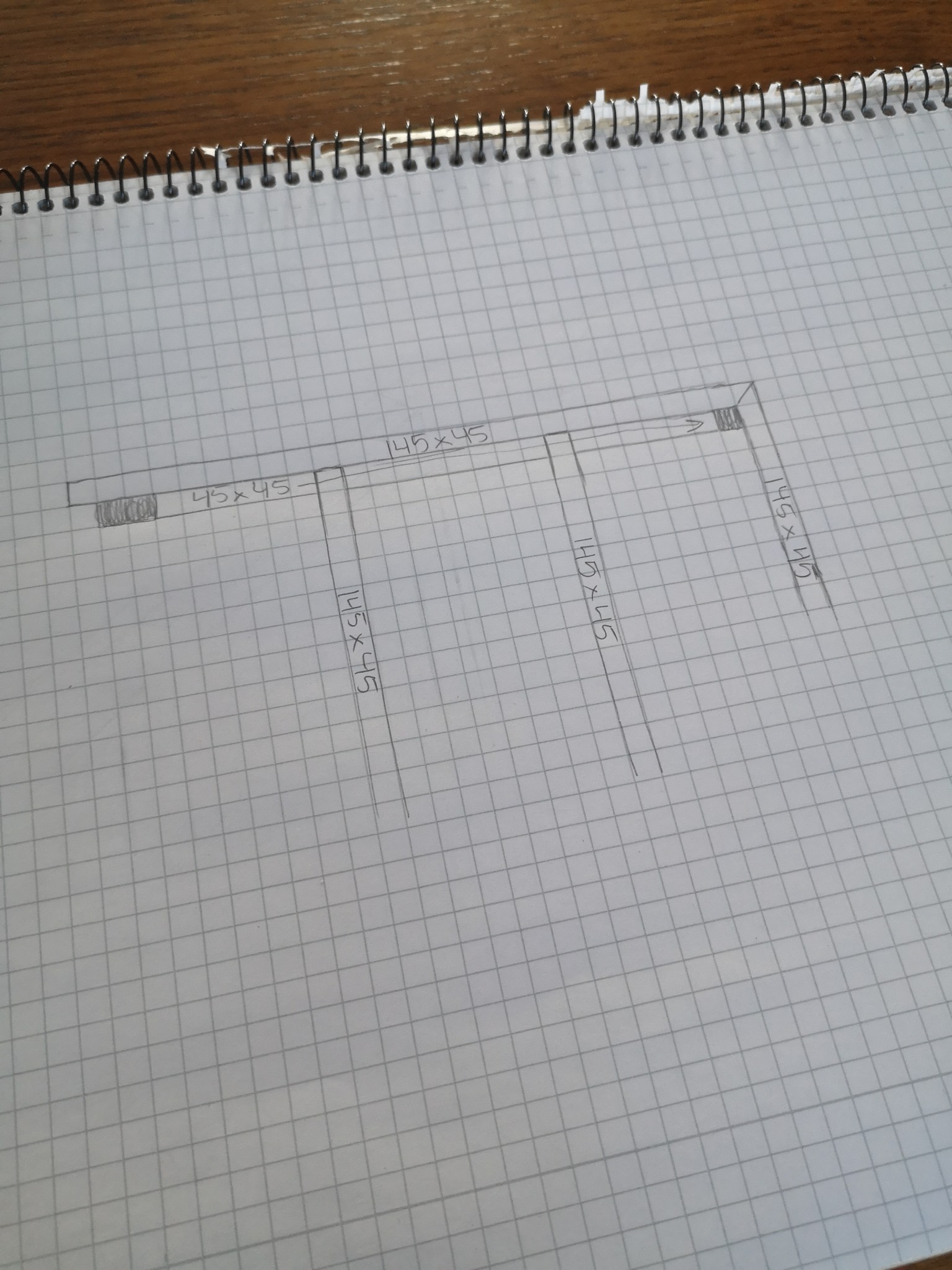
In this thread, there are good examples of how to solve it with 45x45 on the inside hammer beam.
https://www.byggahus.se/forum/threads/mitt-altanbygge-nagra-fragor.300457/page-3#post-3163180
https://www.byggahus.se/forum/threads/mitt-altanbygge-nagra-fragor.300457/page-3#post-3163180

Click here to reply