The beam is only supposed to transfer the load of the bearing walls that I plan to demolish, not the roof. Basically, you could say that in the entire path where I have drawn the glulam beam, there are currently walls on which the trusses rest.
 
M MrPajjas said:
The beam will only replace the load-bearing walls that I plan to demolish, not the ceiling. Essentially, you could say that the entire way where I’ve drawn the glulam beam, there are currently walls that the roof trusses rest on.
The walls support the roof trusses...

The roof trusses support the roof...

So.. Why are you putting in a glulam beam when you demolish the wall?

To replace the ceiling!
 
J justusandersson said:
I don't quite understand that? Looking at the floor plan, the right gate seems to be positioned too far to the right.
When I write HEB 180, it's just a conversion based on your information. One should have a correct understanding of the loads before calculating the deformation.
Now I'm not quite following?
Too far to the right?
The images only show part of the house, the whole house is just over 40 m long.
 
Violina Violina said:
The walls carry the rafters...

The rafters carry the roof...

So.. Why should you install a glulam beam when you tear down the wall?


To relieve the roof!
Yes, I get that too! But what I've been trying to explain is that the beam in the middle is a must since the rafters are not self-supporting. And not an extra relief for, for example, a smaller steel beam by the doors.
 
B bossespecial said:
If you unload the ridge with the glulam beam, the load is almost halved
M MrPajjas said:
Yes, I understand that too!
But what I tried to explain was that the beam in the middle is a must as the trusses are not self-supporting. And not an extra unloading, for example, a smaller steel beam at the gates.
Read this and what justus writes... they know what they're talking about.
 
You don't have the opportunity to photograph the rafters or make a simple sketch of what they look like? I think it gets a little confusing when the calculation shows something completely different.

 
Can fix a photo by tomorrow!
Yes, for me who can't do this, it becomes quite confusing.
 
  • Like
bossespecial
  • Laddar…
The right gate ends up partially in front of the boiler room, that's not ideal, is it?
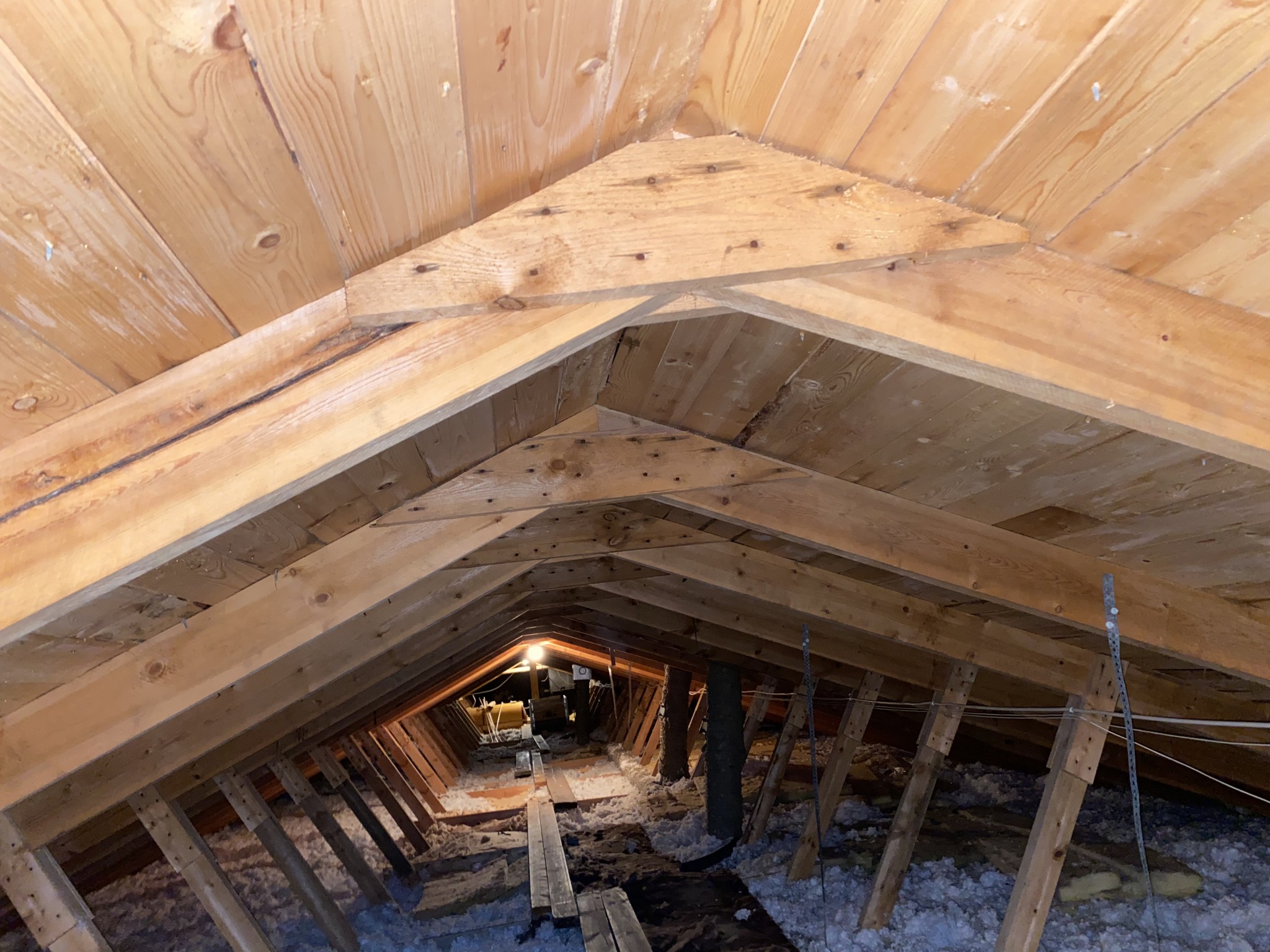
 
Difficult to take pictures when some are under 50 cm of loose fill insulation.
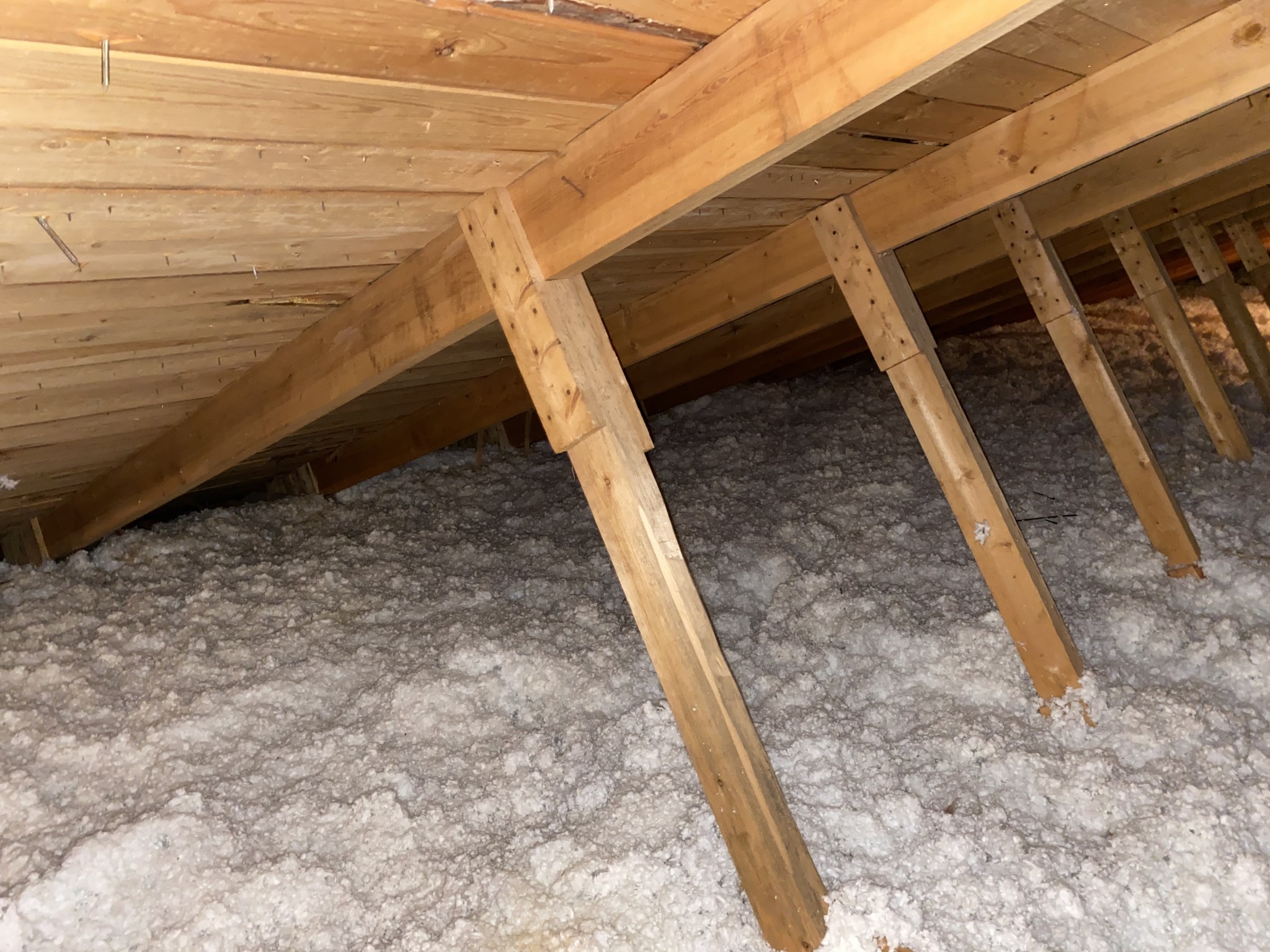
150x50 is at least the timber in the trusses and the center-to-center distance is 106, not 120 as I wrote before.
 
  • Attic with wooden rafters measuring 150x50, ceiling joists spaced at 106 cm apart, some areas covered by 50 cm of loose-fill insulation.
  • Wooden roof trusses in an attic with 50 cm of loose-fill insulation on the floor.
J justusandersson said:
The right gate partly ends up in front of the boiler room, that's not ideal, is it?
No, you're right, it's not ideal, but since the door and window are where they are, the gate ends up where it does (the gate covers the door and window), otherwise I would have to patch up the facade and it's half-timber sawed at a local saw in the late 70s, so I can't get new material without having to specially order it, feels like it would be an awful lot of work.
 
Additionally, there are still just over 5 meters to the boiler room, so I can still fit a standard car.
 
Click here to reply
Vi vill skicka notiser för ämnen du bevakar och händelser som berör dig.