
5,927 views ·
42 replies
6k views
42 replies
Demolish and remove brick firewall between two rooms on entry level

The situation is somewhat of a Catch-22. Since the floor joists run parallel to the fire wall, they are of no use. On the contrary, they are in the way. The fire wall is one and a half bricks thick, which means about 380 mm excluding plaster. It is not load-bearing in the usual sense, there may possibly be roof loads. This can be seen in the attic by looking at how the roof trusses are placed next to the fire wall. The self-weight can be as high as 3.5 tons per meter. The density of brick varies quite a bit between different types. If you don’t know which type has been used, you have to account for the heaviest variant. It’s hard for me to believe that a HEA 180 would be enough to transfer the fire wall between the outer wall and chimney. You need at least two depending on the span. However, it is not wrong to place two HEA 180 side by side. This provides good support for the entire width of the wall.
The question remains how to proceed. I think before demolition, you should make holes in the wall at regular intervals so that you can pass through small steel beams, which in turn can rest on propped beams running parallel to the fire wall on both sides. This temporary transfer should be done at a height above the future opening. I would hire a masonry company with experience in this type of work.
The question remains how to proceed. I think before demolition, you should make holes in the wall at regular intervals so that you can pass through small steel beams, which in turn can rest on propped beams running parallel to the fire wall on both sides. This temporary transfer should be done at a height above the future opening. I would hire a masonry company with experience in this type of work.

Really fun to hear different opinions and considerations!J justusandersson said:The situation has a bit of a catch-22 feeling. Since the floor beams run parallel to the fire wall, they are of no use. On the contrary, they are in the way. The fire wall is one and a half bricks thick, which means about 380 mm excluding plaster. It is not load-bearing in the usual sense, possibly there are roof loads. This can be seen in the attic by how the rafters are placed next to the fire wall. The self-weight can be as high as 3.5 tons per meter. The density of brick varies quite a bit between different types. If you don't know what type has been used, you have to calculate with the heaviest variant. I find it hard to believe that a HEA 180 would be enough to convert the fire wall between the outer wall and the chimney. At least two are needed depending on the span. However, it is not wrong to lay two HEA 180 side by side. Then you get good support for the entire width of the wall.
The question remains how to proceed. I believe that before demolition, you should make holes in the wall at regular intervals so that you can pass through small steel beams that can rest on shored beams running parallel to the fire wall on both sides. This temporary conversion should take place at a height above the future opening. I would hire a masonry company with experience in this type of work.
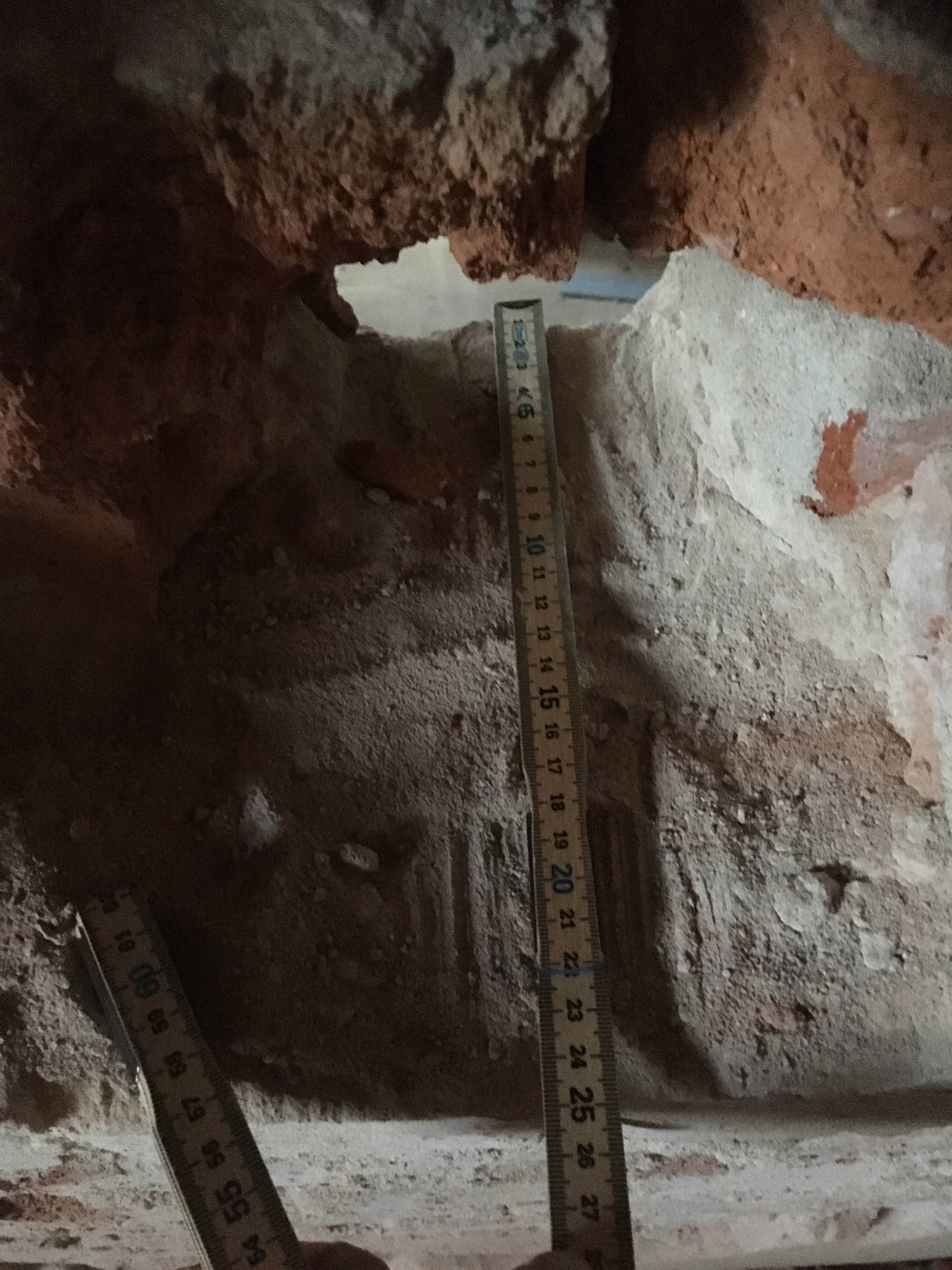
As I mentioned in a previous post, the wall is one brick deep, measuring the depth at 24-25 cm without plaster. Could one consider a thin steel plate (can't find the name) with the width of a brick over a HEA 180...or heavier. Do you think a HEA 180 is more reasonable with that wall thickness?
Last edited:
With a full brick wall, the self-weight decreases to about 2/3 of the estimate I used earlier. Note that this is only an approximation. With the help of a dimensioned sectional drawing, you can calculate a bit more accurately. The length of the opening is also of great importance. The best is for the beam (possibly two in width) to support the entire wall. Depending on the load you encounter, you can also experiment with the type of beam. An IPE beam is narrower and higher than an HEA. A full brick wall is essentially two parallel half-brick walls with binding stones here and there.
You can't get away from the pillars, there will be large loads coming down at the supports.B bearTGO said:It seems to be alternating rows full length and alternating rows full depth. I definitely like the idea, but the constructor might not be so happy if one goes against his idea. I guess I'll have to talk to him then. Do you then save a number of stones on the ends that act as support/posts or do you still use steel posts?
My wall seems to have full brick on depth every other row and full brick on width every other row.
Thanks to you, I'm starting to feel more ready to move forward with the project. I'll expose the wall a little better (remove plaster) and then contact a craftsman. It doesn't seem easy to find a bricklayer who also works with steel, but maybe they all do?
Do you think I should contact a bricklayer, blacksmith, or carpenter? I want a 63-year-old bricklayer who is also a blacksmith, who has worked a lot with old houses like mine!
Thanks to you, I'm starting to feel more ready to move forward with the project. I'll expose the wall a little better (remove plaster) and then contact a craftsman. It doesn't seem easy to find a bricklayer who also works with steel, but maybe they all do?
Do you think I should contact a bricklayer, blacksmith, or carpenter? I want a 63-year-old bricklayer who is also a blacksmith, who has worked a lot with old houses like mine!
It must be a mason with experience in larger masonry (i.e., not just façade brick).
Click here to reply