Tricky project. I'm not sure how you can completely avoid settlements.
Make holes as close to the ceiling as possible "straight through the wall."
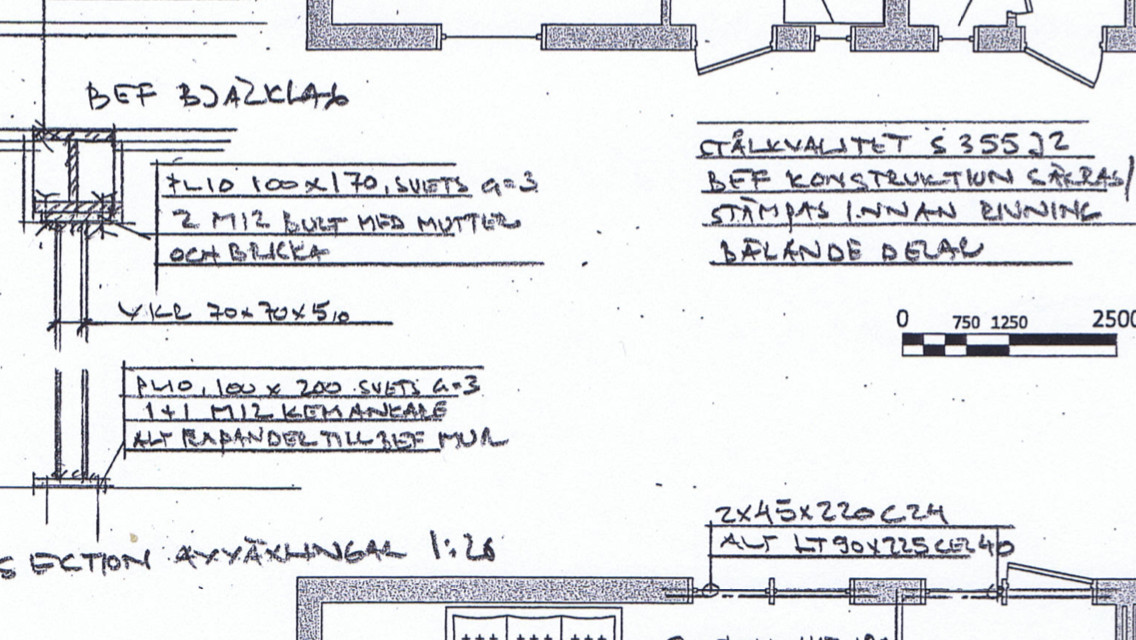
Insert the steel profile (becomes part of the construction when everything is finished) that lies flush with the wall.
Support as before (across blue) with the difference that you're doing it straight through the wall now. So a support on each side takes the load for each steel beam. (It doesn't need to be particularly long, I suspect!)
Do the above in several places along the wall.
Demolish the wall and hope it holds.
Place vertical steel posts on the sides.
Lay a steel beam to replace the wall. This is placed on the vertical posts but under the steel cleats you use for supporting.
Cut away excess steel from the cleats.
Not something you'd typically do yourself, I suspect. But there's a bit of "hope it holds" there at one point when the wall is gone. You don't exactly know how the loads are transferred down into the wall.
So you'll have a wall resting on steel. You'll likely need to do something more to fix the wall laterally.
Ah, maybe that's how it can be done
Hard to know how many right-angled beams you need and how to get the long steel beam in without the supports being in the way. Thanks for the idea! Yes, will probably have to contact some kind of firm.
A thought I had myself was to kind of mill/chisel away part of the wall (5-6 cm on each side of the wall, along the entire wall/ceiling) up by the ceiling, on both sides of the wall so you can insert a temporary wooden beam, one on each side of the wall. These are supported. It relies on the supports being slightly angled and that the steel beam then fits between the temporary wooden beams. Not sure if anyone can understand what I mean. Hard to get the beam in without the supports being in the way...
You have a constructor who has calculated this, I assume? He should reasonably have an idea of how this should be executed?
One thought I have is to mill out the brick from both sides (but leave enough material in the middle for the wall to remain standing) and insert 2 L-profiles (one from each side) of steel. Then bolt them together. This way, the wall can be demolished when the bracing is finished.
Ah, a bit like what I was trying to describe myself right after your post, but maybe you can avoid both props and another beam? Sounds like a really good solution if there are such strong/suitable L-profiles available.
I don't know how to usually solve this kind of load-bearing.
You have a constructor who has calculated this, I assume? He should reasonably have an idea of how this should be performed?
One thought I have is to mill out the bricks from both sides (but leave enough material in the middle for the wall to remain) and insert 2 L-profiles (one from each side) of steel. Then bolt these together. In this way, the wall can be demolished when the shifting is completed.
The constructor has written a beam dimension but nothing about how to install it without the house collapsing. It's possible he also has a practical idea and that the type of beam can be changed.
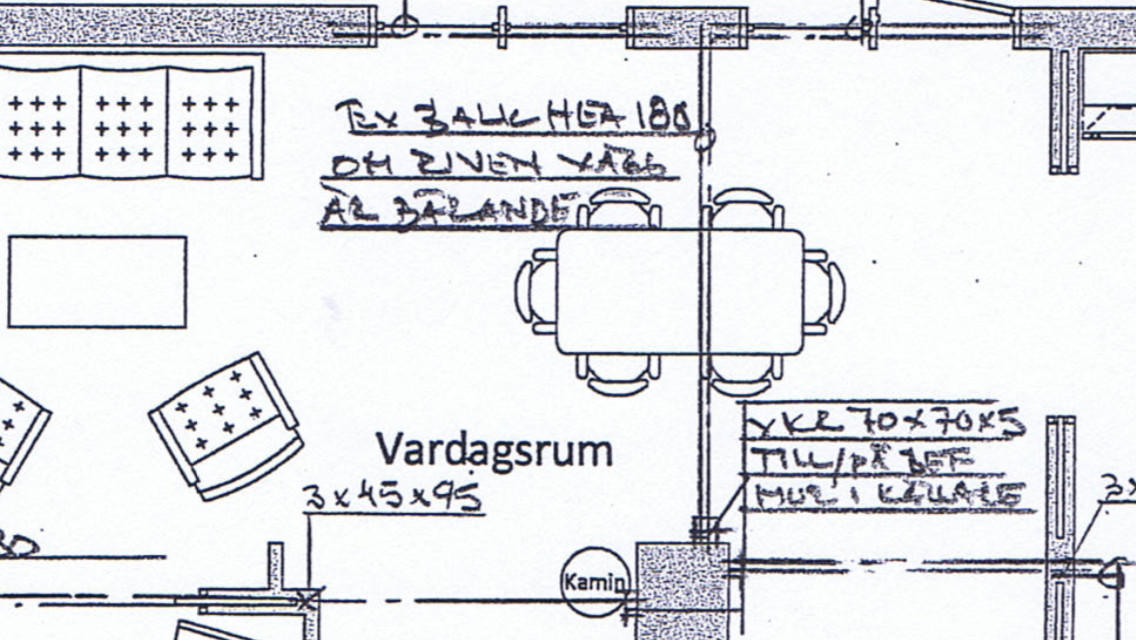
It is 3510 mm between the exterior wall and the chimney. I don't know if the opening can be quite that large. As you can see, he suggests HEA180 "if the wall is load-bearing," which I had hoped he would answer, but I take it for granted, given the weight of the wall.
Okay, IPE180 should correspond to two angle bars dimension 200x100x16 mm, but it depends on the steel quality.
It should be possible to mill away material in a joint between two rows of bricks. Is the wall in full-brick width?
The wall at least supports the weight of the part of the wall above, but then it's hard to say if it supports anything more. But the idea with a firewall is to separate the building, so it would be a bit strange if, for example, wooden joists were laid on the wall.
Okay, IPE180 should correspond to two angle bars dimension 200x100x16 mm, but it depends on the steel quality.
You should be able to mill out material in a joint between two masonry courses. Is the wall a full stone in width?
The wall at least carries the weight of the part of the wall above, then it's hard to answer if it carries anything else. But the idea with a firewall is that it should divide the building, so it would be a bit strange if, for example, wooden joists were laid directly on the wall.
It seems to be alternating rows of whole stones in width and whole stones in depth. I definitely like the idea, but the designer might not be so happy if you override his idea. I should probably talk to him if that's the case. Would you then save a row of stones at the ends to act as support/posts, or would you still use steel posts?
At most, some floor joists are nailed to the wall. As you say, no wood goes straight through.
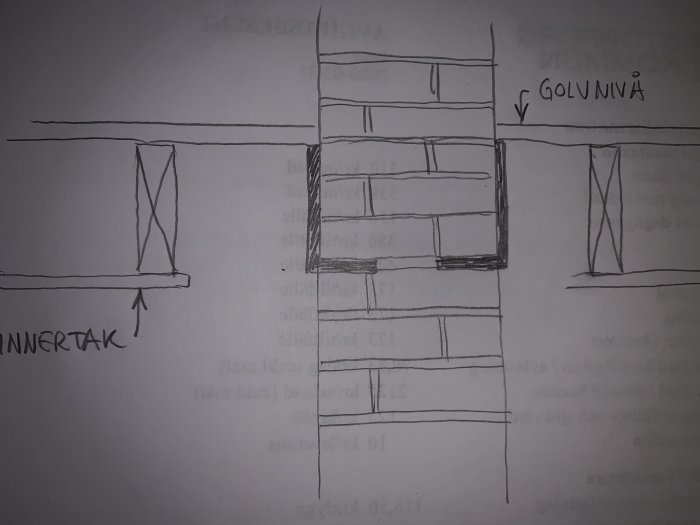
If it looks like in my sketch with the intermediate floor, it's possible to remove a visible beam in the ceiling. But it's a bit of work.
But as I see it, this is the only way to install a beam (two in the image) without tearing down the whole thing.
I know what I'm talking about, I have successfully implemented the above solution in a brick wall where a large door was to be installed and a meter of brick above the door was to remain.
With this technique, you can work calmly and confidently without risks; you can also use other types of beams since they are concealed within the intermediate floor.
If it looks like my sketch with the intermediate floor, then it's possible to remove a visible beam in the ceiling. But it's a bit of work.
[image]
But as I see it, the only way to get a beam (two in the picture) there without tearing down the whole thing.
I know what I'm talking about, I've successfully used the above solution in a brick wall where a large door was to be installed and a meter of brick above the door was to remain.
With this technique, you can calmly and safely work without risks, and you can also use other types of beams since they are concealed in the intermediate floor.
The floor joists are practically flush against the brick wall in our case, so there is no room to bolt iron so high up. A bit further down, however, seems like an awesome solution. Don't know if we can use those angle irons without altering the building permit though. Thanks for your post!
If it looks like my sketch with the intermediate floor, it is possible to remove a visible beam in the ceiling. But it's a bit of work.
[image]
But as I see it, the only way to get a (two in the picture) beam in without tearing down the whole thing.
I know what I'm talking about, I have successfully implemented the above solution in a brick wall where a large door was to be installed and a meter of bricks above the door was to remain.
With this technique, you can calmly and safely work without risks, you can also use other types of beams since they are hidden in the intermediate floor.
There is significantly more masonry in this case. It is a wall, as I understand it, that goes all the way up to the ridge. So, it probably weighs quite a bit. It should be possible to calculate. Now it seems pretty tight with the floor joists (right next to the wall), so it might be tricky to get the iron in.
The engineer should know how to proceed. Maybe it can be done in several steps? Where you tear down the wall little by little and secure it in a way that allows you to safely install the beam afterwards. I think my idea of making holes, just enough for short steel beams in several places, would work. But when you cut these, you risk setting the house on fire. Maybe not so smart after all!
We'll laugh at how simple it was when someone smarter than us shows how it's really done!
There is significantly more wall in this case. So, as I understand it, it's a wall that goes all the way up to the ridge. So, it must weigh quite a bit. It should be possible to calculate. Now, it seems tight with the floor joists (flush against the wall), so it might be tricky to get the iron in place.
The engineer should know how to proceed. Perhaps it can be done in several steps? Where you dismantle the wall bit by bit and secure it gradually in a way that allows you to safely install the beam afterward. I think my idea to make holes just big enough for short steel beams in several places could work. But when you cut these, you risk setting the house on fire. Maybe not such a smart idea after all!
We will laugh at how simple it was when someone smarter than us shows how it really should be done!
My experience with engineers is that they are good at the theoretical but not the practical. That is, they know what size the beam should be, but not how to get it in place.
When I made the opening for the door, I don't remember what dimensions we used for the beams, but they were less than 200x100x10, I know that.
I am somewhat handy. But this is something I would never do myself.
Another option, more practical but not certain to work completely without some settling, is:
1) Build a platform to place the longitudinal beam on and haul the beam up onto it. It should be at exactly the right level.
2) Tear down the wall where the vertical steel beams are supposed to stand and place these, anchoring them to the basement wall. Leave space, of course, for the supports on either side.
3) Gradually demolish parts of the wall and "slide" the beam in step by step. Maybe you can work with wedges or similar to get it as snugly against the wall above as possible.
Eventually, you have demolished along the entire wall. But, damn if it works in practice. It’s quite heavy, and it probably doesn't take much for it to kink.
I still prefer my idea of steel ledgers best.
But it’s best to turn to a company for insurance purposes!
The problem is that many "professionals" don't have a clue what they're doing. My experience. Just saying. They just plow ahead and don’t care much about the end result. Then they move on to the next job, and there’s so much work available that they don’t need to care. If you complain, you get a little discount, and then they take the next job. There’s so much work available.
With 170 steel beams plus 70x70 crossbars, the construction builds up to 240 mm. Then, some engineer needs to review the construction since the load comes down on n number of spots instead of uniformly along the entire beam. But I think it's perfectly fine as long as there are enough spots.
Vi vill skicka notiser för ämnen du bevakar och händelser som berör dig.


 Maybe not so smart after all!