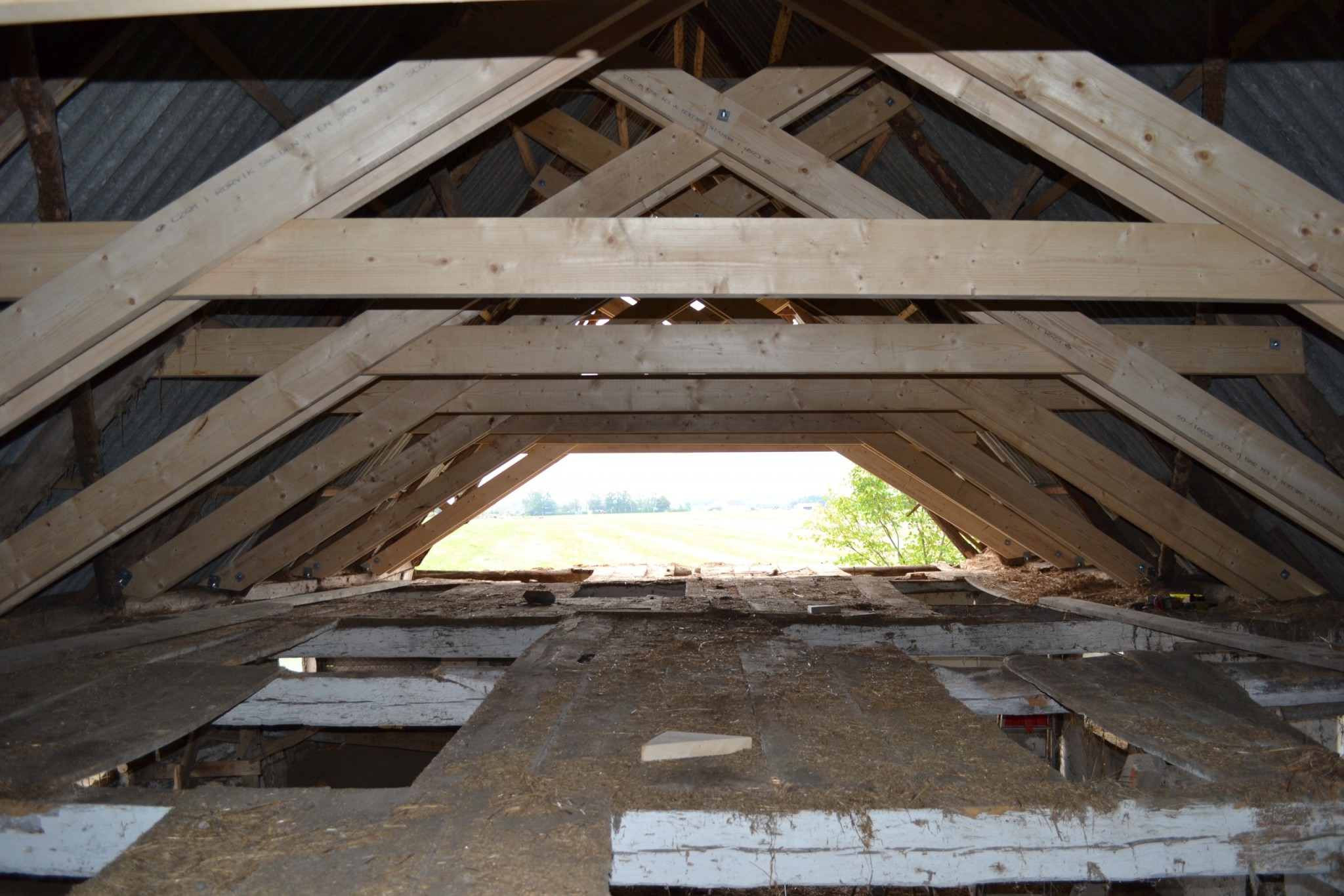
I don't think the lower option can withstand the wind forces when it presses on the roof and wall from the right in the image.
The standing yellow beams will buckle in the middle from the pressure forces from the blue.
It might work if the truss is very securely attached to the brick wall so that YELLOW-BRICK WALL-TRUSS forms a rigid triangle, but there will still be very large pressure forces across the yellow.
mycke_nu. A majority of the country's log buildings are constructed in a similar manner. If you want to be completely sure about how the forces in the constructions are distributed and how large they become, you must sit down and calculate the frame (pencil and paper or e.g. pcframe). My advice to hire a designer to determine the dimensions therefore remains firm.
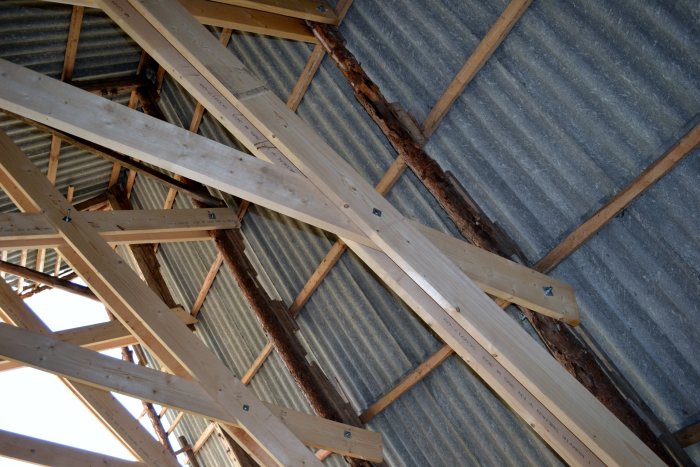
The question is whether the wood can withstand the edge pressure from the bolts, especially at the ends towards the roof trusses. The risk is that the wood splits and the bolts slip out. However, it's not my area, so maybe someone else can offer insights.
Spontaneously, it feels like there should be more bolts or metal reinforcement around them.
Apart from what mycke_nu mentions about the number and execution of anchoring points, I wonder why you haven't brought together the lower horizontal with the legs in the scissors?
In addition to what mycke_nu mentions about the number and execution of anchor points, I'm wondering why you haven't brought together the lower horizontal with the legs of the truss?
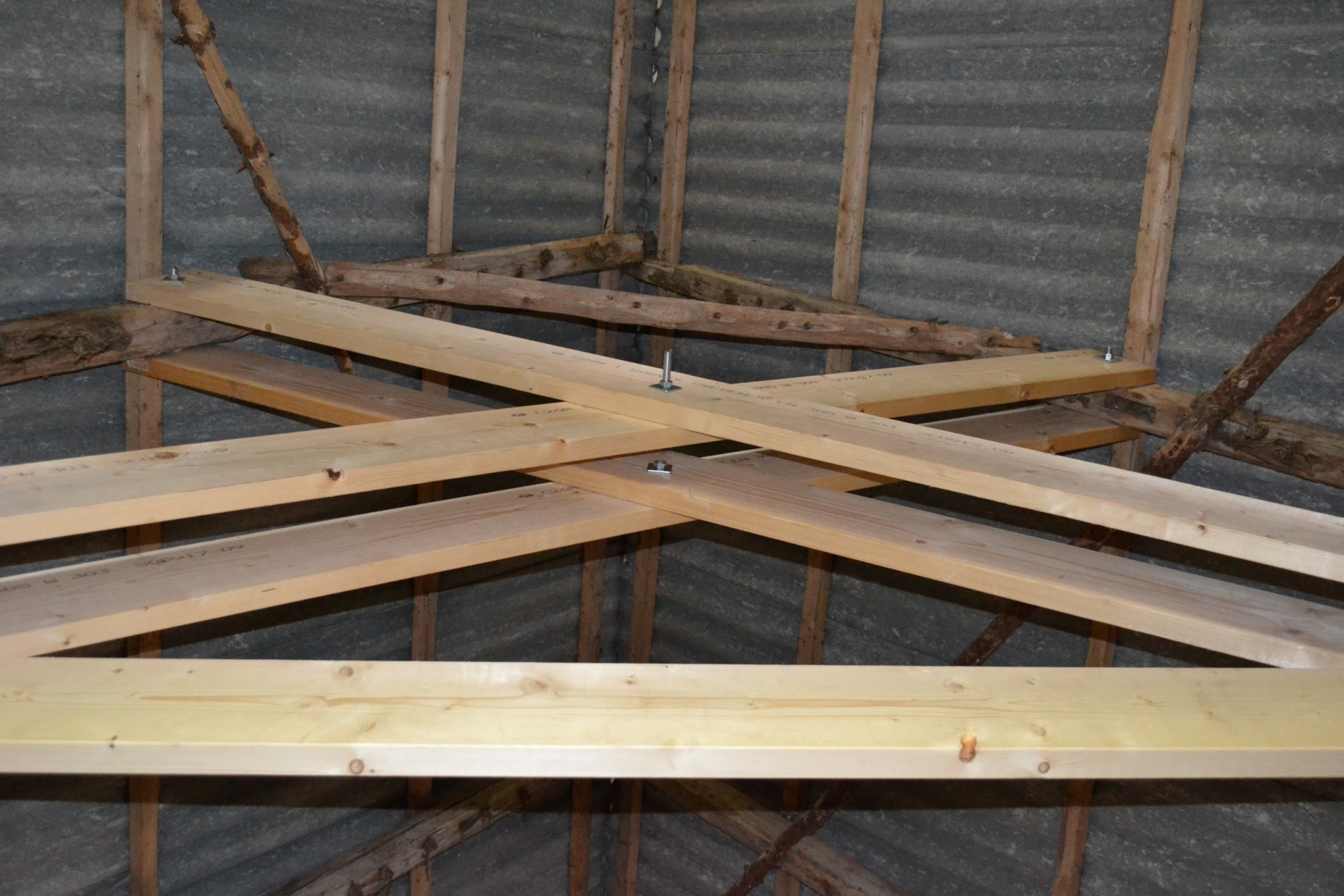
Okay, I've bought some bolts to attach the lower tie beam with the trusses.
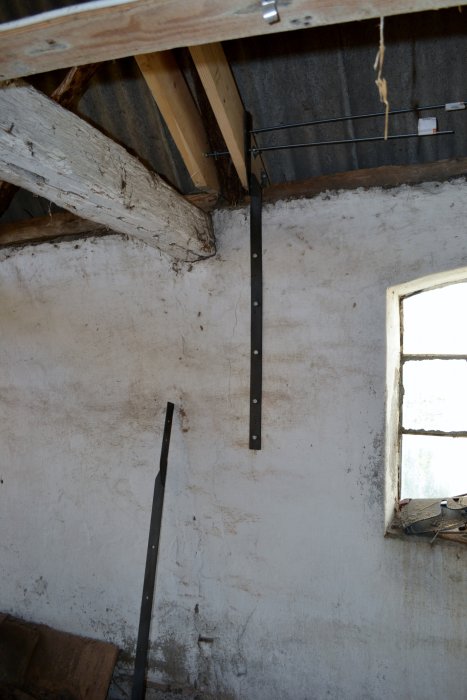
I will review if I should increase the number of anchor points, what is currently there is:
16mm threaded rod
Washers 50mm x 5mm
Nuts
I think it looks good, really sturdy, better to go a bit extra while you're at it. Just like mycke_nu wrote, I would probably have doubled up at the ends near the rafters, but that's mostly intuition. More important might be how you secure the fittings at the lower points.