
5,882 views ·
28 replies
6k views
28 replies
Convert glulam beam to steel beam
It plays
I understand that TS wants an "equivalent beam," but as mentioned more information is needed to provide an appropriate answer.A a_w said:The original question concerns the cross-section, not the construction as a whole. The steel cross-section in question is stronger than the glulam beam at the cross-section level. Perhaps if you start analyzing very unrealistic cases, the glulam beam might be better, for example if you were to load the HEA profile with a lot of twisting, causing a LOT of distortion.
Then if you start removing pillars and making other changes, of course it becomes a new question, as you have to look at the entire construction.
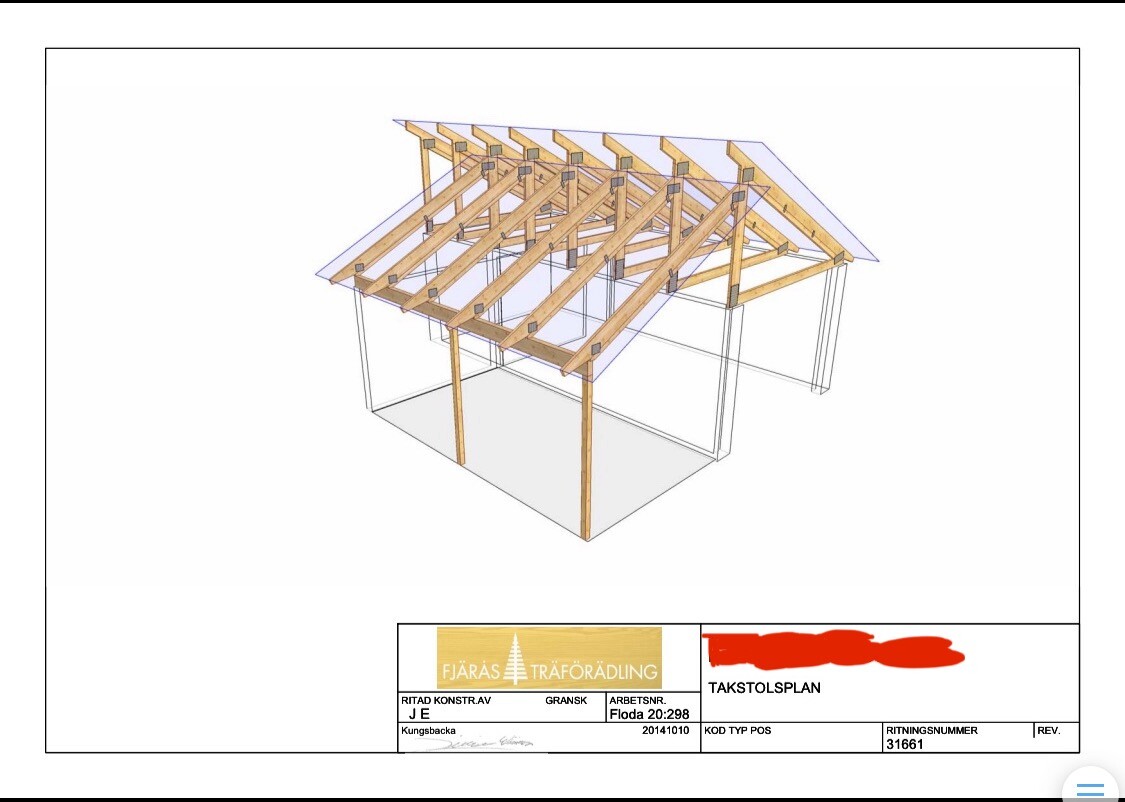
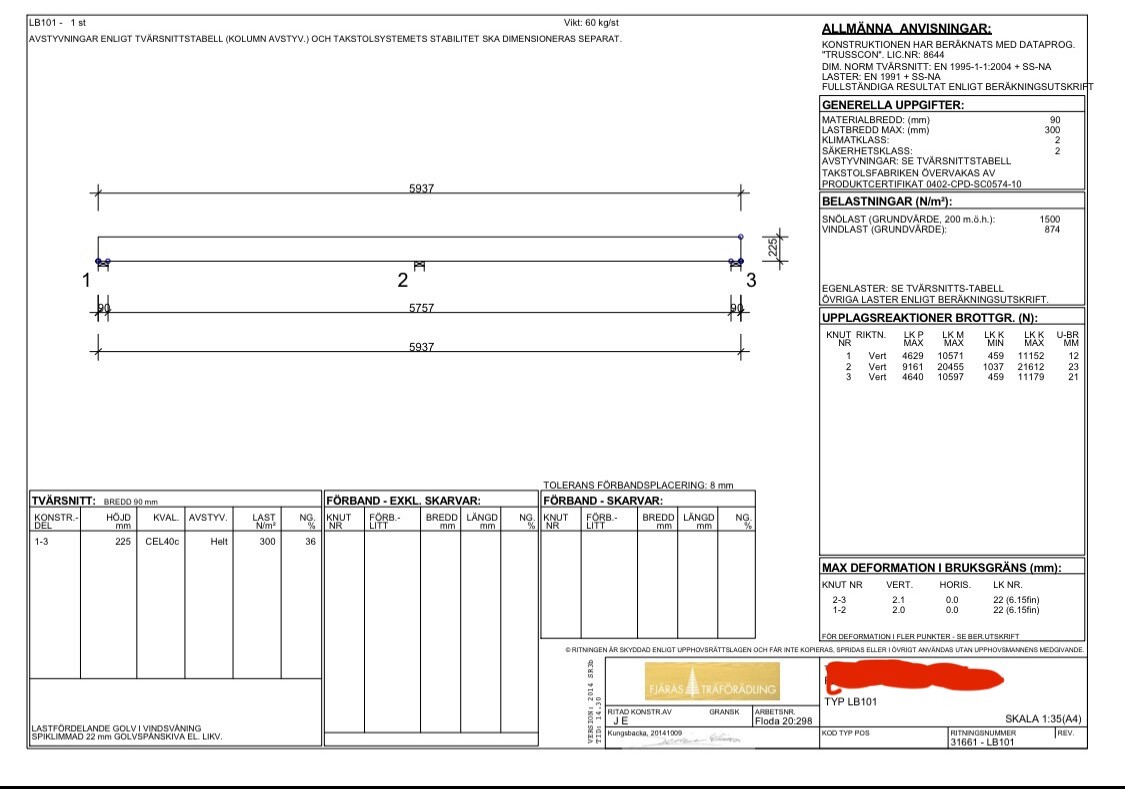
It is the beam that runs between the posts here that I want to replace in order to simply avoid having the post in the middle. I will then, of course, also need to replace the post itself with something stronger.
Member
· Västernorrland
· 12 076 posts
If you are going to replace a glulam beam that currently has a support in the middle with something that can handle it without support, it will be a significantly stronger beam regardless of the material. At that length and without support, you also need to consider the self-weight of the steel beam. I'm not an engineer, but I could easily imagine that you would need a beam twice as high to start with.

U
Utsliten och utdömd
Building conservationist
· 2 840 posts
Utsliten och utdömd
Building conservationist
- 2,840 posts
No, I can buy that.
It's probably just as well to go with an IPE beam that's 220 high so it fits more or less directly, it only costs 3000 SEK for 6 meters, so not much money to argue about.
The next question is what kind of post to use. Maybe go with an HEA beam 100 that you encase in wood?
Then it should handle an elephant on the roof if one were to climb up...
It's probably just as well to go with an IPE beam that's 220 high so it fits more or less directly, it only costs 3000 SEK for 6 meters, so not much money to argue about.
The next question is what kind of post to use. Maybe go with an HEA beam 100 that you encase in wood?
Then it should handle an elephant on the roof if one were to climb up...
Member
· Västernorrland
· 12 076 posts
I don't think you quite understand how a beam works. Just because it's made of metal doesn't mean it becomes rigid. Especially not when there's a bit of length to them. The thicker they are, the heavier they become as well....
I quickly checked the calculator and the bending moment capacity increases by a factor of 6, while the external bending moment (from the load) increases by a factor of 4. So you can sleep soundly with an IPE 220. Don't forget to weld end plates on the profile or stiffeners at the supports (industry standard that it’s usually done, although there’s debate about whether it’s always necessary).C crazytok said:No, I can accept that.
It's probably just as well to go with an IPE beam that is 220 high, so it fits more or less straight away. After all, it only costs 3000kr for 6 meters, so not much to argue about.
The next question is what to use for a pillar. Maybe use an HEA beam 100 that you clad in wood?
That should support an elephant on the roof if one were to climb up...
Regarding the columns, a tip is to download Tibnor's construction tables. Then you can get an idea of what you need. However, these are only valid as long as you load them with a normal force (vertical load), i.e., no wind from, for example, walls connected to the column.
- The buckling length can be set to the length of the column
- The load can be calculated as: (1.2xself-weight of the roof+1.5×snow load)×area of the load going to each column
- For example: with a self-weight of 0.50 kN/m2, snow zone 1.5, and a loaded area of 10 sqm per column, you get the load: (1.2×0.50+1.5×1.5)×10=30 kN
- From the table, you can see that an HEA100 with a 3 m buckling length can handle 465 kN
Good luck!
By the way, don't forget to reinforce the foundation blocks as well. If you ensure that the total resisting mass and area of the foundations remain equal, then you're good there too.A a_w said:I quickly calculated on the calculator and the capacity for bending moment increases by a factor of 6, while the external bending moment (from the load) increases by a factor of 4. So you can sleep soundly with an IPE 220. Don't forget to weld end plates on the profile or stiffeners at supports (industry standard to usually do this, though it can be debated if it's always necessary)
Regarding the columns, a tip is to download tibnor's construction tables. Then you can get an idea yourself of what you need. However, these are only valid as long as you load them with a normal force (vertical load), i.e., no wind from, for example, walls connected to the column.
- you can set the buckling length to the length of the column
- you can calculate the load as follows: (1.2×own weight of the roof+1.5×snow load)×load area that goes to each column
- for example: with an own weight of 0.50 kN/m2, snow zone 1.5, and a loaded area of 10 sqm for each column, you get the load: (1.2×0.50+1.5×1.5)×10=30 kN
- From the table, you can see that an HEA100 with a buckling length of 3 m handles 465 kN
Good luck!
Thank you very much for the help!
So I should actually manage with a glulam post 115x115 in gl30c quality, which according to the Swedish wood guide should handle 135kN.
If I start from the following…
Roof area approx. 22 sqm.
Roof tiles weigh 51kg/m2 + Own weight of the roof, other approx. 1000kg/22m2 = 45.5kg/m2
Total own weight of the roof is thus approx. 96.5kg/m2
If I follow your calculation it is:
(1.2x0.95+1.5x1.5)x22= 74.6kN
Good thinking about the casting, easy to forget!
It is a large lump that a concrete truck once placed there during construction. So it should be properly stable!
I'm probably more worried about the post bracket itself instead. 🤔
So I should actually manage with a glulam post 115x115 in gl30c quality, which according to the Swedish wood guide should handle 135kN.
If I start from the following…
Roof area approx. 22 sqm.
Roof tiles weigh 51kg/m2 + Own weight of the roof, other approx. 1000kg/22m2 = 45.5kg/m2
Total own weight of the roof is thus approx. 96.5kg/m2
If I follow your calculation it is:
(1.2x0.95+1.5x1.5)x22= 74.6kN
Good thinking about the casting, easy to forget!
It is a large lump that a concrete truck once placed there during construction. So it should be properly stable!
I'm probably more worried about the post bracket itself instead. 🤔
Guessing that it's approx 22/4=5.5 sqm of the load that goes to each pillar (half to the wall and the remaining half is divided between the pillars). So the dimensioned load will be about 1/4 of what you calculated.C crazytok said:A big thank you for the help!
Basically, I can manage with a glulam post 115x115 in gl30c quality, which according to the Swedish wood guide should handle 135kN.
If I start from the following…
Roof area approx 22 sqm.
Roof tiles weigh 51kg/m2 + own weight roof other approx 1000kg/22m2 = 45.5kg/m2
Total own weight of the roof is therefore approx 96.5kg/m2
If I follow your calculation, it becomes:
(1.2x0.95+1.5x1.5)x22= 74.6kN
Good thinking regarding the casting, easy to forget!
It's a big lump that a concrete truck once placed there during construction. So this should be properly sturdy!
I'm probably more worried about the post shoe itself. 🤔
However, I wouldn't use too weak pillars even if it's possible, as it:
- looks a bit off
- robustness is needed when you back into them with the car
- in case you want to nail up some walls in the future
- it might be difficult to attach beams to them.
It's worth considering that the connection between the wooden pillar and the beam will require quite a bit of care, as it needs to be able to transfer the lifting forces from the roof when it's very windy. Otherwise, the roof will blow away (in theory, anyway).
Confusion of concepts! Which steel cross-section do you mean is stronger? A 90x225 cross-section has a greater moment of inertia than the cross-section of, for example, a HEA100 or an IPE120. The cross-section of a beam has nothing to do with the material in the beam. However, the beam's rigidity is a product of both the cross-section and the modulus of elasticity. And the E-modulus for steel is 15-20 times greater than that for glulam in bending.A a_w said:The original question concerns the cross-section, not the construction as a whole. The steel cross-section in question is stronger than the glulam beam at the cross-section level. Perhaps if one begins to analyze very unrealistic cases, the glulam beam might be better, for example, if one were to load the HEA profile with a lot of torsion so that a LOT of warping occurs.
Then if one starts removing columns and making other changes, it obviously becomes a new question, as one must look at the entire construction.
Fire load case! Don't forget that steel often needs to be fire-protected in some way.
Conceptual confusion! I was referring to the difference between checks on cross-section level and element level (instability phenomena).P petterovski said:Conceptual confusion! Which steel cross-section are you referring to as stronger? A 90x225 cross-section has a larger moment of inertia than the cross-section of, for example, an HEA100 or IPE120. The cross-section of a beam has nothing to do with the material of the beam. However, the beam's stiffness is a product of both the cross-section and the modulus of elasticity. And the E-modulus for steel is 15-20 times greater than that for glulam in bending.
Fire load case! Remember that steel often needs to be protected from fire in some way.
A a_w said:
The support reactions are in the calculation report for a number of load combinations. I don't know what the notations in the report stand for, but the largest one is “LK K Max”. 11152 + 21612 + 11179 = 43943 NC crazytok said:Thank you very much for your help!
In other words, I can manage with a glulam post 115x115 in gl30c quality, which according to the Swedish wood guide should handle 135kN.
If I base it on the following…
Roof area about 22 sqm.
Roof tiles weigh 51kg/m2 + Self-weight of roof other about 1000kg/22m2 = 45.5kg/m2
So total self-weight of roof about 96.5kg/m2
If I follow your calculation, it becomes:
(1.2x0.95+1.5x1.5)x22= 74.6kN
Good thinking about the casting, easy to forget!
It's a large lump that a concrete truck once placed there during construction. So this should be quite stable!
I'm probably more worried about the actual post shoe though. 🤔
If you remove the middle pillar, it is essentially distributed equally on the two remaining pillars: 43943 / 2 = 21972 N = 21.98 kN per pillar.
Click here to reply