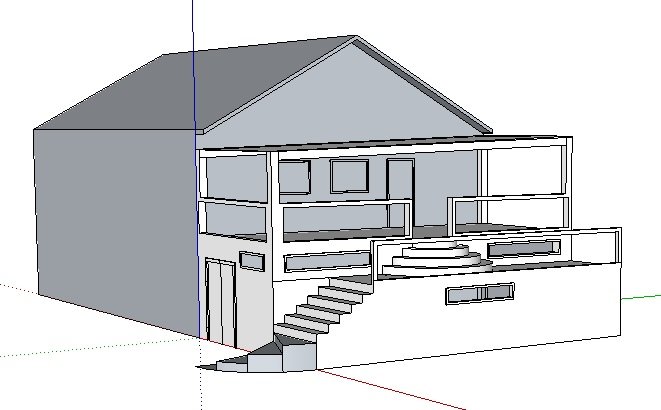
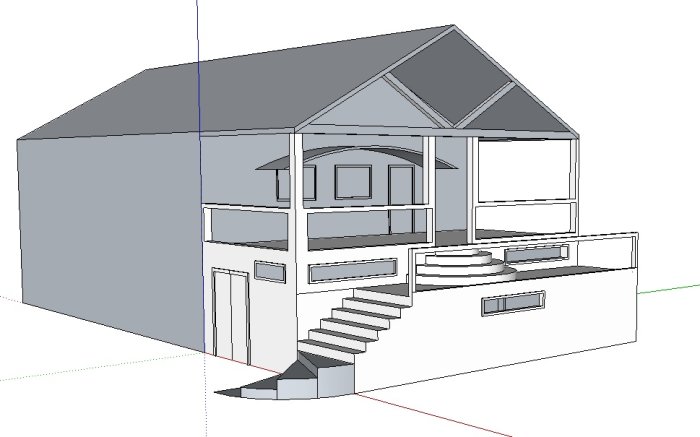
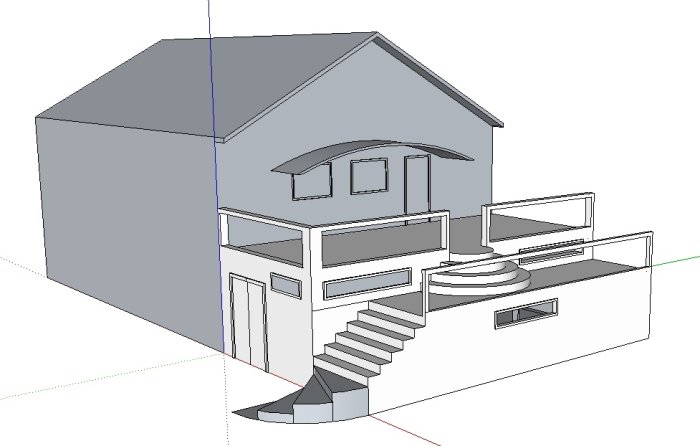
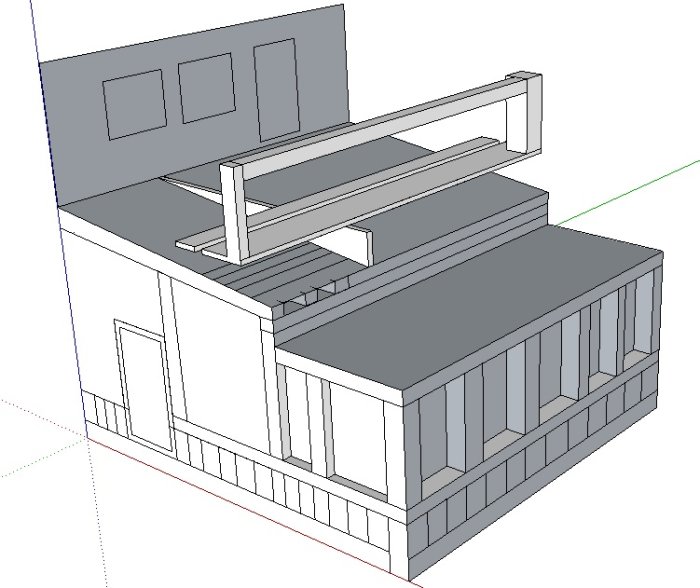
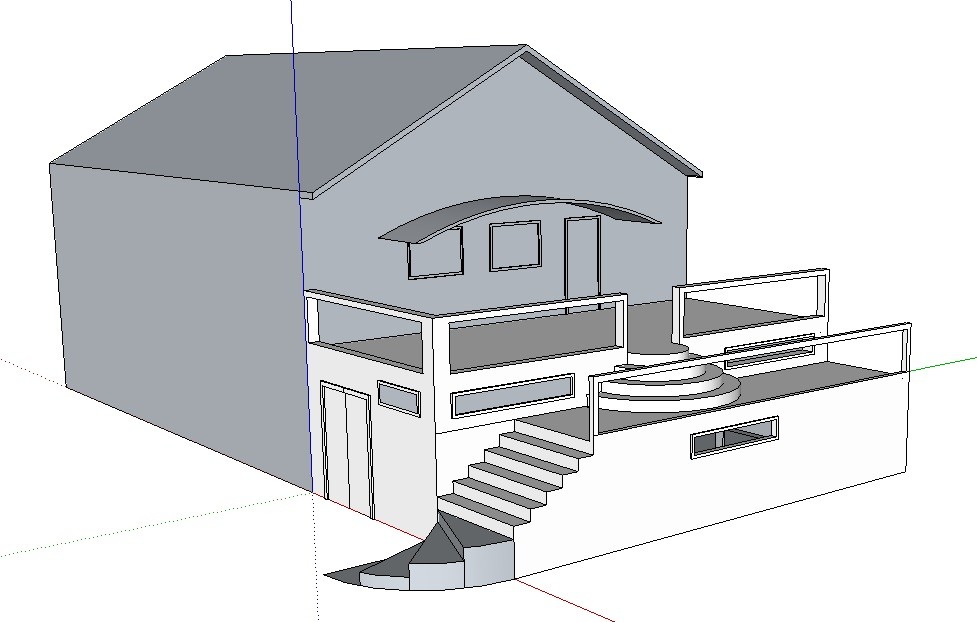
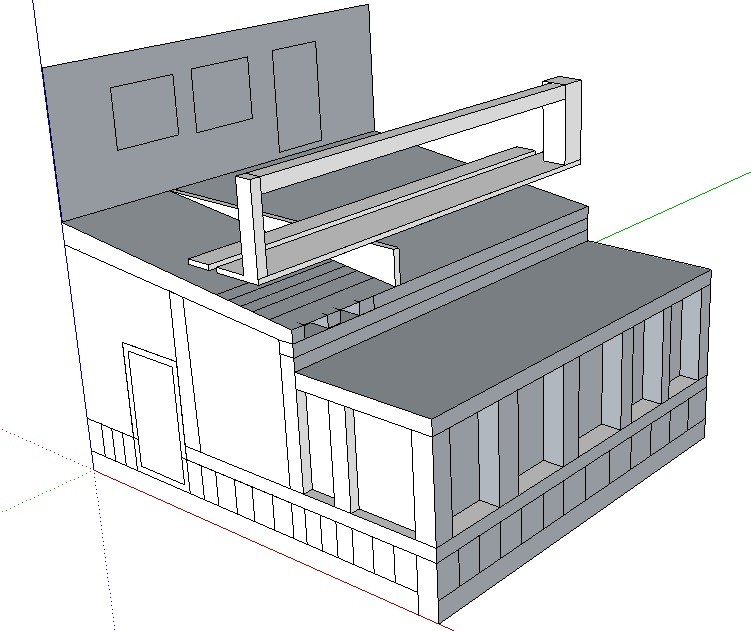
I can't open your skp files because I'm using an older version of Sketchup which is very good. Therefore, the question about the height so I can make a new version. Anyway, first some roof suggestions: Sloped roof with incline to the side. Roof that continues from the existing one. Roof over door and window. As you can see, I insist on making stairs out from the middle of the patio, as an emergency exit and a pleasant place. If I were to do what you are considering, my work order is as follows: Cast the slab according to standard; Build with Lecablock; Erect studs and lay out joists; Nail or screw raw boards and lay a surface felt according to the manufacturer's recommendations. Be careful with upstands and drainage. Consider electrical wiring, check with an electrician if you can attach pipes and boxes yourself, when you achieve a good result, add a few more, you can never have too many outlets, don't forget to prepare electricity for the patio. Consult with the electrician on where a new panel should be placed; Let the old cladding on the existing house remain and place a new wall on top, facilitates any remodeling. Exterior walls and windows, doors are put in place, all according to proven techniques; Complete the roof with surface felt, according to the manufacturer's recommendations, groove the cladding and attach metal strips and lay moldings sealed against the base with tar or rubber strips for the floor in the direction of the slope. If you do this carefully and according to recommendations, feel free to ask a roofer, you will get a stable, tight, and good roof: Attach railings and others to the decking, avoid penetrations into the underlying room. Hopefully, some knowledgeable people will provide you with even more advice here in the thread which you should gratefully receive. Start sketching now, write up an action plan, follow it, and start looking for used windows, you won't regret them either.
Considering a flat plastic roof that lets through light, possibly 3m deep (half of the wooden deck), width from outer edge of the door to the outer edge of the window. With 3 posts. And sloping not to the side but forward towards the stairs.
Installing roofing felt sounds complicated, is a metal roof really such a bad option?
How about screwing a metal roof directly onto the råspont?
(Råspont for stability) Possibly underlay felt then råspont..
All ideas are good if you are somewhat satisfied afterward.
Sealing roof felt is quite simple and doesn't require much besides a bit of craftsmanship. Look on YouTube for how to do it.
Tongue and groove boards and metal are perfect, but you still need to have felt underneath and battens.
A beautifully easy-to-lay metal roof that also looks amazingly stylish when you lay it directly on felt-covered tongue and groove boards can be found here: https://www.youtube.com/watch?v=DT9-ivVNH3c
If you do it this way, you'll have a stable and value-secure construction. Otherwise, you can always just nail metal directly to the rafters if quality and value retention aren't as important, as the function is roughly the same.
Can you explain the following...
Do I need both underlay and surface roofing paper?
How are the battens attached through the paper when there are so many holes?
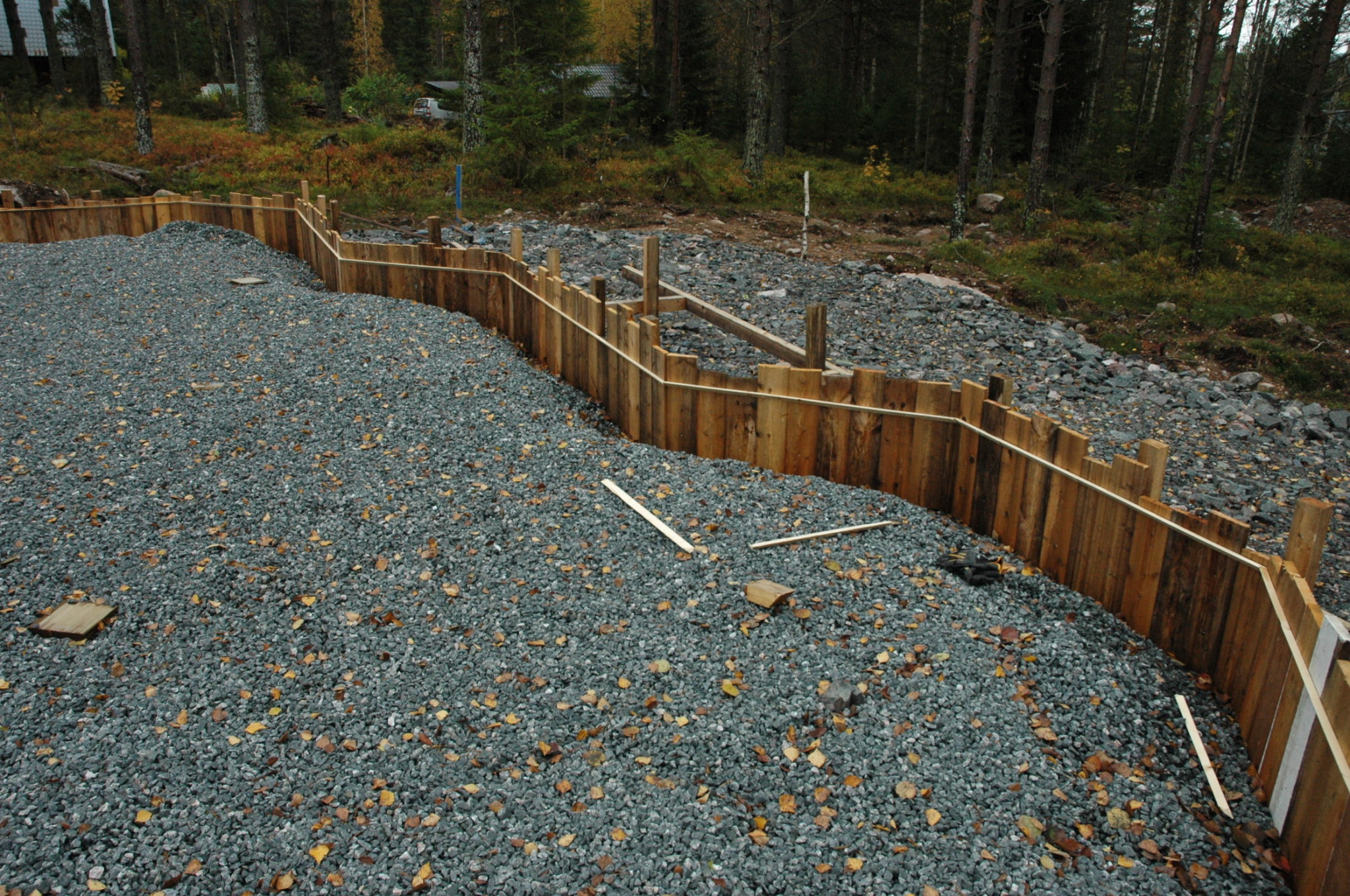
I got a good price on 300mm L-element but actually don't need any insulation for this build, how difficult is it to craft a wooden form compared to setting up L-elements?
OveRa said:
Complete the roof with surface roofing paper, according to the manufacturer's recommendations, rout grooves in the panel and attach metal strips and lay out battens sealed against the substrate with tar or rubber strips in the direction of the slope. If you do this carefully and according to recommendations, feel free to ask a roofer, you will have a stable, tight and good roof:
Attach railings and other items to the wooden deck, avoiding penetrations to the underlying room.
You seal against the felt with adhesive, the battens lie in the slope line so no water stays but runs off. I would suggest maybe two to three screws/nails per batten. I nail down my formwork with tongue and groove boards, mostly because of some angles but also because it's quite simple. A rectangular formwork works well with L-elements.
What would you have used for rule dimension in the walls, I am thinking just standing 45x95 cc 60 type? Then nail standing cladding boards on the outside, block each other without cover strips. Should I, for example, attach 22x70 to the frame to nail the standing cladding boards into?
What would you use for stud dimensions in the walls, just thinking of standing 45x95 cc 60 type? Then nail vertical cladding boards on the outside, block to each other without covering battens. Should I put, for example, 22x70 on the framework to nail the vertical cladding boards into?
If I understand your plans correctly, you're thinking of building a substantial "shed" with external dimensions of 6 meters X 9 meters, with a deck on top for partying people or something similar. It can get quite snowy in your area during the winters, adding a lot of weight, and with people standing on it, the stud dimensions seem a bit weak in my eyes, although I like stable things, so there's probably someone here who thinks it's sufficient. My bike shed has stud dimensions of 45X120, but it's 2.5X4 meters with a gently sloping raw board roof with under and over felt, where no one will be dancing around and it easily holds quite a bit of snow. cc 60 is probably fine!
Increasing the dimension of the regelstomme is not particularly expensive. Additionally, I was thinking of casting 2 lecarader as the foundation, which are 190mm + plaster.
What size regeldimension would you increase to?
45x145mm? How important are blocking and braces?
At least, and then you should have a fairly long free-hanging ceiling, which increases the load on the walls. I have suggested that you build a partition wall about 4 meters from the existing house wall, consisting of strong studs to support it.
A 6-meter ceiling requires a lot of strength, 4 meters significantly less.
Braces are a must, noggings are not, since you will attach the panel to horizontal studs nailed onto the wall studs.