
1,655 views ·
11 replies
2k views
11 replies
Builders' knowledge regarding moisture problems
Now I am really irritated! Different builders give different answers and they are all equally sure about what they say. Unfortunately, it seems that many builders' theoretical knowledge differs, and many probably haven't opened a trade magazine in many years to learn about the latest findings.
What is the rule for vapor barriers when insulating from the inside? I know it's preferable to do it from the outside, but the situation is as it is. Some say that a vapor barrier traps moisture, while others say it is necessary. My own opinion is that it should look like the attached sketch below.
The air gap is ventilated to the outside on the parts I plan to insulate; on other parts with double stone, it is not. What has happened is that I have opened up to the ridge in an old house where the inner wall of brick only covered the warm parts.
What is the rule for vapor barriers when insulating from the inside? I know it's preferable to do it from the outside, but the situation is as it is. Some say that a vapor barrier traps moisture, while others say it is necessary. My own opinion is that it should look like the attached sketch below.
The air gap is ventilated to the outside on the parts I plan to insulate; on other parts with double stone, it is not. What has happened is that I have opened up to the ridge in an old house where the inner wall of brick only covered the warm parts.
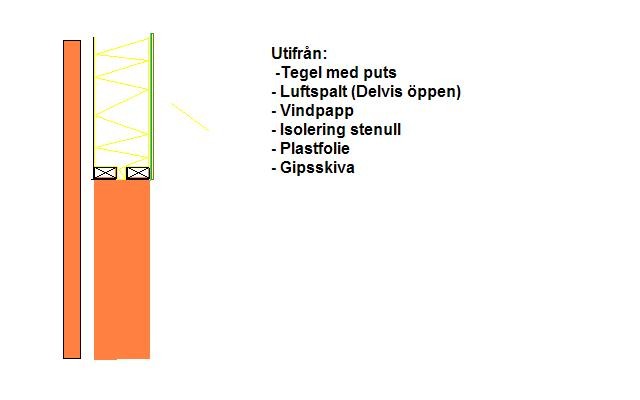
Last edited:
Correct thinking, the vapor barrier should be placed closest to the drywall, but the statement that it traps moisture is also correct, that's the whole point, it should prevent moisture from migrating into the walls. So it traps the moisture in the rooms, and from there it should be ventilated out in a suitable manner, such as natural ventilation or a heat exchanger system.
However, when it comes to additional insulation of an old house, I don't want to get into that, the whole house should be "tight", but if you only seal certain parts, more moisture might migrate to other places.
However, when it comes to additional insulation of an old house, I don't want to get into that, the whole house should be "tight", but if you only seal certain parts, more moisture might migrate to other places.
Last edited:
Exactly! I may have been a bit unclear in my text, but the question is whether the vapor barrier should be present or not. I'm completely sure that it should be placed on the inside of a construction, but according to these carpenters, it wasn't needed, and the wind barrier could be placed directly against the outer wall.
What do you think about the studs in the picture that are placed directly against the brick wall? Is there a risk that these could absorb moisture, or is the danger mitigated by having an air gap that interrupts the moisture's path?
What do you think about the studs in the picture that are placed directly against the brick wall? Is there a risk that these could absorb moisture, or is the danger mitigated by having an air gap that interrupts the moisture's path?
Found a bit in another thread:
tartan said:Thomas_P. Unfortunately, many carpenters have the opinion that you shouldn't put up plastic in old houses. This is because carpenters are usually not updated on ventilation and moisture migration and what happens when the house's conditions change. I am a carpenter myself but have further educated myself on moisture problems, and I would claim that your carpenters are wrong. But their opinions are theirs, and you must take responsibility for your house. I suggest you call the municipal building inspector and ask for advice. These individuals are always updated and should be seen as a resource where our tax money goes. It would surprise me greatly if they have a different opinion than mine.
Tartan
Why use a material that doesn't withstand moisture? I'm thinking of fiberglass and mineral wool. To me, it's strange that one would choose that!?
Why don't we do it then? Besides the fact that it burns well. We all want to live in healthy and well-maintained houses!?
It is a reasoning one can ponder over. The problem as I see it is that moisture is always present, regardless of the material, and what can grow and cause problems can enter through the air, such as spores and others. What really is a healthy house? Does it exist with today's insulation requirements?
Found additional info on this subject. Seems to have been hotly debated over the years.
Found additional info on this subject. Seems to have been hotly debated over the years.
pleximaster said:Worth considering in old houses
If you are going to use fiberglass/rockwool, you should have
plastic/vapor barrier as these materials are not hygroscopic, that is, can
bind water molecules, which organic insulation materials like
sawdust can. If water molecules are chemically bound to a material,
even loosely, it is not available for, for example,
mold growth. In modern insulation materials that cannot bind moisture,
the moisture precipitates (Condenses) and thus allows mold growth.
There is always organic dust and other things that can mold in the
inorganic insulation materials. That is why you have plastic in
modern houses; the insulation materials require this. If you put plastic in
houses with organic insulation materials, it can prevent
water molecules from being aerated away when the chemical bonds
release with changes in temperature and humidity. Then
water vapor may condense in the material and thus
also mold.
In summary, there is a difference between water, water vapor, and
water molecules bound to other molecules. It is only in the
water phase that it can contribute to mold growth.
If you cannot create a sufficiently tight vapor barrier, which can be difficult in old houses, you should refrain from inorganic insulation materials and use organic hygroscopic insulation materials.
Fiberglass/Rockwool - must have a vapor barrier (plastic)
Organic insulation materials - should not have a vapor barrier
Regards, plexi

remove the cellplast and replace it with foamglas for an optimal construction method against moisture and fire
Yes. Agree. Right material in the right house. Old houses should not have plastic in walls and roofs. The way I see it, only eco fiber of all kinds works in old houses.
Can someone explain to me what is meant by an "old house," as it is so nicely put? What is the difference between a new house and a renovated older one? Does it mean that the soul of the house somehow determines where moisture damage occurs or not, or is it simply that building methods in the past could withstand a bit more moisture without being damaged?
The main question is: In what way can a properly placed vapor barrier do more harm than good?
The main question is: In what way can a properly placed vapor barrier do more harm than good?
If the vapor barrier is not sealed around the house's four walls and roof, moisture will seek out more intensely where there is no plastic. The only way to achieve this (almost) is to tear out all interior walls and ceilings, so that all that remains is an insulated shell, without even drywall.
Then you can start wrapping, and make sure to have overlaps, the seam should preferably be at a stud, then you can pinch it with drywall, in addition to the construction film tape you used,
Of course, you also place it in the plastic film seam between the wall and ceiling,
The house should be as tight as a balloon, not a hole or gap should exist in the plastic,
Then you've done it right, then it's a matter of not damaging it when you put the drywall back and start with the interior walls and ceiling...
But it ended up being a lot of work......
Otherwise, the risk is that you'll get convection damage, I believe that's the word, I dozed off a bit during the "plastic course," which mostly dealt with new constructions,
But the principle is the same for old houses too, not getting it completely sealed, which is difficult (when there are often interior walls in the way)... can lead to damage.
The answer is that it's not possible to place the vapor barrier correctly in an old house...
Then you can start wrapping, and make sure to have overlaps, the seam should preferably be at a stud, then you can pinch it with drywall, in addition to the construction film tape you used,
Of course, you also place it in the plastic film seam between the wall and ceiling,
The house should be as tight as a balloon, not a hole or gap should exist in the plastic,
Then you've done it right, then it's a matter of not damaging it when you put the drywall back and start with the interior walls and ceiling...
But it ended up being a lot of work......
Otherwise, the risk is that you'll get convection damage, I believe that's the word, I dozed off a bit during the "plastic course," which mostly dealt with new constructions,
But the principle is the same for old houses too, not getting it completely sealed, which is difficult (when there are often interior walls in the way)... can lead to damage.
The answer is that it's not possible to place the vapor barrier correctly in an old house...
Last edited:
Click here to reply