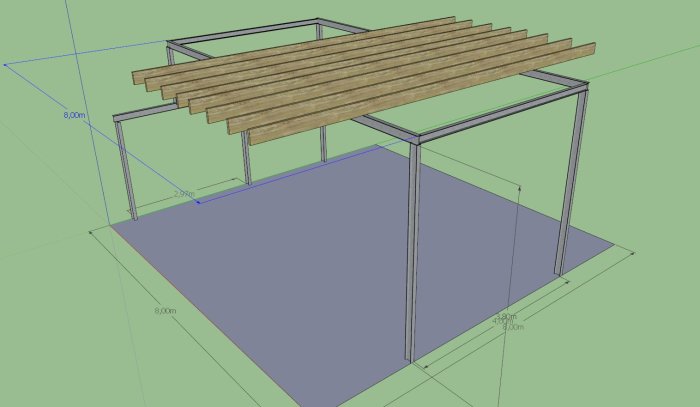
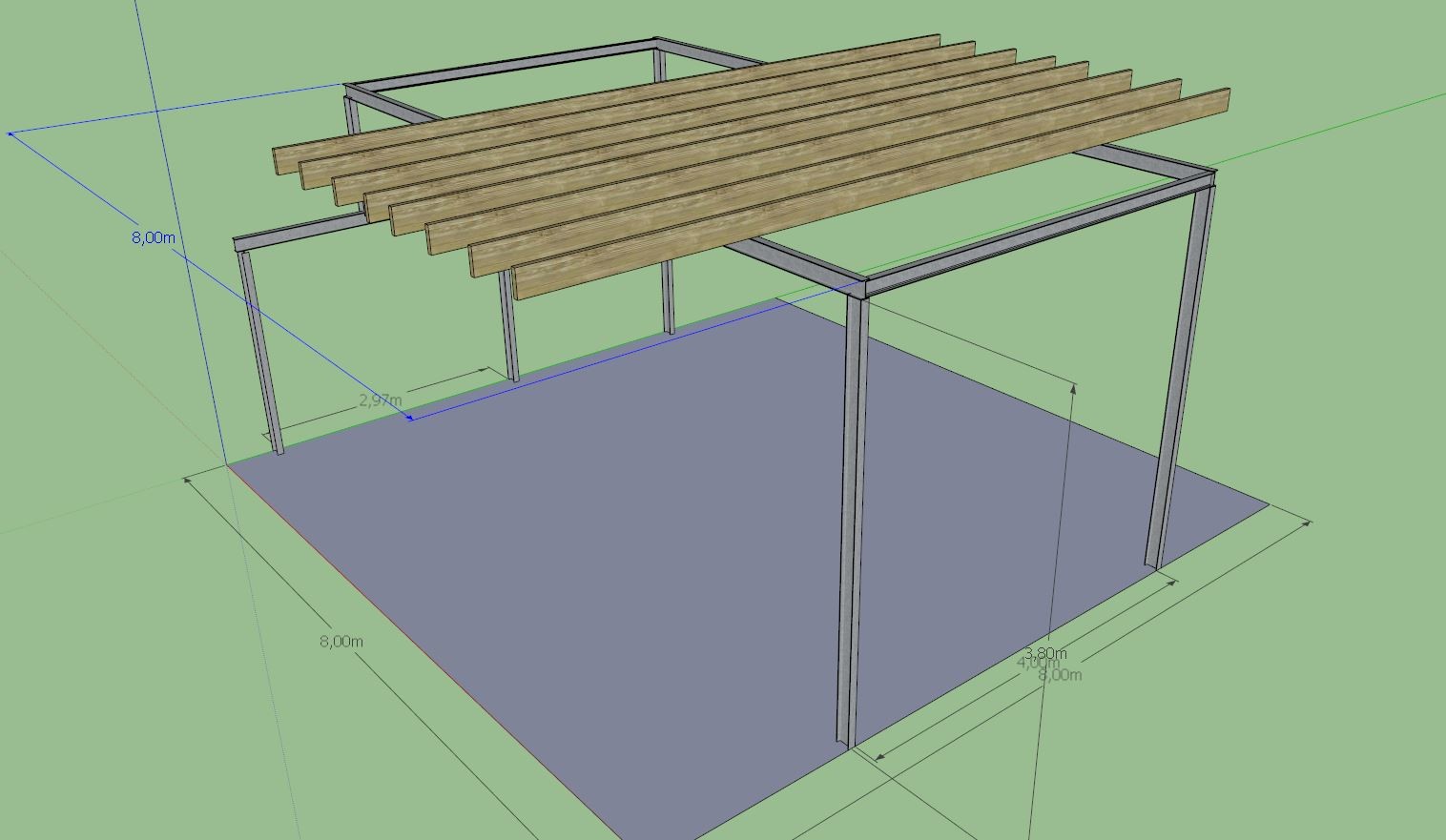
The joists for the floor will be attached to a wall plate and rest on the steel beams. I have also drawn in two smaller beams to further prevent "tipping." And as I mentioned earlier, the floor will not be loaded from above as it will be a cold attic...
Is more information needed to be able to make the calculations? How much deflection is acceptable?
The slab is not cast yet, it will be necessary to reinforce the slab significantly where the posts will stand, I've also received a tip to weld a plate for the column to stand on.
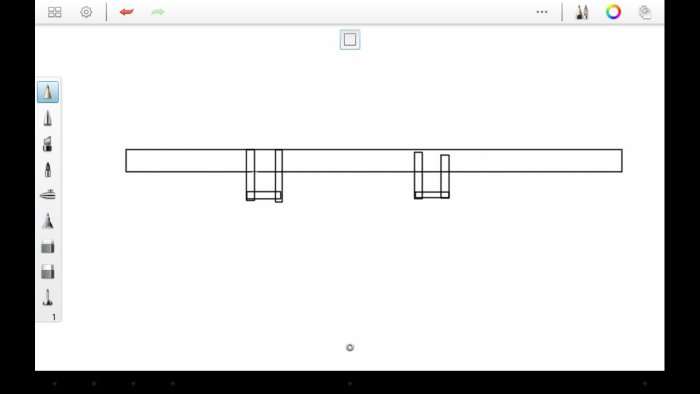
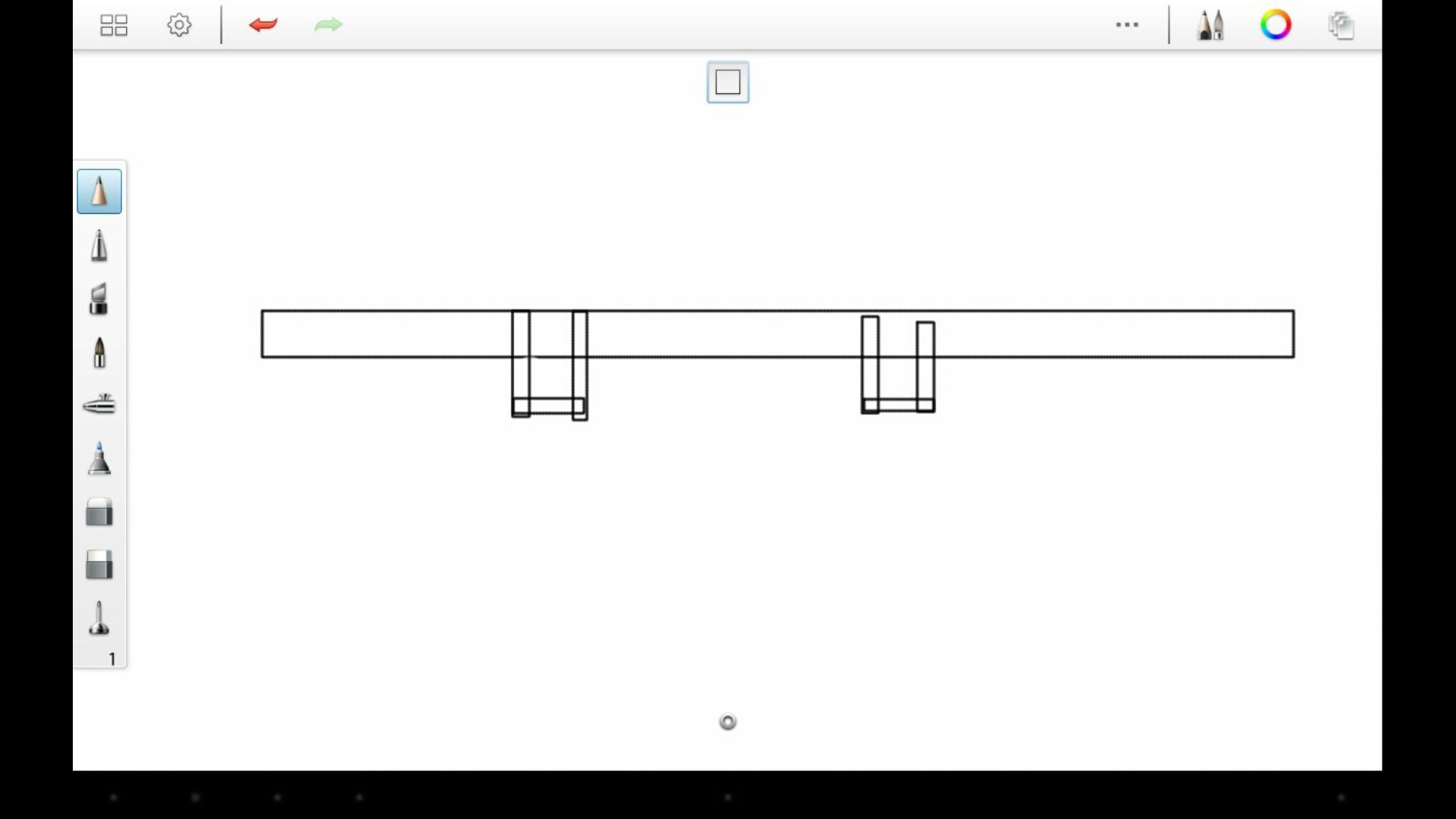
Regarding attaching the floor joist to the beams, I plan to build in the beams to be able to plaster around, made a quick drawing to show how I'm thinking (made on the slab )
Cast a little stronger where you will have the columns, then mount them with threaded rods with nuts on the underside of the base plate so you can adjust them in height, then grout them with expanding concrete, of course with nuts on the top side as well!
But I would have mounted a cross between the columns to prevent them from "tipping" sideways if you ever pull at an angle with the overhead crane.
Cast a bit stronger where you will have the columns, then mount them with threaded rods with nuts on the underside of the base plate so you can adjust them in height. Then grout them with expansion concrete, with nuts on the top side too!
But I would have installed a cross between the columns to prevent them from "tilting" sideways if you ever pull crooked with the crane.
Starting to feel like the crane thing won't work, as there will be trouble with the fire rating....
It's starting to feel like the traverse won't work, as there are issues with fire rating....
Alternatively, you can have a free-hanging floor structure that you double gypsum and then mount the steel structure with bolt connections and press it up against the floor structure using the threaded rods belonging to the underpinnings.
Alternatively, you have a free-hanging floor structure that you double plasterboard and then mount the steel construction with bolt connections, pressing it up against the floor structure using the threaded rods belonging to the underpinning.
Don't you think an 8m free-hanging floor structure is a bit long?
Don't you think 8m suspended beams are a bit too long?
You can have braces from the trusses, but it must be calculated by someone knowledgeable.
An alternative is to drywall and then have the steel frame as load-bearing, but if the entire room/area is a fire cell, it should work. I’m not so well-versed in fire protection but more in steel assembly.
You can have hangers from rafters but it must be calculated by someone knowledgeable.
An alternative is to plaster and then have the steel frame as load-bearing, but if the whole room/location is a fire compartment, it should work. I am not so familiar with fire protection but with steel assembly, I am.
Sounds like something I need to look into! I have to admit that I didn't quite understand that part about threads on the plate?
Sounds like something I need to check out! I must admit I didn’t quite understand the part about threads on the plate?
Is there an image showing what you mean?
Here are some images of what an underpinning of a column might look like, the threaded rods are chemically anchored and the column is placed on them so that you can adjust the height and level them by adjusting 3 of the 4 nuts.
Interesting thread. Now I have to add some comments.
Firstly, both 8m beams must be dimensioned for 1000kg since one beam will bear all the load when the crane is at the end position.
Then I wonder where you'll get 8-meter wooden beams? Isn't it better to integrate the beams into the steel beams?
The attachment of columns is usually done as Lutte describes.
However, what was said about unloading onto trusses, I do not recommend! You should never hang a load in the ceiling while unloading onto the floor. You have no idea how much of the load the ceiling or the floor is supporting.
Since this is in a barn, one must also consider thermal expansion. The columns must handle both buckling and expansion from the beam.
The two steel beams you added in your second image I don't think are needed (the transverse 8-meter beams). There you are tying the structure together with the wooden beams.
What is the problem with the fire rating? Isn't it enough to paint the beams with fire protection paint? I'm not an expert on buildings, so I'm a bit unsure here.
The problem with the fire classification is that the other half of the barn will become a stable, and then (as I understand it) it must be possible for the workshop to burn for a while before the stable burns down...
I have received a quote on 8m lightweight beams (plywood), so I am leaning towards using them.
What is supposed to be lifted? There may be other solutions than an overhead crane?
Yes, you
I don't really know yet, but I have a feeling that it might be good to have one. I know that many people work with engine hoists and rolling scaffolds. But I like the idea of having an overhead crane, but 1 ton might be overkill, let's say 4-500kg...
I haven't quite decided how I'm going to do it, on one hand, light beams are very easy to work with. On the other hand, if I go with beams, I can further reinforce the roof or alternatively build an overhead crane. But I have emailed about 10 structural engineers to get quotes on what they would charge to calculate what I need, but haven't received a reply
Personally, I think it's pretty strange if 2 IPE360s shouldn't work, but I've been wrong before
Then there's the weight—these beams aren't so easy to get in place, it seems. Does anyone have experience with similar work?
Click here to reply
Vi vill skicka notiser för ämnen du bevakar och händelser som berör dig.


 )
)