I need help with the sizing for a beam framework that will be placed in a barn.
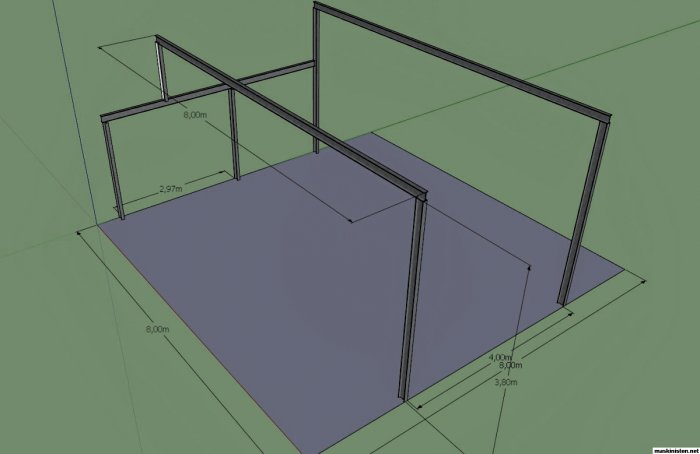
Attached is a picture of how I envisioned it. The conditions are as follows: on this frame, I will add a mezzanine that will "hold together" the walls and act as a ceiling. There will be no load on this mezzanine.
I would like to install a crane on the 8m beams if possible.
So my questions are:
1. Do you have a better construction solution?
2. What dimensions do I need for the various beams?
3. What dimensions do I need if I want to lift, say, one ton with a crane on the 8m beams?
4. What will be the point load on the slab where the beams stand?
If you can't answer, I'd appreciate tips (email address) for someone who works with this and can provide a quote for the calculations.
There's no point in calculating the proposed construction since it can never become stable sideways. Additionally, you need to calculate the buckling of the poles, etc.
Start over from the beginning, and get help from a constructor. It will be significantly cheaper, more efficient, and not least safer.
There's no point in calculating the proposed construction since it can never be stable sideways. Additionally, you need to calculate the buckling of the posts, etc.
Start from scratch, and then get help from a designer. It will be significantly cheaper, more efficient, and above all safer.
It will be attached to the intermediate floor, so I can secure it sideways at cc60.
Yes, as I wrote, if anyone knows of a designer who responds to emails, it would be gratefully received
Isn't not contacting "professionals" the whole point of a forum?
Hello.
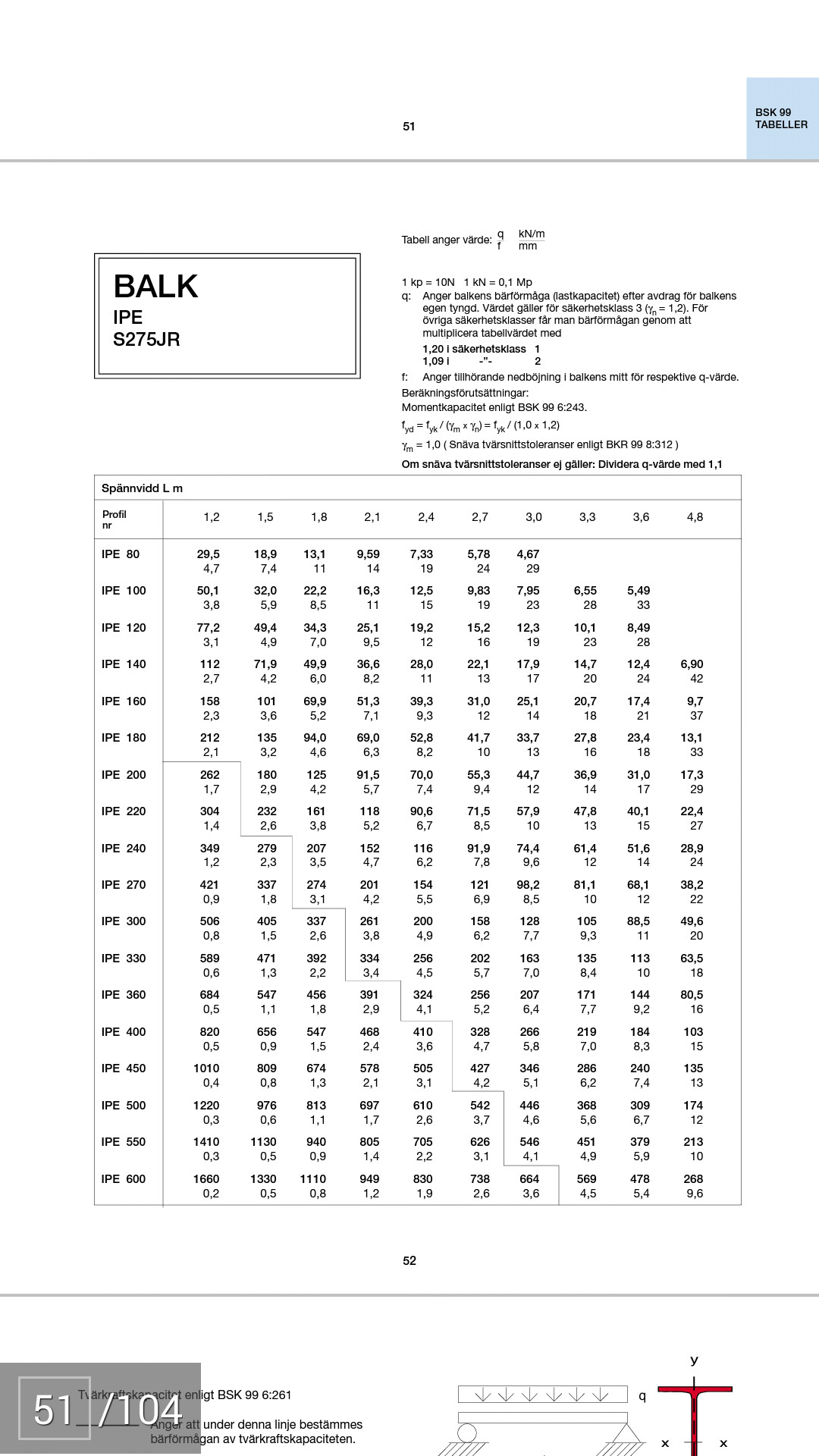
I am not a civil engineer, and you should probably consult one, but with an IPE300 beam, you get a maximum deflection of just over 7 mm with a point load of 1000 kg and self-weight. According to the crane standard, which allows a maximum deflection of 1/1000, the IPE300 therefore meets this requirement.
Hello. I'm not a structural engineer, and you should probably consult one, but with an IPE300 beam, you get a maximum deflection of just over 7 mm at a point load of 1000 kg and its own weight. If you follow the crane standard, which allows a maximum deflection of 1/1000, the IPE300 meets this requirement.
Thanks for the reply!
A few follow-up questions, have you only calculated for the point load?
Have you considered that it is two beams, assuming they don't each need to support 1000kg?
I know of some IPE360 beams that might work, but I don't understand how to calculate it, even though I've received the formula above...
With an IPE360, the moment of inertia increases from 83,560,000 to 162,700,000 and the self-weight increases from 337.6 to 456.8 in the calculations above. For 2 beams sharing the load, you now get a deflection of about 2.41 mm. For a beam with a point load in the middle, you get about 4 mm.
However, it is very important to brace beams this long, but I interpret that you intend to do so with the intermediate floor.
With an IPE360, the moment of inertia increases from 83,560,000 to 162,700,000, and the self-weight increases from 337.6 to 456.8 in the calculations above. For 2 beams sharing the load, you now get a deflection of about 2.41 mm. For one beam with a point load in the middle, you get about 4 mm.
However, it's very important to brace beams this long, but I interpret that you intend to do so with the intermediate floor.
Ok, thank you so much!
Just one question, what you calculated was a point load or distributed load, the reality will be a constant distributed load plus a point load. If I understand correctly, when you lift 100kg, the load on the beam becomes closer to 300-400kg?
So my question is how do you calculate for both evenly distributed load from a floor and the point load?
I will also draw in two braces between the beams to further eliminate "tipping" risks...
The calculations are both for the point load of 1000 kg and the self-weight (distributed load). The point load has the greatest impact as you can see in post 9.
Edit: Or do you also mean the load for the floor slab? I have not included that in the calculation since information about it is missing. This is solely deflection due to the beam's weight and a point load of 1000 kg.
The calculations are for both the point load of 1000 kg and the self-weight (distributed load). The point load has the greatest impact as you see in post 9.
Edit: Or do you also mean the load for the joists? I have not included that in the calculation as there is no information on it. This is solely the deflection due to the beam's weight and a point load of 1000 kg.
Ahh. That's exactly what I mean
The load on the joists will be none except for the joists themselves and the gypsum ceiling. I remember that you calculate 200kg/m2 when it's a "normal" joist, for me 100kg is enough (if even that, it will be a cold attic above).
Edit: forget the previous message. It should be 8x8 m, but I'm guessing the flooring also rests on something other than the beams? Probably need more info to calculate this.
If the entire flooring is to be supported solely by 2 IPE360, the deflection would be 16.19 mm.
Edit: forget previous message. It should be 8x8 m but I guess that the floor structure also rests on something other than the beams? Probably need more information to calculate this.
If the entire floor structure is to be supported solely by 2 IPE360 beams, the deflection will be 16.19 mm.
The floor structure is attached to the walls and then rests on the beams...
I'll draw up how I'm thinking!
Vi vill skicka notiser för ämnen du bevakar och händelser som berör dig.