I am planning to create an opening in a load-bearing wall in the house. The wall is directly under the ridge in the direction of the ridge. The opening should be closest to a gable, and ideally, I would like to avoid having a vertical pillar against the gable due to space constraints.
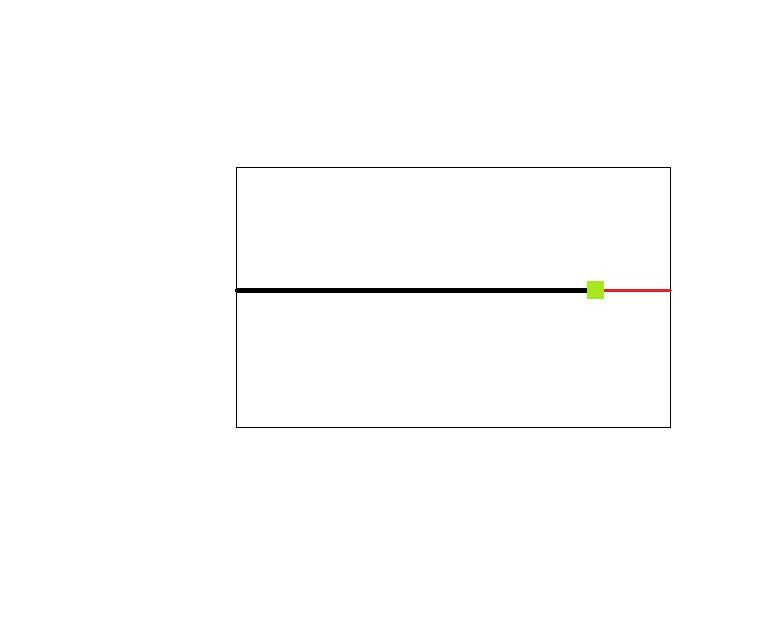
Attached is a paint sketch... The red is the intended opening. Against the load-bearing wall, I have space for a vertical pillar.
According to byggbeskrivningar.se, I can use a 66x270 glulam beam as a transfer beam. As a vertical pillar, I can use a 45x145 C14 as the first option.
I would preferably skip the vertical beam against the gable wall. I live in a brick facade house; the inner wall consists of standing tongue and groove timber 2"4. Could one either create an opening in the tongue and groove timber and insert the beam there for support or alternatively, manufacture a substantial beam shoe in 3mm steel plate for the beam to rest in? And thus count on the standing wall to handle the load?
Why not place the beam on top of the attic floor? That is, on the lower frame of the roof truss. The roof truss at the outermost against the gable wall might rest on the plank wall or is or can be fixed to this?
That was a thought; it was done at the other end of the house when it was built. The problem is that the attic on this end of the house has a simple plank floor and acts as storage. So unfortunately, that's not an option. But it was a good suggestion otherwise, but considering your suggestion, I should be able to use the existing gable wall to bear the load without any problems?
You haven't revealed the span of the beam, but it looks to be quite a short distance? You have substantial planks in the wall, so it should surely be possible to attach the beam to it. Difficult to have an opinion without seeing how it looks.
How about attaching a horizontal beam to the plank wall to distribute the load on the gable and then hang the beam from this horizontal beam? Certainly overworked but it's unlikely to fall apart.
The span is just under 2 meters, yes a horizontal beam or an iron that distributes the weight over 4-5 standing planks should do the trick. It should work with a sturdy flat iron with a plate welded on which the beam can rest, then let the beam protrude into the wall as well.
That's how it will be, better overdimensioned than underdimensioned.
A few years ago, I made a similar solution, using a steel beam instead of glulam, but the attachment and the plank wall (2"x4") were similar. I placed the largest nail plate I could find under my beam, which followed the same principle MathiasS suggested, but less bulky (it could be hidden under a layer of drywall). The nail plate distributed the load over 4-5 standing planks. In my case, I could weld the nail plate to my steel beam; in your case with glulam, you'll need to try to find or make some type of angle plate that supports the glulam beam.
If one imagines making their own joist hanger, with the ambition to achieve minimal construction height to be able to mount a gypsum board over it. How "light" can one dimension, do you think?
Starting with a sheet metal of 500x300 mm so it extends over 5 standing planks in width. It is screwed and glued with wood screws and construction glue in a square pattern of 50x50.
How thin can the sheet metal be? For the joist hanger itself, I think 3mm would be suitable, the sheet on the wall would be nice if it could be dimensioned down a bit, can one manage with 2mm?
One can still let the beam go into the wall for support.
Now it has been in place for a couple of days and doesn't seem to have fallen down yet, so I probably succeeded...
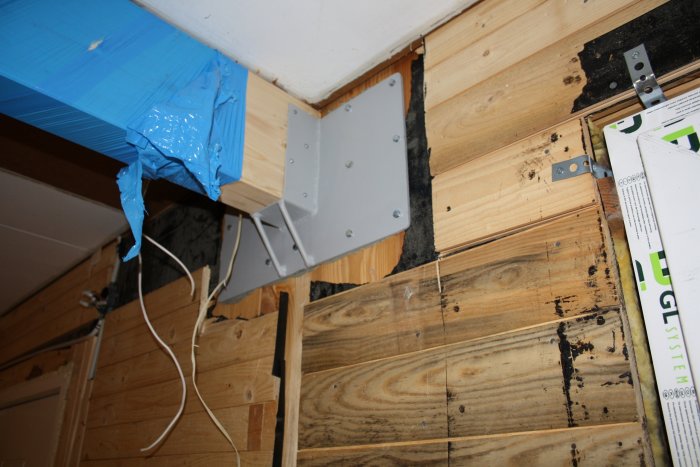
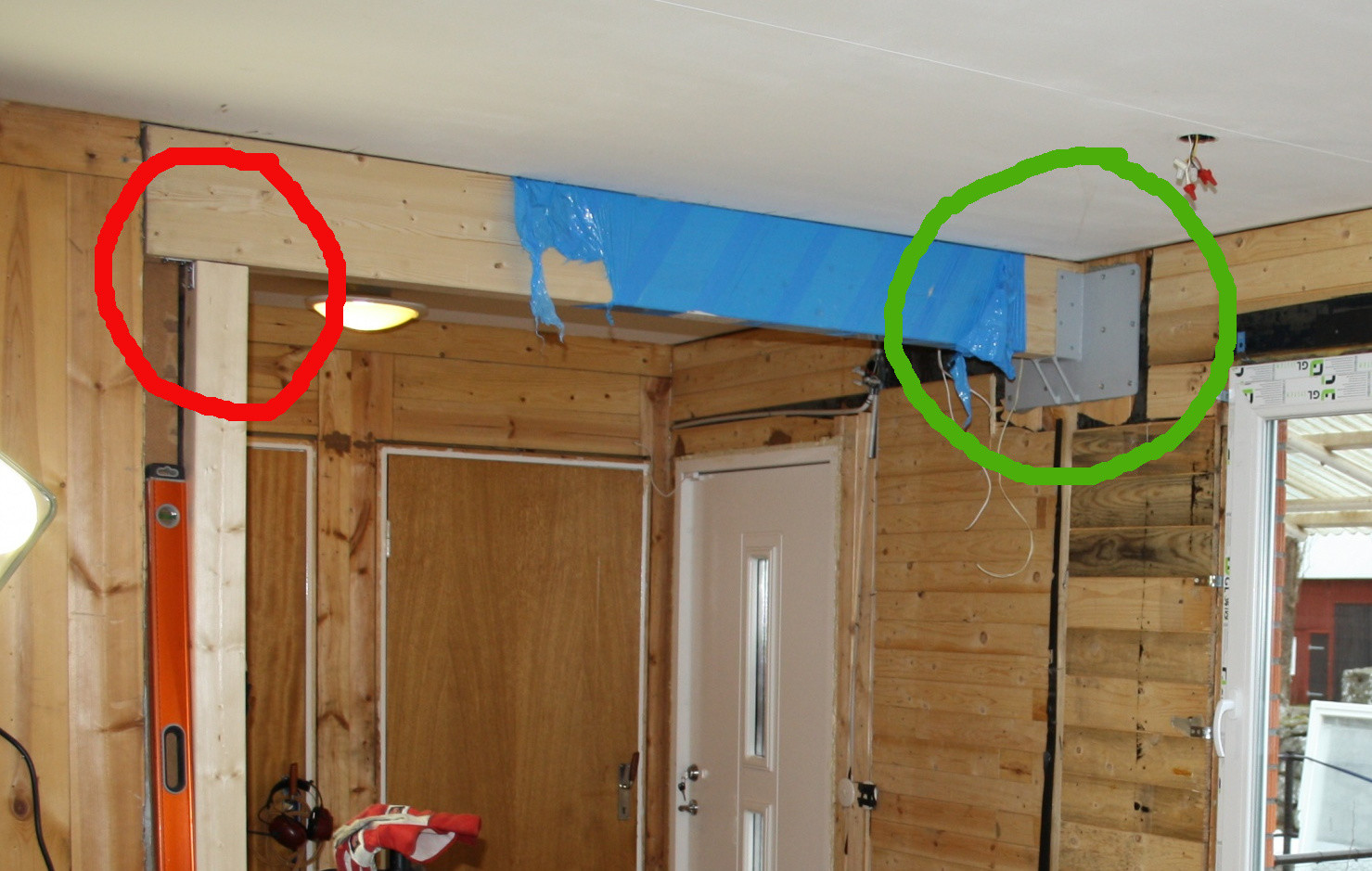
It was an 8mm metal plate that was notched out and I inset a 3mm bent plate. Welded on 2 supports, a bit overkill perhaps but why under-dimension? The plate was screwed on with 15 screws distributed across 4 vertical planks. Glued the plate with a Bostik glue that was supposed to hold 250kg/m2, so the screws were probably overkill anyway: D
Attached the beam to the joist hanger with regular anchor screws.
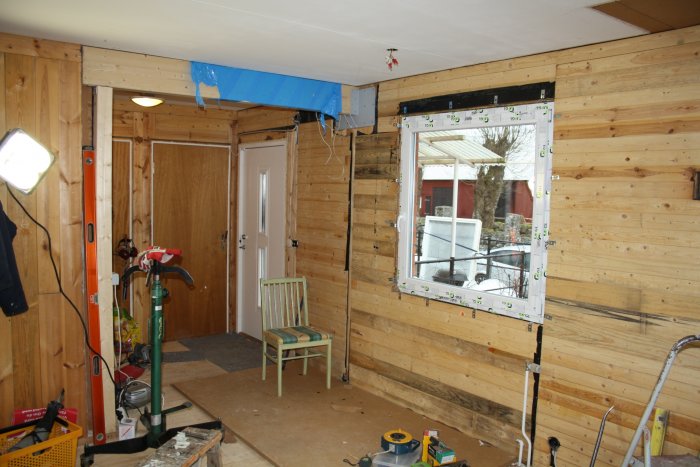
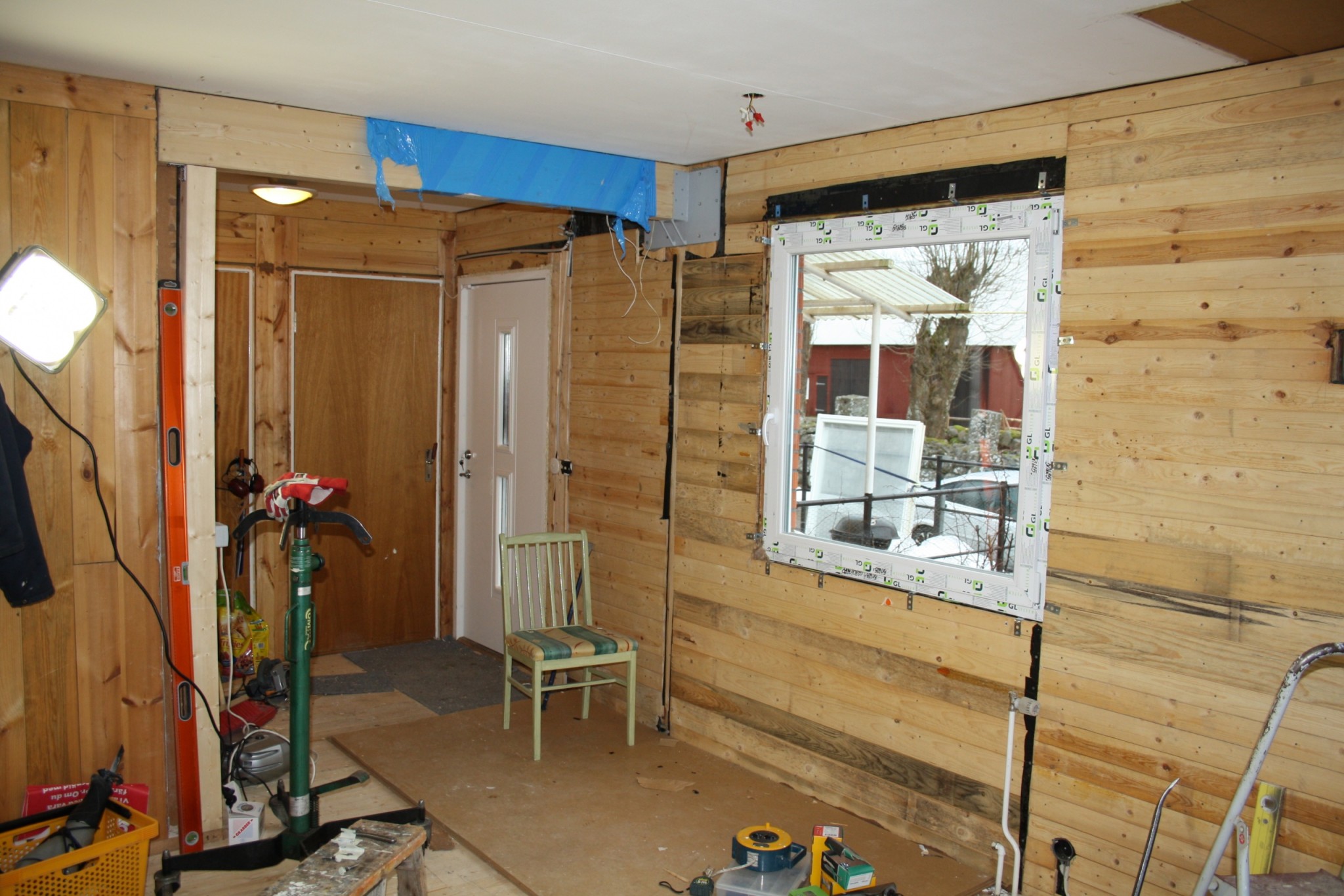
At the other end, I inset a 90x90 vertical into the wall, so the support is completely hidden. I am very pleased with the result, 2 pictures for public viewing.