
4,753 views ·
11 replies
5k views
11 replies
Attaching loft to load-bearing glulam beam?

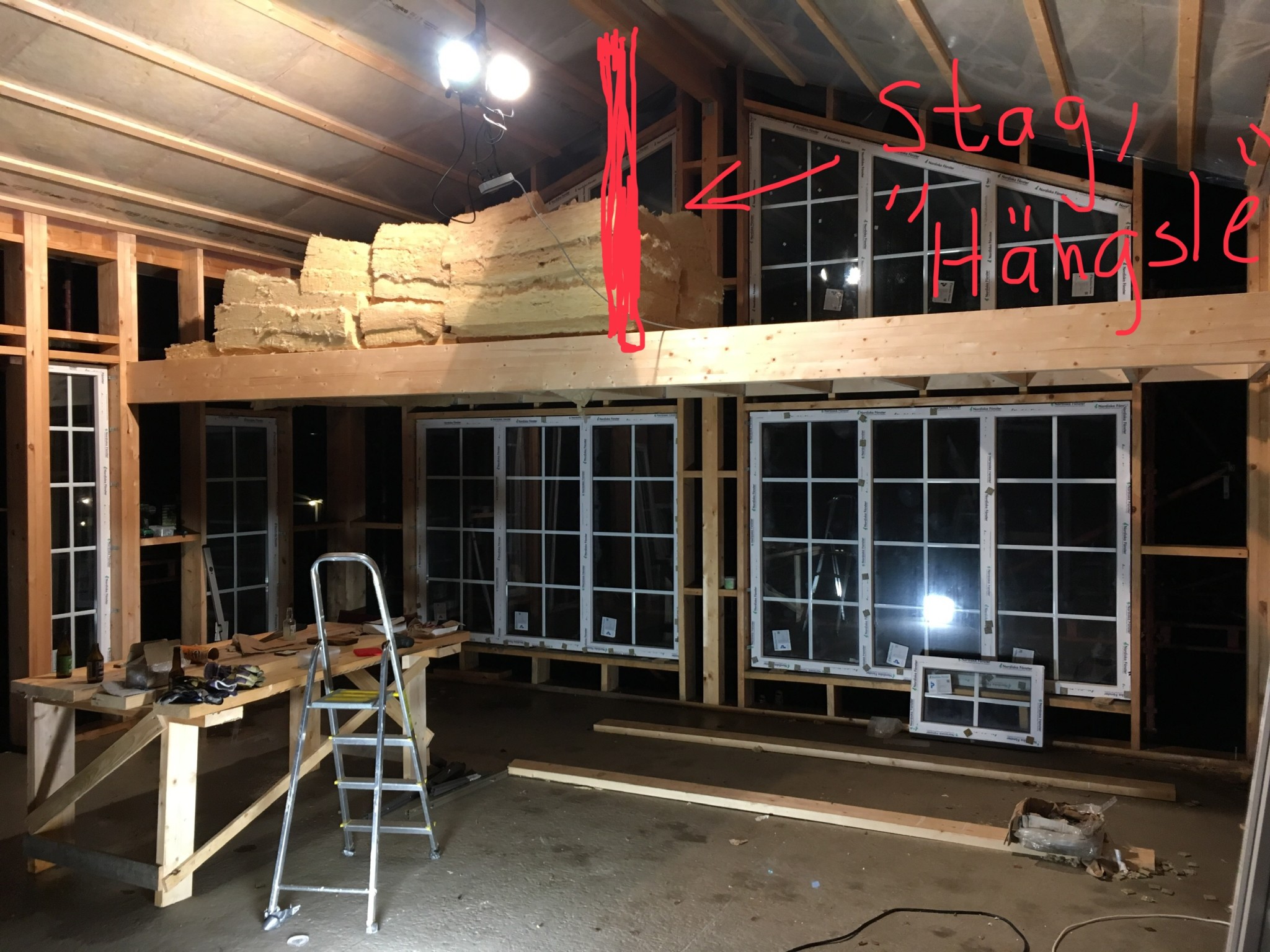
My question actually arises from a small mistake in the construction of my 56 sqm extension with a loft. The loft spans 7 m (supported by glulam 220 x 95), and the idea is to attach the loft's center to the supporting 8-meter long glulam beam (630 x 115) in the ceiling to ensure the loft's stability without sagging. The plan was to make a metal bracket for the loft to "hang" in the middle to achieve stability.
I am now considering the suitability of drilling/screwing into the supporting glulam in the ceiling (with concrete tiles on the roof) given the risk of damage/cracks. I can go around the roof's glulam beam from the inside, but the board interferes with fitting any larger fittings.
Does anyone have ideas on how I should proceed? Strong steel bands might be possible to fit around; do such bands exist? Or are there better ideas? Is it risky to drill a hole for a bolt in the middle of the glulam beam?
See image.
I am now considering the suitability of drilling/screwing into the supporting glulam in the ceiling (with concrete tiles on the roof) given the risk of damage/cracks. I can go around the roof's glulam beam from the inside, but the board interferes with fitting any larger fittings.
Does anyone have ideas on how I should proceed? Strong steel bands might be possible to fit around; do such bands exist? Or are there better ideas? Is it risky to drill a hole for a bolt in the middle of the glulam beam?
See image.
We have a closet suspension where one corner extends over the entrance hall, and there is a laminated timber beam (90x315) that spans an opening of about 4 meters which it "hangs" from. Then there is a laminated timber post, 90x90, attached with nail plates on both sides of the laminated timber beam, down to the joist where some heavier screws are drawn through the joist's beams into the post.
I don't have the construction drawing at hand, but the nail plates are attached with anchor screws, I believe there are 8-10 in the beam and the same number in the post. The screws in the joist beam into the post I think are 6 pieces of 6x80, similar to French wood screws, but self-drilling "modern" variants.
In your case, I would absolutely believe it works with a nail plate on each side of the ridge beam and also in the bottom truss. Post of laminated timber or screw-laminated beams.
I don't have the construction drawing at hand, but the nail plates are attached with anchor screws, I believe there are 8-10 in the beam and the same number in the post. The screws in the joist beam into the post I think are 6 pieces of 6x80, similar to French wood screws, but self-drilling "modern" variants.
In your case, I would absolutely believe it works with a nail plate on each side of the ridge beam and also in the bottom truss. Post of laminated timber or screw-laminated beams.

Hello and welcome to Byggahus forum!
Yes, it cannot look like that. It will be very unstable. I think the best solution would be a strong steel rod, threaded at both ends, that goes through both the ridge beam and the balcony beam. If that's not possible, you can have a U-shaped steel bracket manufactured, which you can attach to the sides of the ridge beam with several through bolts and then attach the aforementioned steel rod to its bottom. If the balcony is 2.5 m deep, it involves a point load of about 11 kN (about 1100 kg), so fairly robust fittings are required. Nail plates and anchor screws are unfortunately insufficient. Nail plates, by the way, should not be used in visible mounting. I am quite sure that the ridge beam can withstand that point load since it does not come in the middle, but it depends a bit on the snow zone...
Yes, it cannot look like that. It will be very unstable. I think the best solution would be a strong steel rod, threaded at both ends, that goes through both the ridge beam and the balcony beam. If that's not possible, you can have a U-shaped steel bracket manufactured, which you can attach to the sides of the ridge beam with several through bolts and then attach the aforementioned steel rod to its bottom. If the balcony is 2.5 m deep, it involves a point load of about 11 kN (about 1100 kg), so fairly robust fittings are required. Nail plates and anchor screws are unfortunately insufficient. Nail plates, by the way, should not be used in visible mounting. I am quite sure that the ridge beam can withstand that point load since it does not come in the middle, but it depends a bit on the snow zone...
Check out ESSVE screw ET-T for hidden installation of glulam beams.
So your first idea is to drill straight through the roof's glulam beam (drilling hole 630 mm), how does that affect the strength, you think? It might be possible if I manage to get a nut and substantial washer on the top side.J justusandersson said:Hello and welcome to the Byggahus forum!
Yes, it shouldn't look like that. It becomes very unstable. The best solution, in my opinion, would be a sturdy steel rod, threaded at both ends, that goes through both the ridge beam and the balcony beam. If that's not possible, you can have a U-shaped steel bracket made, which you can attach to the sides of the ridge beam with a number of through bolts and then attach the aforementioned steel rod at its bottom. If the balcony is 2.5 meters deep, it's about a point load of approximately 11 kN (about 1100 kg), so quite sturdy fittings are required. Nail plates and anchor screws are unfortunately insufficient. Nail plates, incidentally, should not be used in visible mounts. I am fairly certain that the ridge beam can withstand that point load since it doesn't come in the middle, but it depends a bit on the snow zone..
I have also considered a U-shaped steel bracket in the way you describe, but then there's the issue of drilling straight through the glulam sideways (115 mm), how it actually affects the strength of the glulam...?
The loft's glulam carries most of the weight but there needs to be support in the middle, and I am also sure that the roof's glulam can hold (as long as it's undamaged).
The strength of glulam is affected to varying degrees depending on how and where the drilling is done. Such a limited hole as the one in question here, far from the beam's support and midpoint, is completely insignificant. In connection with large glulam constructions, rather extensive drillings are made. If you check out Träinformations's website, you can find quite a few examples. The magazine "Trä," which is published regularly, is particularly worthwhile if you're interested in glulam. Performing the drilling as I described in my first example is absolutely the best from a strength perspective. This way, you achieve optimal stress distribution both for the glulam and steel. Steel is also the best material by far for suspending the balcony beam, as it involves tensile load. Get assistance from a mechanical workshop to ensure that the screw joints are correctly dimensioned. Additionally, compressive distributing steel plates (approx. 100x100 mm) of heavy material are required so that the pressure against the glulam beam surfaces is not too high.
That sounds reasonable, but shouldn't the hole for a bolt in that case be in the middle of the glulam beam for the least weakening of the beam?J justusandersson said:The strength of glulam is affected differently depending on how and where the drilling is done. A hole as limited as the one in question here, far from the girder's support and midpoint, is of no importance. In connection with large glulam structures, quite extensive drilling is done. If you visit Träinformation's website you can find quite a few examples. The magazine "Trä," which is published regularly, is particularly worth reading if you're interested in glulam. Making the drilling as I described in my first example is absolutely the best from a strength standpoint. Then you get optimal loading of both the glulam and the steel. Steel is also by far the best material for hanging up the balcony beam, as it is a question of tensile loading. Get help from a mechanical workshop to ensure the screw joints are properly dimensioned. Furthermore, pressure distributing steel plates (about 100x100 mm) of thick material are required so that the pressure against the surfaces of the glulam beams is not too high.
The holes should be vertical and, of course, in the middle of both beams. Let me know if you don't understand what I mean, and I will draw a diagram.
Check out this link to a house that was featured in the TV program
Husdrömmar.
The entire floor level is suspended by steel rods, as is the staircase.
https://www.byggahus.se/bergskuben-i-vastra-frolunda-husdrommar
The entire floor level is suspended by steel rods, as is the staircase.
https://www.byggahus.se/bergskuben-i-vastra-frolunda-husdrommar
Click here to reply